

August 17, 2026
Soil doesn’t know what the weather station recorded. Wind speed is usually where the conversation starts. The site is running a more complicated conversation.
That conversation begins the moment earthwork disturbs the first layer of surface material. By the time the treatment crew mobilizes, the surface they’re treating may already bear little resemblance to the one described in the geotechnical investigation, not because the investigation was wrong, but because several weeks of earthwork have created a different erosion problem. The specification written before that work began is now describing a site that no longer exists.
Effective Wind Erosion Control Starts with Site Assessment
Many erosion control specifications are built on a reasonable assumption: assess the site before work begins, characterize what’s there, and select the appropriate treatment. On sites with stable, undisturbed soils, simple geometry, and short project durations, specifications built primarily around wind speed data often perform adequately because the variables that wind speed measurement misses, namely fetch variation, localized acceleration, and aggregate stability change, are less consequential when the site’s simplicity limits their effect.
The places where that approach becomes insufficient are the places where the work has changed what the wind speed data was describing.
Construction doesn’t happen to a stable site. It transforms the site as it proceeds, and the variables that determine erosion risk shift with it.
The soil that existed before grading is not the soil the treatment will encounter. Exposure recorded in the initial assessment changes when stockpiles are built, when terrain is cut and filled, and when surfaces that were sheltered become open to prevailing winds.
The window between disturbance and treatment, when vulnerability is typically highest, is also when the original assessment is least current, and that gap widens with every phase of work that falls between investigation and application. The activities that disturb soil structure, extend exposed area, and compress the application window are often the same activities, which means the project drives multiple erosion risk variables toward convergence through the same work that created the need for erosion control in the first place.
Soil Characteristics Set the Performance Baseline
The report tells you what the soil was. The site tells you what the project has turned it into, and those are often different enough that treating one as a proxy for the other is where specifications first begin to fail.
Geotechnical reports accurately describe the site at the moment of sampling. The difficulty is structural: earthwork creates the conditions that increase wind erosion risk in predictable directions.
Grading breaks down aggregate structure in ways that increase erodibility, not occasionally but reliably because the structural interlocking that resists particle entrainment is precisely what grading disrupts. Excavation removes organic matter that contributes to cohesion. Earthwork phases expose disturbed surfaces during the window when the original characterization is least current.
The report didn’t get the soil wrong. The project changed it toward vulnerabilities the specification should anticipate rather than encounter unprepared.
Particle size establishes baseline susceptibility, but it’s the characteristic the project inherits rather than the one it creates. Fine-grained soils, particularly silts, fine sands, and clays that have broken down into loose particles, are readily entrained because small particles are light relative to their surface area. Coarser, well-graded soils with natural interlocking resist entrainment better, though no soil is immune under sufficient exposure and dryness.
Aggregate stability is where the baseline can get complicated because aggregate stability is the characteristic grading and excavation degrade most directly and most consequentially.
Intact aggregate structure and disturbed aggregate structure behave like different materials, which is where field conditions most often depart from what specifications anticipated.
The first sign a specification is underperforming is rarely visible erosion. More often it’s a superintendent fielding complaints about dust crossing a property line while the treated surface still appears intact.
The investigation showed stable soil. The specification was reasonable. The work that happened between the two created a surface condition neither document had characterized.
Organic content loss compounds the aggregate stability problem on stripped or heavily processed sites in a specific way. Soils that have lost organic matter tend toward weaker aggregate stability and often retain less moisture, which narrows the window between adequate surface cohesion and critical dryness.
That narrowing affects how much time a treatment has to cure and develop bond strength before surface conditions turn against it, connecting organic content not just to erodibility but to treatability, and on heavily stripped sites these two problems arrive together because the same stripping that removes organic matter also destroys the aggregate structure that both moisture retention and treatment adhesion depend on.
Wind Exposure Shapes Risk More Than Wind Speed Alone
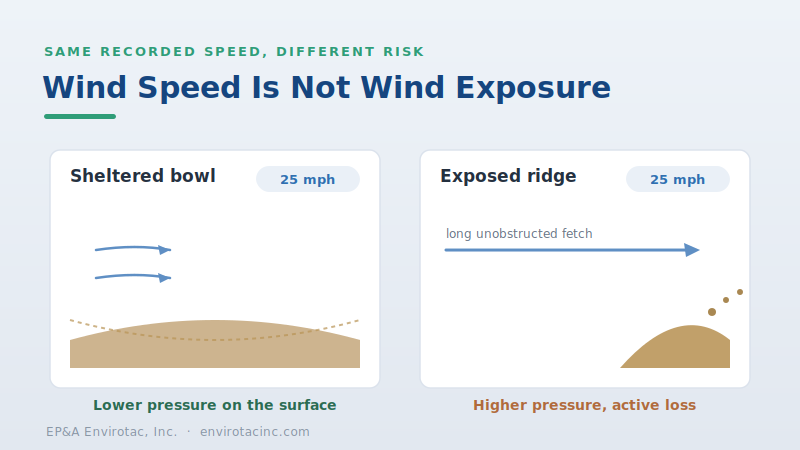
Two sites can log identical wind speeds and present completely different erosion problems. Sometimes the site with the lower recorded speed is the harder one because wind speed and wind exposure are related but not the same variable, and specifications calibrated to one can systematically underestimate the other.
Wind speed is what instruments capture at a fixed measurement point. Exposure is what the surface experiences, shaped by fetch, terrain, topography, and the physical features construction itself creates. Standard regional weather stations are designed for meteorological measurement, not for erosion risk assessment, which means the gap between what they record and what determines erosion on a specific site is structural rather than occasional.
Fetch, the unobstructed distance wind travels before reaching the vulnerable surface, shapes how much energy it carries on arrival. A ridge site with a long fetch into the prevailing wind direction typically faces greater erosion pressure than a sheltered bowl site with similar recorded speeds, not because the wind is stronger but because it has more distance to develop before it arrives. The weather station captures neither fetch nor the surface condition the wind meets at standard regional measurement points, and specifications built on recorded wind speed may be calibrated to conditions that don’t exist at the site.
Stockpile orientation reveals this gap in concrete terms. A pile running perpendicular to prevailing winds tends to create a high-velocity zone at the crest and a turbulent wake on the lee side, both of which generate localized erosion that regional wind speed data wouldn’t predict. Reorienting a stockpile changes the exposure profile the treatment has to manage. Knowing that reorientation isn’t possible establishes that the treatment has to handle conditions the regional data doesn’t capture.
Gusts and sustained winds impose different demands on treated surfaces, and the distinction matters for specification in ways that average wind speed figures obscure.
Some erosion control measures handle prolonged steady winds well and degrade under repeated peak loading. Others accommodate gust loading more reliably but may not hold as consistently under sustained exposure.
An inspector arriving after a weekend of variable gusts sees something a specification written around average conditions didn’t fully account for: localized failures at crest lines and lee faces while adjacent areas remain intact, the pattern that fetch and orientation would have predicted.
A specification calibrated to average conditions may perform adequately most of the time and be tested hardest at the moments that determine whether it holds.
Project Objectives Determine the Right Performance Requirements
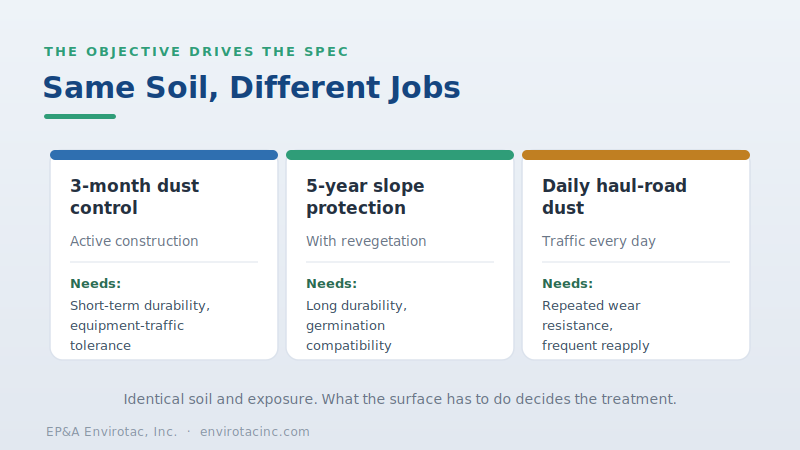
Two sites with nearly identical soils and wind exposure can still require completely different treatments because the treatments aren’t managing the same problem.
They’re managing different definitions of success, operating across different timelines, with different operational constraints, and with different consequences when they fall short.
A cleared construction pad that needs to stay stable for three months occupies a different specification than a reclaimed slope that needs to support vegetation for years. Dust suppression on an active haul road where equipment runs daily requires different properties than stabilization on a closed site where nothing will cross the surface again. These aren’t variations in degree. They reflect problems that share a variable but diverge in what managing that variable actually requires across the project’s life.
Maintenance access tends to determine product selection on more sites than the specification anticipated, often more than product performance does because when access is constrained, the reapplication requirement cannot be met regardless of how well the product performs on paper. Maintenance windows and application windows share the same vulnerability: both often get compressed first when earlier phases overrun their timelines.
By the time the first reapplication window arrives, the project has usually moved on, the crew has demobilized, and access has been cut off by work that came after.
Specifications that build maintenance into the selection criteria from the start tend to select treatments the project can actually sustain.
Sequencing introduces a related constraint that product-first specification tends to surface too late. A haul road crossing a freshly stabilized area carries equipment traffic the stabilization wasn’t designed to survive, and that conflict between two site requirements won’t appear in a specification selected before accounting for what else the surface had to accommodate.
What other trades will do to the treated area, and when, belongs in the performance requirements alongside erosion control duration and maintenance access because it determines what the treatment actually has to survive rather than what it was selected to handle.
Environmental Conditions Influence Performance, But Rarely Dictate It
Product failure in the field traces more reliably to application conditions than to product chemistry because conditions determine whether the chemistry can develop its rated performance at all. A product applied outside its curing window doesn’t partially hold.
Point-in-time moisture content is less useful for assessing erosion risk than understanding how quickly a surface dries and under what conditions because erosion risk is dynamic rather than static. Morning moisture readings have put crews in difficult positions on sites where the surface was adequately cohesive at 7 a.m. and critically dry by midday on a south-facing slope.
Drying cycles describe erosion risk across time rather than at a moment. How fast the surface loses cohesion, how completely, and how often, tells more about field performance than any single moisture reading, and that logic extends across seasons: a surface treated in fall may encounter winter conditions outside the intended operating range of some products, which makes the environmental conditions the treatment will face over its full service life part of what the specification has to account for.
Application timing is where this becomes most consequential. By the time the treatment crew mobilizes, the schedule is often already behind because the application window is typically the first activity compressed when earlier phases overrun their timelines.
Many treatments require adequate temperature and sustained drying time to cure and develop the cohesion their rated performance assumes, and those requirements don’t compress with the schedule. Roughly twenty-four hours of suitable curing conditions is a common threshold for many stabilization treatments, and a site that drops below freezing each night may never provide that window regardless of what the project timeline says.
Specifications that define application conditions as a plan requirement give that requirement standing when schedule pressure arrives. A product applied correctly under adequate conditions will often outperform a chemically superior product applied under the wrong ones because the wrong conditions prevent the superior chemistry from developing its rated performance.
Specify the Right Treatment, Not the Familiar One
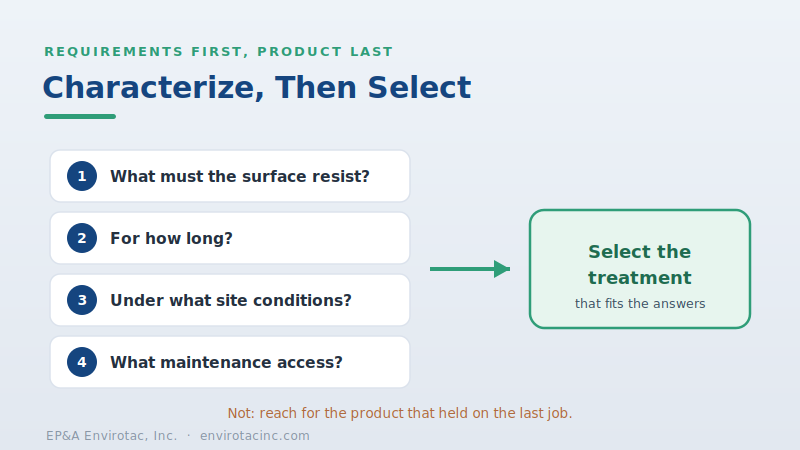
Experienced engineers who’ve watched specifications underperform tend to identify the same origin point: the product was selected before the problem was fully characterized. Pattern recognition, drawing on what held on a previous job, is a reasonable cognitive approach that works when conditions are stable and similar across projects because experienced practitioners who skip formal characterization are substituting accumulated pattern knowledge for explicit reasoning, which holds until the site conditions depart from the pattern the knowledge was built on. It becomes less reliable when that departure happens, which is precisely what makes each site’s combination of disturbed soil, specific exposure, defined objectives, and constrained maintenance window different from the previous one that looked similar.
Specifications that hold tend to arrive at product selection from a prior characterization of what the surface has to do: what it needs to resist, for how long, under the conditions the site will produce across the project’s full timeline, and with the maintenance access the project will realistically provide. When product selection precedes that characterization, the specification describes a product’s capabilities rather than a site’s requirements, and the distance between those two descriptions is where underperformance tends to originate.
Consider a fine-grained, recently disturbed soil on an exposed embankment. If the project requires three months of dust suppression during active construction, the stabilization approach needs adequate durability for that period, compatibility with equipment traffic, and reapplication intervals the site can support. If it requires five years of slope protection with vegetation establishment on the same embankment, the requirements shift entirely: longer durability, germination compatibility, and maintenance intervals calibrated to a closed site with limited access.
The soil is identical. The exposure is identical. The objectives produce specifications that share almost nothing else because what the surface has to do, over what period, and under what operational constraints determines what the treatment has to be.
Underperformance on treated sites tends to trace to causes that cluster rather than appear independently because they’re sequential consequences of the same initial error. When a specification names a product before defining what the site requires, what follows is visible in the document itself: criteria written around the product’s known behavior rather than the site’s actual demands, a maintenance plan that assumes access the project timeline won’t provide, and no accounting for what subsequent trades will do to the treated surface.
Defining what the surface needs to do, over what period, and with what access for maintenance, before selecting the treatment gives the specification a basis that holds when field conditions test it.
Where Polymer Soil Stabilization Fits
Polymers work at the particle level, binding fine material into a more cohesive surface matrix. On a recently disturbed site with fine-grained soils in an exposed position, this matters in a specific way that lighter or shorter-duration measures often can’t match: the treated surface resists particle-level entrainment during the period immediately after earthwork when aggregate structure has been compromised, before vegetation establishes sufficient cover, and when repeated maintenance is typically least practical given where sequencing leaves site access.
The surface that would otherwise begin losing material in the first significant wind event after grading holds differently. How much differently depends on application rate, soil characteristics, and curing conditions, which is why the site profile that precedes product selection shapes actual field performance as much as the product itself does.
On sites where the specification process identifies recently disturbed fine-grained soils as the primary erosion mechanism, polymer treatment addresses that mechanism at the particle level, improving cohesion within the soil matrix itself. Where the specification identifies simultaneous objectives, such as dust suppression during active construction and long-term slope protection with revegetation, polymer treatment remains compatible with vegetation establishment, stabilizing the surface through the period when cover is incomplete without preventing germination. And where the specification identifies maintenance access as a binding constraint, polymer durability reduces dependence on reapplication windows the project may not reliably provide.
These three characteristics emerge from the same site conditions that make the specification decisions consequential: recently disturbed soil, meaningful wind exposure, and constrained maintenance access. The sites where polymer stabilization fits most precisely are the sites where the specification process this article describes produces its most consequential decisions.
Selecting polymer treatment because it held on the last job is the same product-first error the specification process exists to move past. The site condition, the project timeline, and the maintenance window are what the assessment reveals. The conclusion follows from there.
Conclusion
Specifications built around a single variable hold when that variable captures most of what the site is doing. On most sites, it seldom does, because such sites are being actively transformed by the projects that require the specifications in the first place, and that transformation tends to move toward the conditions that increase erosion risk.
The earthwork that disturbs soil structure also extends the exposed area, advances the project toward the timeline points where application windows close, and initiates the sequence that will eventually cut off maintenance access.
These aren’t independent changes. They’re driven by the same phases of work, which means the site the specification describes at the project’s outset is moving away from the specification in several directions at once.
A specification that accounts for that movement is written for the site that will receive the treatment.
Site assessment is designed to anticipate the conditions that earthwork predictably creates, not to predict every variable the site might produce across its full life. Those are different ambitions. Confusing them produces specifications calibrated to conditions that are theoretically possible rather than conditions that are structurally inevitable, which is a harder standard to meet and a less useful one.
Start with the assessment. Keep asking what the site looks like now.
Related reading
Applications - Dust Control & Soil Stabilization Products

Leave a Reply