
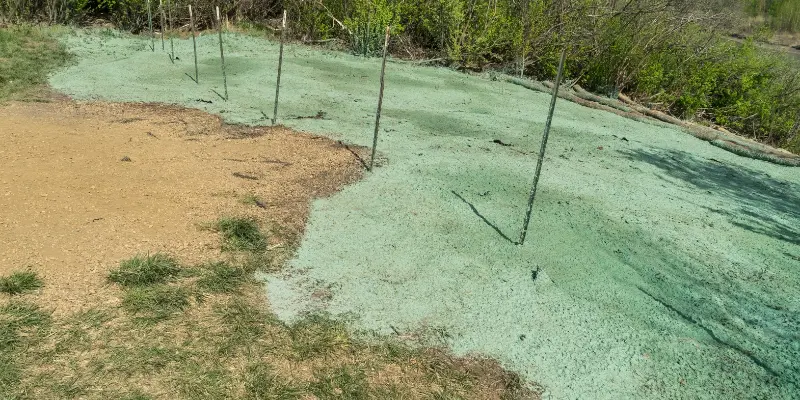
April 25, 2026
Some slopes hold after rain. Others tell you something the application couldn’t.
A week passes. Maybe two. The surface that looked even when the crew left starts showing where the water went. Not everywhere. Just in the places where the slurry didn’t.
The slope was still responding to the rain.
What the slope reveals in those first weeks after application comes down to one thing: how well the slurry held its ground. That’s a soil stabilization question as much as it is a hydroseeding one.
Why Hydroseeding Loses Ground on Slopes
A standard hydroseeding slurry is built to cover the ground. On flat, stable surfaces with predictable moisture, that’s often enough. On slopes, water moves across the surface with enough force to carry whatever isn’t anchored, and a slurry without adequate stabilization has no reliable way to resist that.
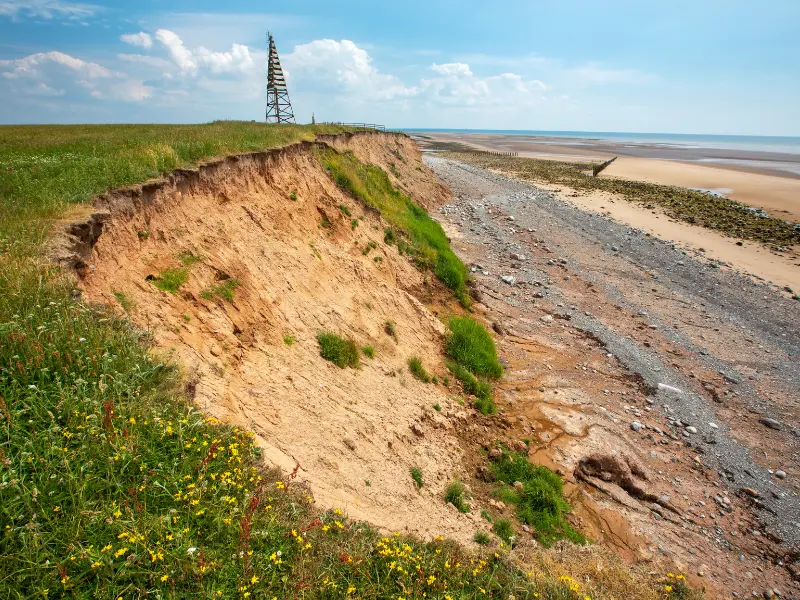
Erosion on a slope works in three stages. Rainfall detaches particles from the soil surface. Runoff carries those particles downhill. They settle wherever the water loses momentum. A hydroseeding slurry applied without adequate stabilization sits on top of this process. The mulch covers the surface, and the seed is in place, but the forces moving through and across the slope don’t stop because something was sprayed on top.
When rain hits a freshly seeded slope before anything has had time to establish, the slurry moves, but not always dramatically. It often starts with finer material shifting, then seed displacement, then sections of mulch breaking apart. The surface still looks covered. But it’s no longer where it was placed.
That movement is where the patchy results come from in conditions like these. Seed quality and equipment calibration matter, but on a slope under rainfall, neither compensates for a slurry that couldn’t hold its position. The areas that came in thin are the areas where runoff concentrated, where the seed lost contact with the soil beneath the mulch, and where the slurry couldn’t hold its position under the weight of moving water. The areas that filled out evenly are the ones that didn’t move.
Rilling compounds this. Once water cuts small channels into disturbed soil, those channels direct the next pass of rainfall the same way. The movement becomes self-reinforcing, and by the time the results are visible, the separation happened days ago.
Seed germination needs consistent moisture and stable placement to establish, not just an initial dose of water. A seed that shifts even slightly in the first days after application may not maintain adequate contact with the soil beneath the mulch layer. An exposed slope that dries faster than expected creates an uneven microenvironment where some seeds establish quickly and some never really get started. That’s where thin, inconsistent results come from, even on applications that looked right from the start.
Standard tackifier rates are designed for general conditions. On steep inclines, sandy soils, heavy clay, or areas expecting rainfall shortly after application, the holding strength in a basic mix often isn’t enough to keep the slurry intact under actual stress. The gap between what the application looked like and what the results showed isn’t always an application error. Sometimes the mix itself wasn’t built to hold under the conditions it was placed in.
What’s Holding the Slurry Back and What Changes It
The slurry is doing its job up to a point. It carries seed, holds mulch, and gets coverage across the surface quickly. On its own, it has no mechanism to stay in place once water starts moving across a slope with any real force.
That gap is where most slope failures actually originate.
What closes that gap is a soil stabilization and erosion control polymer working inside the slurry itself. When the polymer makes contact with soil particles, it adsorbs onto their surfaces, forming physical and electrochemical interactions at the particle level. From there, single polymer chains attach to multiple particles simultaneously, a process called bridging flocculation, pulling those particles together into larger, heavier aggregates that resist displacement significantly better than the fine particles they were before.
Research on polymer-based soil stabilization confirms that these polymers strengthen soil mechanically, improve water retention and infiltration, and increase resistance to erosion, effects that carry directly into how a polymer-strengthened hydroseeding slurry performs on a slope under rainfall.
EP&A Envirotac, Inc.’s products work at exactly this level. Inside the hydroseeding slurry, the polymer binds mulch fibers, seed, and soil into a continuous reinforced layer rather than leaving them as separate materials sitting loosely in contact with each other. A soil stabilization polymer builds a composite layer that anchors mulch, seed, and soil surface together against wind and runoff, with a holding strength that standard tackifier rates don’t reach in real field conditions on steep inclines.
Germination responds to this in a way that’s worth understanding separately from the retention story. The polymer and mulch together create a stable moisture microenvironment directly around each seed. Water stays close to the seed rather than evaporating off an exposed slope or running off before it absorbs. The seed maintains contact with the soil beneath the mulch layer because the layer itself isn’t shifting.
How Soil Stabilization Polymers Work Through a Hydroseeding Application
Water, seed, mulch, and polymer go into the hydroseeder tank together and circulate as one mix. What comes out of the hose is a slurry whose components are already relating to each other differently. Seed and mulch stay more evenly distributed through circulation rather than separating as the tank runs. That consistency carries through to how the slurry lands and spreads across the slope.
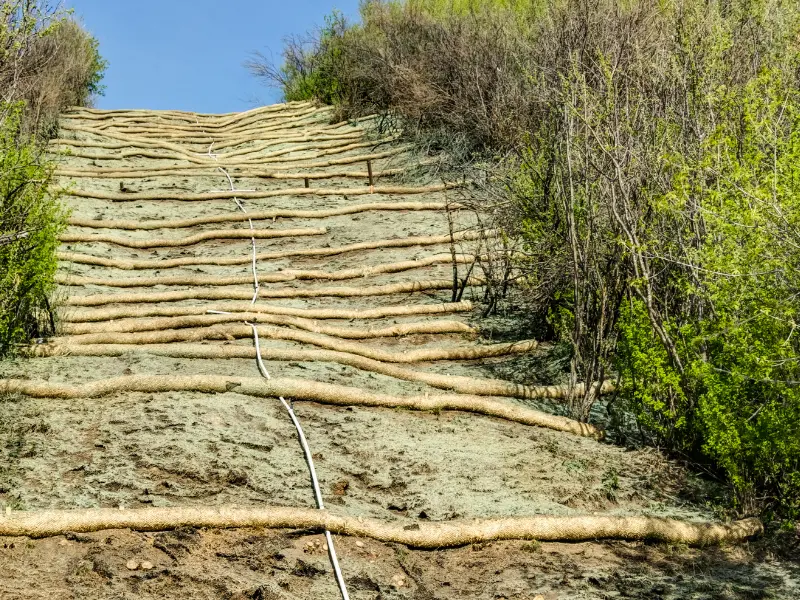
On steep sections, this effect becomes apparent quickly. The slurry lands and holds rather than thinning at the edges or pulling away in streaks. Water drains across the surface the way it always does on a slope, but the slurry layer doesn’t follow it. Material stays closer to where it was placed.
In the hours after application, the polymer is already working at the particle level. The slurry forms a bonded layer across the surface; mulch and seed are held in place while soil particles beneath begin aggregating into the more stable structure that bridging flocculation creates. The surface sets rather than staying loose.
Over the following days, that bonded layer stabilizes further, and the matrix the polymer has built begins showing its holding strength under real conditions. The first significant rainfall hits a surface that resists separation rather than giving way to it. The window between application and the first stress the slope faces is where most standard slurries lose material, while a polymer-strengthened mix maintains the difference in the final results.
As vegetation begins establishing over the following weeks, roots gradually take over the stabilization work the polymer initiated. The polymer holds the slope together through the critical period between application and establishment, long enough for the root system to develop into the permanent stabilizing layer the slope needs.
Cost, Equipment, and Seed Establishment in a Polymer-Enhanced Hydroseeding Mix
Cost is usually the first consideration. Bringing a polymer into the mix adds to the upfront cost, and that number is real. The fuller picture is that the mix cost and site revisit cost are two different numbers, and they don’t always get weighed against each other when the initial decision is being made. A stronger mix that holds through the first stress cycle changes what the project actually costs across its full run, not just at the point of application.
Equipment behavior is a fair question for any contractor running a tight operation. A mix that changes how the slurry moves through the system creates real problems, and that concern makes sense. In most setups, the polymer circulates with the slurry through the same hydroseeding equipment without requiring modifications or changes to how the project is run. It sprays clean and doesn’t create handling issues during or after application.
Another consideration that arises, sometimes directly and sometimes indirectly, is whether stronger holding strength affects seed establishment. A surface that locks too tightly could theoretically interfere with germination or restrict how moisture moves through the layer. The holding strength depends on the slurry layer itself. Moisture still moves through the surface, the seed stays in contact with the soil beneath, and germination follows its natural path. The difference is that the layer around the seed holds its position rather than shifting during the critical early period after application.
From Application to Establishment: The Full Picture of Slope Stabilization
When the slurry holds, the slope tells a different story at the two-week mark than it does when the mix wasn’t built to stay in place. Coverage comes in consistently across the surface rather than breaking into sections that are established and sections that aren’t. Germination moves at a steadier pace because seed placement and moisture retention stay in control from the day of application, rather than shifting with the first pass of water.
For contractors running large-scale slope work, that consistency changes how the project closes out. The surface doesn’t need to be assessed for patchy zones or thin coverage that requires attention. What was applied does what it’s supposed to do.
That picture extends beyond the first few weeks. As the root system develops and vegetation takes hold across the slope, the stabilization the polymer started gets handed off to the plants permanently. The erosion control work that began with the slurry continues through establishment and finishes with a root-anchored surface that holds on its own. A slope that holds through that full cycle rarely needs to be revisited.
On slopes where water movement is a given, early stability is what the rest of the application stands on. That’s what polymer-based soil stabilization systems are built to provide, and it’s what EP&A Envirotac, Inc.’s soil stabilization polymers bring to a hydroseeding mix from the moment they enter the tank.
The mix goes down once. What it was built for shows up later.
Applications - Dust Control & Soil Stabilization Products

Leave a Reply