
October 1, 2026
Sometimes, busyness is how a lack of progress disguises itself.
A site can be moving: trucks hauling, equipment cycling, and crews logging hours while quietly losing ground on the schedule.
That loss shows up as a haul route that once handled the day’s traffic without much thought now needing additional passes or unplanned attention to deliver the same result. It shows up as dust suppression that used to get scheduled and forgotten now pulling equipment and supervisory attention away from work that was supposed to happen that day. And it shows up as a working surface that is still passable, but only on terms the project didn’t plan for.
Time, labor, equipment availability, and room to adjust when something else goes wrong: something is being spent across all of those, and it can be well underway before it registers as a schedule problem.
The question isn’t whether work is continuing. It’s whether the current way of handling a recurring site problem still makes sense given what it’s actually costing the project.
Recurring Management Is Not Failure, But Its Burden Isn’t Neutral
Repeated dust suppression on an active haul road, periodic surface work after rain events, and regular erosion checks on a slope in active use: recurring maintenance can be the right call. It preserves flexibility. It avoids committing resources to something more permanent when site conditions are still shifting or when the area doesn’t warrant it.
Whether the project can reliably plan for it is what separates a manageable recurring cost from one that starts affecting how the project runs.
A maintenance activity that gets scheduled, resourced, and executed without disrupting the work around it carries a different weight than one that forces the team to react. The first fits into the rhythm of the work. The second competes with it, pulling labor and equipment away from what was planned, creating decisions that weren’t on anyone’s agenda that morning, and narrowing the room the project has to handle anything else that comes up.
The more durable alternative isn’t automatically better. It may need application conditions the schedule can’t accommodate, impose temporary restrictions that create their own disruptions, or require an upfront commitment the project isn’t positioned to make. A crew running a treatment that fits how they operate isn’t managing poorly just because it needs to be reapplied.
The burden shifts when something that used to be a plannable cost starts introducing unpredictability the project struggles to work around.
A Visible Problem Is Not Automatically the Most Consequential One
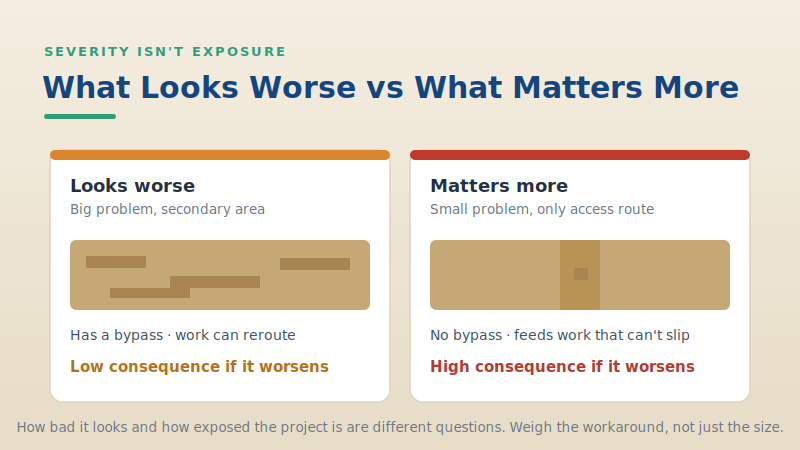
Apparent severity and operational priority don’t always point in the same direction.
A widespread surface problem across a secondary staging area can look considerably worse than a short deteriorating section on a single access route. But if that section is the only practical path for equipment that can’t be rerouted without replanning a significant portion of the work, its consequences bear no relationship to its size. Severity matters particularly where safety, environmental exposure, or regulatory obligations are involved.
But severity alone doesn’t tell you where the project is most exposed.
How much room the project has to respond if a problem gets worse rarely gets weighed against how bad the problem looks. Whether alternatives exist. Whether sequencing can shift. Whether the affected area is one of several options or the only one. A problem with a practical workaround sits in a different category than one without, even if the one without looks smaller.
Where something deserves attention and how much to do about it are different questions. A critical access route may justify prompt action without justifying the most intensive treatment available. Conflating priority with intervention level leads to both over-solving and under-solving on the same project.
When a Problem Keeps Returning, Don’t Collapse Two Different Questions Into One
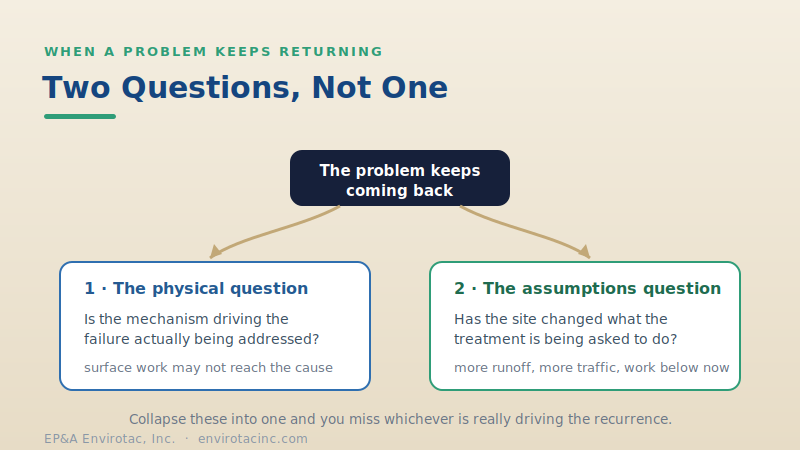
A recurring site problem can reflect a physical issue that hasn’t been adequately addressed, a shift in what the existing treatment was designed to handle, or some combination of both. Treating them as the same question tends to obscure whichever one is driving the recurrence.
The physical question is whether the mechanism driving the problem is actually being addressed. A road surface that keeps breaking down under traffic may have an underlying support issue that surface work alone can’t resolve. The constraint driving the failure may sit below what the surface treatment reaches. The visible failure and the actual failure mode don’t always coincide. Getting that wrong means repeating the same treatment against a problem it was never positioned to solve.
A slope gets an erosion control measure early in the project. At the time, the call is reasonable: a modest gradient, limited runoff contribution, and no active work or critical infrastructure sitting below the slope. Over the following months, grading expands the contributing drainage area, a detention feature gets relocated, and active work opens up below. The slope is now catching more runoff than the original measure was designed around, and a failure that would have been a minor setback earlier in the project would stop work that can’t be easily moved. The treatment may still be performing as designed. The assumptions it was designed around no longer hold.
The crew keeps managing it the same way because the slope hasn’t failed and the problem stays within what the project can handle, until the work below reaches a phase where it can’t.
At that point, the question isn’t whether the treatment failed. It’s whether anyone asked whether the original assumptions still held.
When a problem keeps returning, asking whether the site has changed what the existing treatment is being asked to do is at least as important as asking whether the treatment is working.
Understanding the Physical Problem Is Necessary. It Doesn’t Settle How Much to Do About It.
Two areas showing similar deterioration can warrant completely different levels of attention. The physical problem may be nearly identical. One area carries intermittent traffic, has alternatives if it goes down, and sits away from anything time-sensitive. The other runs daily equipment cycles, has no bypass, and feeds work that can’t slip. The same surface condition in those two places is not the same problem.
Once the physical mechanism is understood, the function the area has to maintain determines how much a given level of deterioration actually matters. On the first, a surface can degrade considerably before it affects anything the project is relying on. On the second, deterioration that looks minor may already be affecting how reliably the operation can execute what’s planned. Where that line sits depends on what the area is carrying, what alternatives exist, and what losing reliable use of it would cost at that point in the project.
More Is Not Automatically Better. Less Is Not Automatically Smarter.
A longer-duration or more comprehensive treatment may be appropriate where sustained traffic, extended use, and operational dependency make the commitment make sense. The same level of effort applied to an area expected to be regraded or vacated before that investment pays out isn’t better management; it’s a mismatch between what was chosen and what the situation called for.
The error runs the other way too. Where the consequences of losing an area justify a more reliable treatment and a lighter one stays in place, the project keeps managing something it may not have to manage, carrying a recurring cost that a better-matched treatment might have reduced or eliminated, assuming one is feasible given the conditions and timeline.
What each error costs depends on the area, the stage of the project, and what failure means at that moment. The intervention was chosen without knowing what the area had to sustain and what it would cost the project to lose it. That’s where the mismatch starts.
Manageable and Acceptable Are Not the Same Standard
A team that has learned to work around a recurring problem has done something genuine. That kind of adaptation takes effort and judgment, and it often keeps projects moving when conditions aren’t cooperating.
When a project runs long enough with a recurring problem, though, the workaround can stop feeling like a workaround. The extra passes on the haul road, the reactive dust suppression call, and the erosion check that now happens every week instead of every month: these get built into how the work gets done rather than recognized as a cost anyone actively questions. The problem stays manageable. The cost of managing it quietly becomes part of the baseline.
That isn’t a failure of attention. It’s what happens when a project runs long enough with unresolved friction. The absence of a visible delay isn’t proof the current treatment is performing well. It may only mean the project has gotten efficient at absorbing something it shouldn’t have to absorb.
The Trigger for Reassessment Shouldn’t Be Failure
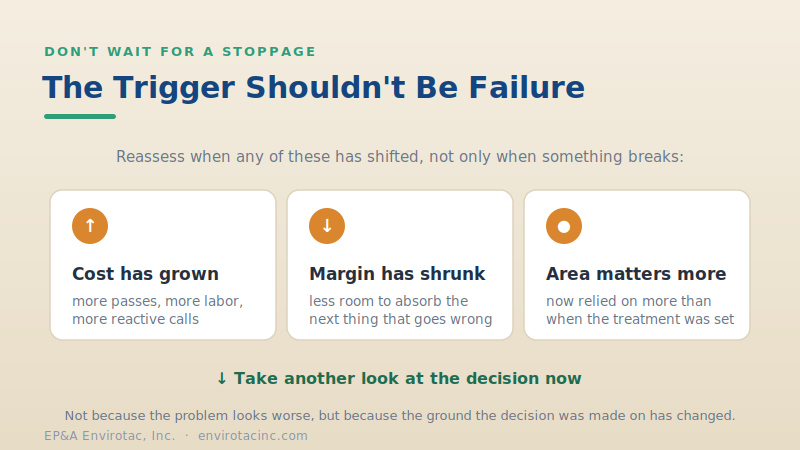
A site can keep moving and still be giving up more than it should.
Reassessment doesn’t require a stoppage, a missed milestone, or a problem that’s visibly gotten worse. What the crew is spending to keep things moving has grown. The margin that once made the burden manageable has been drawn down elsewhere. The area has become more relied upon than it was when the current treatment was put in place. When any of those things has shifted, the decision behind the current approach deserves another look, not because the problem has gotten worse on the surface, but because the ground it was made on has changed.
“Manageable” describes what the project can currently handle. It doesn’t settle whether handling it is still the right call, or whether the treatment in place still fits what the area is being asked to do.
Asking what the area needs now costs less than waiting for the answer to arrive on its own. EP&A Envirotac, Inc. works with project teams to evaluate recurring site conditions and identify dust control, erosion control, and soil stabilization approaches that fit how the area is being used now.
Applications - Dust Control & Soil Stabilization Products
Leave a Reply