
August 7, 2026
Why do two erosion control projects built to similar specifications end up performing differently? The answer isn’t always the stabilization measures or the quality of installation. It begins with the assumptions shaping project decisions long before construction starts.
These assumptions may go unnoticed because they shape which site areas receive identical treatment, how product selection gets framed, what a finished job looks like, and whether a project team has room to respond when circumstances shift. Examining them can lead to decision-making that is better suited to what a site actually presents and improve the chances of erosion control success over the project’s life.
Not Every Part of a Site Is the Same
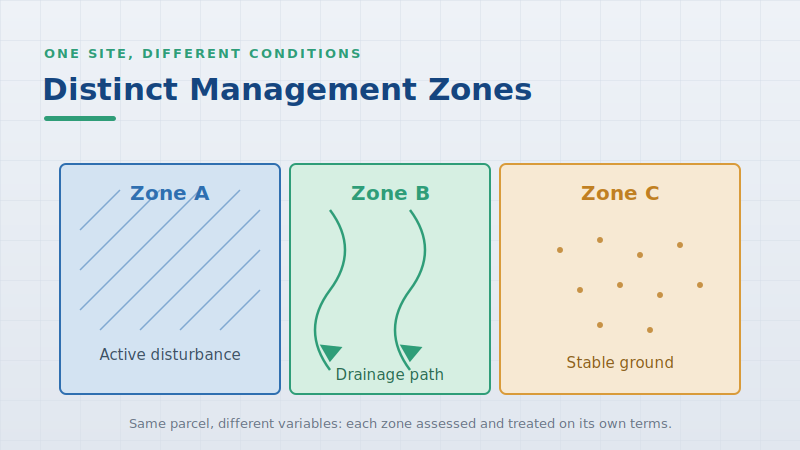
A site that appears uniform from a distance can behave very differently across its own footprint. Two areas sharing the same slope angle and comparable ground cover may have fundamentally different drainage behavior, distinct histories of disturbance, and varying exposure to ongoing construction activity. Visual similarity may suggest comparable conditions, but it doesn’t capture every factor that determines how erosion control measures will perform across a site.
The variables that can produce meaningfully different site characteristics within a single project boundary include:
- Grading and surface geometry
- Drainage pathways and the way water moves across and through the site
- The distinction between recently disturbed and relatively stable ground
- Previous land use and its effect on soil properties and compaction
- The intensity and location of active construction activity
- Physical constraints that limit where measures can be placed
When construction sites are treated as uniform, the stabilization approach gets calibrated to a generalized site profile rather than to the specific circumstances that determine where problems are most likely to develop. Evaluating project areas as distinct management zones, each assessed against its own variables, shifts the question from which solution works best across the site to what each area is expected to present and what that means for how erosion control measures should be positioned.
Product Selection Is Only One Part of the Equation
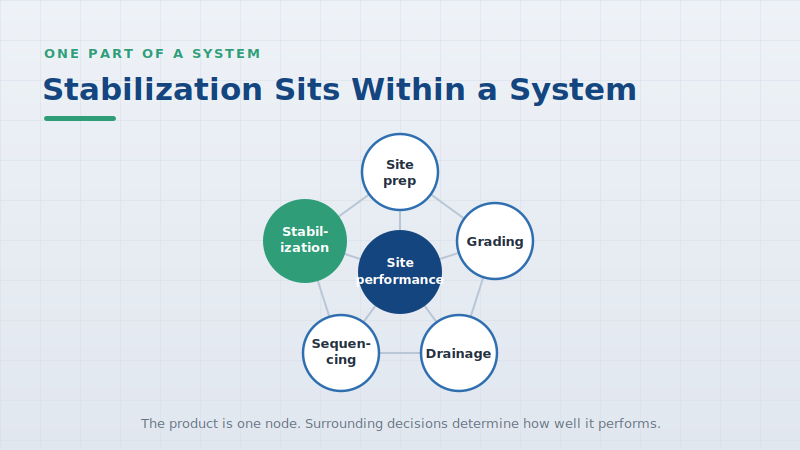
Placing the full weight of project performance on product selection alone treats one decision as though it operates independently of everything surrounding it. Engineering guidance from erosion control in construction contexts consistently presents stabilization measures as components within a system, where surrounding decisions bear directly on how well any individual measure performs in the field.
Site preparation, grading, drainage design, construction sequencing, and stabilization selection all bear on each other. A stabilization measure applied to poorly graded ground, or without accounting for how water will move across the surface after installation, may perform under field circumstances different from those it was selected to address. The measure itself may be appropriate for the site. The decisions surrounding it may not have addressed what the location calls for.
When product selection dominates planning decisions, other factors affecting long-term performance may go unaddressed until corrective work becomes necessary, as the relationship between surface-only fixes and schedule drag illustrates. Evaluating how erosion control measures interact with surrounding site decisions gives engineers and project personnel a more complete picture of what the location requires.
Installation Doesn’t Define Long-Term Performance
Shortly after stabilization measures go in, a site can look exactly as intended. What that observation doesn’t account for is how much the site will continue changing from that point forward and how those changes bear on whether the measures hold up over the project’s full timeline.
- Disturbed areas expand or shift as construction moves forward
- Grading changes alter how water moves across the surface
- Equipment activity modifies ground conditions in areas adjacent to stabilized zones
- Drainage patterns develop differently from what the original design anticipated
Each of these is a normal part of active project development, and each can affect how erosion control measures perform in ways that weren’t visible at installation.
Examining erosion control systems through periods of active site change can reveal vulnerabilities that may not be apparent immediately after installation, as a closer look at how erosion control systems respond to evolving site circumstances makes clear. Initial appearance may not expose those vulnerabilities. Defining performance expectations before installation, with a clear view of how the stabilization system is expected to hold up as the site develops, gives the field team a more grounded basis for evaluation than a single post-installation observation provides.
Compliance Isn’t the Same as Project Success
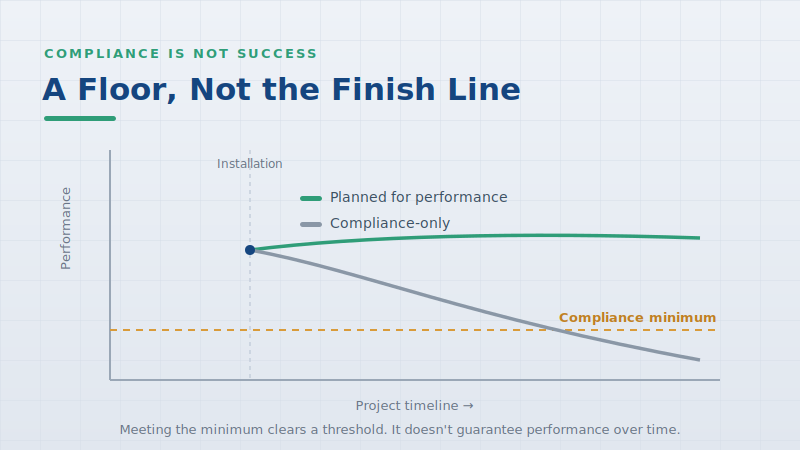
Regulatory compliance establishes that a required process was followed, and meeting that standard matters. What it leaves open is whether the erosion control system will continue doing what the site needs after that threshold is cleared.
Meeting minimum requirements establishes compliance. It doesn’t necessarily establish long-term performance. Compliance asks whether the required erosion control measures were selected, installed, and documented according to applicable standards. Performance asks whether those measures are holding up as site characteristics develop over the remainder of the project and beyond, which is a different question with a different set of answers.
The gap between preventive project strategy and the cost of corrective work makes this concrete: when decision-making is oriented primarily toward meeting compliance requirements, factors that influence long-term performance may go unaddressed until corrective work is already on the table. Measuring project success against long-term performance objectives gives the construction team a more durable basis for judgment than regulatory approval alone provides.
Resilient Planning Accepts Uncertainty
A well-developed plan can account for a great deal of what a site will present. It cannot account for everything, and treating it as though it can may leave engineers without a clear path forward when circumstances shift in ways the original plan didn’t anticipate.
- Sites change during active development
- Ground conditions change
- Drainage behaves differently from the initial assessment
- Construction sequencing adjusts
Each of these shifts can affect how erosion control measures perform, and a plan without room to respond becomes harder to execute accurately as the project progresses.
This is particularly visible in environments like oil and gas operations, where site access, ground conditions, and development sequencing change continuously across a project’s life. A plan calibrated to the initial site assessment, without accounting for how field circumstances are likely to shift, is working against what those sites present over time.
Leaving room for adjustment in erosion control decision-making, so that field observations can inform where the plan needs to flex, is consistent with sound project management. Sites in active development are not static, and project strategy that accounts for that can make more durable outcomes more likely.
Conclusion
Before erosion control measures are installed, the assumptions guiding project decisions are already shaping what the finished site will look like. Which areas get treated as distinct, how stabilization fits within the overall site strategy, what the construction team is measuring as success, and whether the plan has room to adapt: these questions get answered during project development, and their answers carry through to the completed work.
Revisiting those assumptions helps align decision-making with actual site characteristics. Treating site areas as distinct management zones, positioning erosion control measures within surrounding site decisions, establishing performance expectations before installation, and preserving room for adjustment as the site develops can make it more likely that erosion control systems continue performing as projects move forward. The decisions that shape erosion control success often begin long before installation, and the assumptions made at the planning stage are where that success is either supported or left to chance.
Seen as one element of a site strategy that has already accounted for field conditions, stabilization technologies take their place as components of a coordinated effort. That systems-based thinking is what separates erosion control approaches that hold up over time from those that surface problems after the fact, and it is the planning philosophy that EP&A Envirotac, Inc. brings to its erosion control services, combining polymer-based stabilization with site-specific decision-making to support long-term performance.
Applications - Dust Control & Soil Stabilization Products
Leave a Reply