
June 28, 2026
Introduction
Swooshes in the winter storm, and with it comes everything property owners expect to deal with — icy roads, snow load, frozen pipes. What doesn’t make that list is the damage happening underground, where saturated soil is one freeze-thaw cycle away from losing the strength it needs to hold together.
Rain, snowmelt, and repeated freezing break soil down well before any erosion shows on the surface — and by the time something looks wrong up top, the ground has already given up much of what was holding it together. This is the gap soil stabilization is meant to close — addressing the cause of that weakening rather than reacting to it after a storm passes.
This article looks at how winter weather affects soil, which warning signs suggest a property is already at risk, and which stabilization approaches hold up best once the season turns.
Understanding Soil Stability and Why It Matters
Soil stability comes down to whether the ground holds together or gives way when something pushes on it — rain, frost, the weight of a structure. That depends on how the particles are arranged, how much load they can take, and whether water passes through or sits. Stabilization is the work of making those conditions better so the ground doesn’t fail under pressure.
Soil stabilization is the process of improving those properties so soil becomes stronger and more resistant to weather and structural stress over time. It’s worth distinguishing from erosion control, which manages soil loss after it’s already underway: stabilization addresses the root cause, while erosion control manages the symptoms — usually as a short-term fix.
Stable soil protects infrastructure, drainage performance, vegetation, and long-term site resilience — which is exactly what winter storms put to the test.
How Winter Storms Affect Soil
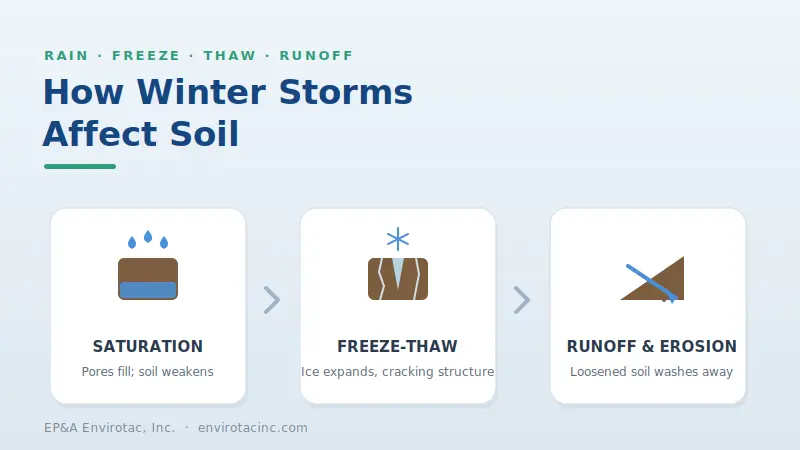
It’s tempting to think of winter soil damage as something that happens during the storm itself. What actually happens is a sequence. Rain loads the ground with water. Freezing locks it in and wedges particles apart. Then a thaw or snowmelt flushes the loosened soil off the property. Each step makes the next one worse. Here’s how that chain actually works.
Heavy Rainfall and Surface Runoff
Winter storms often bring extended rainfall, and extended rainfall does something specific to soil: it fills the pore spaces until there’s nowhere left for water to go. Once soil reaches that saturation point, any additional rain has only one direction to travel — across the surface.
Saturated soil isn’t just wet — it’s structurally weaker because water reduces the friction holding particles together, which makes it far easier to dislodge. And in winter, infiltration is already working against you — frozen or partially frozen ground simply can’t absorb water the way it does in warmer months, so precipitation pools near the surface instead of soaking in.
The result is runoff that moves faster and carries more force, especially on sloped ground. Faster runoff doesn’t just sit on the surface — it actively detaches soil particles and carves out rills and channels, then carries that displaced soil downslope into drainage systems and waterways. With vegetation cover often thinned out in winter, the soil has little to protect it from this process.
Snow Accumulation and Snowmelt
Snow landing on the ground isn’t usually what causes the damage.
When temperatures climb back above freezing — especially during a rapid warming spell — accumulated snowpack converts into liquid water quickly, sometimes releasing a volume of runoff that rivals a heavy rainstorm. The complication is that this meltwater frequently hits the ground while the soil underneath is still frozen solid. Frozen ground seals off the soil below it, so meltwater has nowhere to go but sideways — straight across the surface.
Add in soil that freeze-thaw cycles have already loosened and vegetation that’s too thin to hold anything in place, and erosion has very little standing in its way. This is part of why a lot of significant soil loss actually shows up in late winter and early spring — well after the snow itself has fallen.
Freeze-Thaw Cycles
Freeze-thaw does more damage to soil than any other part of winter. Every time the temperature crosses the freezing line — in either direction — water inside the soil swells into ice, melts back, and swells again.
Water grows roughly 9% when it freezes. Inside a soil pore, that’s enough force to crack particles apart and open up fractures in the structure around them. Run that cycle a few dozen times between November and March and the ice keeps grinding particles out of place, chewing through the aggregates that are supposed to hold everything together.
What you lose in the process is cohesion — the binding force holding particles together — and less cohesion means runoff can pick up and carry soil far more easily. Over a season of repeated freezing and thawing, the cumulative effect is a soil structure that’s measurably weaker, more porous, and more prone to failure than it was before winter started — leaving it far more vulnerable when the next rain or snowmelt event arrives.
Ice Formation and Soil Compaction
Freezing doesn’t just loosen soil — in some cases, it compresses it. As ice forms and expands, it can press against neighboring soil particles and shift their arrangement, particularly in fine-textured soils where moisture migrates toward the freezing zone and accumulates as ice. That movement changes the soil’s density and structure, and the change doesn’t necessarily reverse once things thaw.
One of the more important downstream effects is what happens to pore space. Freeze-thaw activity deforms pores and changes how they connect to each other — and since pore networks govern water infiltration, air movement, and root growth, disrupted pores translate directly into disrupted soil performance. In practice, that means some areas drain worse than before and start ponding water, while others develop new preferential flow paths that channel water in unintended ways. Either outcome increases the odds of runoff and erosion in the storms that follow.
These same density and drainage changes don’t stop at the soil — they extend into anything resting on top of it. Subgrade deterioration beneath roads, foundations, and retaining walls is a well-documented consequence of repeated freeze-thaw expansion and contraction, which is part of why winter is so hard on built infrastructure, not just open land.
The Real Takeaway
Winter soil damage rarely comes from one storm — it’s a sequence: saturation, freezing and expansion, loss of cohesion, then runoff and erosion once the thaw or next storm arrives. Most discussions of winter weather stop at that last step — erosion — without acknowledging that the real damage began weeks earlier, inside the soil itself.
The Hidden Damage Winter Storms Can Cause
Erosion is usually where the conversation about winter storm damage starts — and, unfortunately, where most of it ends. But erosion is really just the first domino. Once soil starts breaking down, the effects ripple outward into slopes, drainage systems, infrastructure, and vegetation, often in ways that aren’t obvious until the damage is already expensive to fix.
Soil Erosion
Saturated ground, dormant or missing vegetation, freeze-thaw damage, and heavy runoff all landing at the same time — winter puts together almost the perfect conditions for erosion. But “erosion” isn’t one single event — it progresses through stages, and each stage is more serious than the last.
The first stage is usually sheet erosion — a thin, even layer of topsoil washed off across a broad area. It’s hard to spot because the loss is so spread out, and by the time it’s noticeable, a significant amount of nutrient-rich soil has already been carried away along with the ground’s ability to grow new vegetation.
If that runoff concentrates rather than spreading evenly, it carves out rills — small channels formed as the water gains enough force to detach and carry soil particles. Freeze-thaw activity makes this worse by weakening soil aggregates ahead of time, so winter and early spring runoff have an easier time cutting these channels.
Left alone, rills can deepen into gullies — the most severe stage, where channels grow too large to fix with normal land management. Gullies destabilize the soil around them, damage drainage infrastructure, and often require costly remediation to correct.
These aren’t three unrelated problems — they’re stages of the same breakdown.
Slope Instability
Erosion strips soil from the surface. Slope instability is what happens when the soil itself starts to fail.
Every slope is a balance between gravity pulling soil downhill and the soil’s internal strength holding it in place. Saturation tips that balance — as water fills the soil, pore-water pressure rises and reduces the friction that normally keeps particles locked together. Add the strength loss from repeated freeze-thaw cycles, and slopes become considerably more prone to movement and failure.
That’s how washouts happen — concentrated runoff strips away enough supporting soil to trigger a partial or full slope failure, often near road embankments, drainage channels, and steep grades. Winter stacks several risk factors at once: frozen ground blocks infiltration, snowmelt adds runoff volume, freeze-thaw activity weakens the soil structure, and dormant vegetation offers less protection than it would the rest of the year. The result can mean property damage, disrupted roads, and stabilization projects that are far more expensive than preventive work would have been.
Foundation and Infrastructure Damage
This is often where winter soil damage becomes a real budget issue, since soil is the support system for nearly everything built on top of it.
Freeze-thaw hits pavement hard. Water works into cracks and pores, freezes, swells, and pushes outward. Keep that up through a winter, and you end up with cracking, heaving, settlement, and potholes.
Retaining walls depend on stable soil to resist lateral earth pressure. Winter saturation increases hydrostatic pressure behind the wall, while freeze-thaw weakens the soil around it — a combination that can lead to wall movement, cracking, and drainage failures.
Roads face damage from both directions: freeze-thaw weakens the subgrade supporting them, while runoff erodes embankments and shoulders. The end result tends to be shoulder erosion, settlement, washouts, and rising maintenance costs.
Utility corridors — pipelines, cables, buried infrastructure — rely on the soil around them staying put. Soil movement and erosion can expose utilities, displace pipes, and lead to costly repairs or service disruptions.
Drainage and Vegetation: The Compounding Effects
Eroded soil has to go somewhere, and most of it ends up in ditches, culverts, and storm drains — clogging the systems that are supposed to be managing the water. The less capacity those systems have, the higher the flooding and maintenance risk. Meanwhile, the vegetation that would normally anchor the soil is often the first thing to go.
Exposed roots face greater risk from freezing and physical stress, while winter dormancy leaves already-thin ground cover even less effective. The result is a feedback loop: less vegetation means more erosion, and more erosion makes it harder for new vegetation to take hold — leaving the site progressively more exposed with each passing season.
How It All Connects
None of these problems exist in isolation. Storms weaken the soil. Weakened soil washes away. That erosion undercuts slopes. Failing slopes dump sediment into drainage systems. Overwhelmed drainage leads to infrastructure damage. And the vegetation that might have slowed the whole thing down gets stripped out along the way. Each stage makes the next one more likely — which is exactly why addressing soil stability early matters more than reacting to any single piece of damage after the fact.
Soil Type Influences Winter Damage
Not all soil responds to winter weather the same way. Sandy soil drains well but has little cohesion, so it erodes quickly once vegetation thins out or runoff speeds up. Silty soil is even more erosion-prone — fine enough to wash away easily, with little of clay’s binding strength to resist it, especially once it’s saturated. Clay soil holds together better against erosion, but it retains water, which means freeze-thaw expansion and slow drainage become the bigger risk instead of sediment loss. Loam, a balanced mix of all three, generally performs best but isn’t immune to extended freeze-thaw stress or heavy runoff.
Slope and drainage pathways matter just as much as texture — steeper ground and natural water-collection points can turn even stable soil into a problem area once enough runoff concentrates there.
Common Signs Your Soil Needs Stabilization
Soil instability rarely shows up overnight — the warning signs are usually visible months before a storm causes real damage. Before winter sets in, it’s worth checking a property for:
- Bare or exposed soil — from grading, construction, or dead vegetation, with no protective cover against runoff
- Standing water after rain — puddles or wet patches that linger for days, signaling poor drainage or infiltration
- Existing erosion channels — small grooves or rills that can widen quickly once winter runoff arrives
- Thin or declining vegetation — less root reinforcement and less surface protection right when it’s needed most
- Surface cracks or separation — openings that let water in, then expand as it freezes
- Previous winter damage — past washouts or drainage failures are a strong sign that the same vulnerabilities are still there
The more of these that show up on a single property, the stronger the case for stabilization before the next storm season — these issues tend to compound rather than resolve on their own.
Why Soil Stabilization Matters More Than Temporary Erosion Control
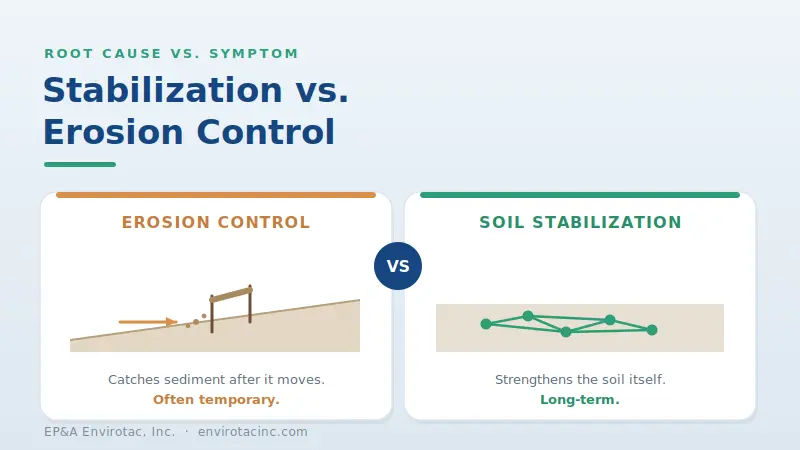
It’s easy to assume that once erosion is under control, the soil problem is solved. But erosion control and soil stabilization are solving two different problems — and confusing the two is one of the most common (and costly) mistakes property owners make heading into winter.
Erosion Control vs. Soil Stabilization
Erosion control catches soil that’s already moving. Silt fences, sediment traps, straw mulch, blankets, and check dams — they’re built to intercept displaced material before it reaches waterways or spreads. They handle the visible problem well enough, but the soil underneath stays exactly as weak as it was before.
Soil stabilization works on the soil itself. Whether through mechanical reinforcement, geosynthetics, vegetation, drainage improvements, or chemical treatment, the goal is to increase the soil’s strength, load-bearing capacity, and resistance to moisture — so it’s less likely to fail in the first place.
| Erosion Control | Soil Stabilization |
| Controls sediment movement | Improves soil strength |
| Reduces visible soil loss | Improves soil performance |
| Often temporary | Typically long-term |
| Protects against runoff impacts | Enhances resistance to environmental stress |
| Addresses symptoms | Addresses root causes |
| Common during construction | Supports both short- and long-term performance |
Think of erosion control as catching soil after it’s already loose. Stabilization keeps it from loosening in the first place — a different job entirely. A silt fence can capture soil after it begins moving — stabilization reduces the odds that the soil moves at all.
Winter is where that difference really shows up. Freeze-thaw cycles damage soil from the inside out, weeks before anything looks wrong on the surface. By the time sediment hits a silt fence, the soil behind it has already been compromised.
Long-Term Cost Savings
The financial case for stabilization comes down to lifecycle cost, not upfront cost. Unstable soil tends to generate recurring expenses — erosion damage, settlement, slope failures, drainage problems, and surface deterioration that all require corrective work after nearly every storm.
Sites with poor soil stability often need repeated regrading, sediment removal, channel repairs, vegetation replacement, and drainage maintenance — work that adds up fast when it has to be redone every season instead of being done once. Stabilized soil, by contrast, holds up against repeated weather events with far less ongoing intervention.
There’s also a scheduling cost that’s easy to overlook: unstable soil during construction can cause real delays, from equipment access problems to subgrade failures to rework caused by excess moisture. Improving soil strength and moisture resistance upfront helps projects stay on schedule instead of losing time to weather-related setbacks.
The bigger picture for winter specifically: if the soil underneath remains unstable, erosion control measures alone often need to be replaced or repaired after every storm season, which means paying for the same fix repeatedly instead of solving the underlying problem once.
Improved Storm Resilience
Storm resilience is about whether a site can take a hit and keep functioning — not just whether it avoids erosion, but whether the soil, drainage, and structures on top of it hold up.
Stabilized soil manages water better across the board: improved infiltration, slower runoff, lower erosion rates, and stronger drainage performance. When water moves through soil the way it’s supposed to, the downstream risks — sediment transport, channel formation, and slope erosion — all drop with it.
Stabilization also directly counters the structural damage freeze-thaw cycles cause. Repeated freezing and thawing reduce soil cohesion and shear strength, making failure more likely — but stabilization measures improve exactly those properties, giving soil more capacity to absorb winter’s stress without breaking down.
The benefits extend well beyond erosion. A stabilized site is generally better protected against slope failures, foundation settlement, road deterioration, drainage failures, and utility exposure — which is why stabilization is increasingly treated as a long-term risk-management strategy, not just a way to keep sediment out of a ditch.
The Core Distinction
Erosion control prevents soil loss. Soil stabilization improves soil performance. They work well together, but they’re not interchangeable — and winter is exactly when that difference shows up, since the most damaging effects of freeze-thaw cycles, poor drainage, and slope instability all begin inside the soil, well before any erosion is visible on the surface.
Common Soil Stabilization Methods for Winter Protection
What works on one site won’t necessarily work on the next — soil type, slope, drainage conditions, and timing all factor in. Most stabilization methods either protect the surface, use vegetation to reinforce the ground, or strengthen the soil structurally, and a combination usually outperforms any one approach alone.
- Plant roots hold soil particles together and help water soak in rather than run off. Seeding gives you long-term coverage, but it needs a head start — put it in too late, and it won’t be established before the ground freezes. Cover crops (winter rye, clover, oats) can step in when permanent vegetation isn’t ready yet. Native species tend to root deeper and need less upkeep once they’re going. And roots don’t quit working just because a plant goes dormant — they keep gripping the soil straight through winter.
- Mulch and erosion control blankets cover exposed ground right away, buying time for vegetation to get established below them. Straw, wood fiber, or compost mulch also buffers temperature swings in the soil, which takes some of the edge off freeze-thaw damage. Blankets serve the same bridging role with more structure, performing well on slopes and channels. Both are temporary — it’s worth being clear that they protect the surface while vegetation develops; they don’t strengthen the soil itself.
- Geotextiles and geocells go further, providing structural reinforcement that holds up year-round rather than just bridging a gap. Geotextiles are permeable fabrics that reinforce soil while letting water pass through; geocells are honeycomb structures that confine soil and distribute load. Both suit steep slopes, embankments, and sites with recurring erosion.
- Hydraulic mulch and hydroseeding apply seed, mulch, and water as a slurry, covering large or difficult terrain quickly and more evenly than traditional methods — useful when there’s limited time before winter, though the vegetation itself still needs normal time to take root.
- Chemical and polymer soil stabilization — lime, cement, fly ash, polymers — works directly on the soil’s particle bonding, improving strength and reducing moisture sensitivity. This addresses freeze-thaw weakening at the source, which makes it well-suited to infrastructure projects and chronically unstable sites, though it requires more upfront cost and engineering evaluation.
- Grading, French drains, culverts, diversion channels — all of it comes back to the same thing: getting water out of the soil before it causes problems. Erosion, frost heave, slope failure — excess water makes every one of them worse, which is why fixing drainage often does more for a site’s long-term stability than any other single investment.
Most sites need a combination — something on the surface to buy time, vegetation for the longer term, and structural or drainage work wherever roots alone aren’t going to be enough.
The Cost of Doing Nothing
Ignoring soil instability rarely saves money — it just defers the cost and adds interest. Erosion repairs alone tend to recur rather than resolve: regrading, replacing topsoil, and rebuilding drainage channels become routine expenses rather than one-time fixes. On road infrastructure projects where erosion wasn’t managed properly, damage-related costs have been reported at 14% to 38% of total project value — a steep price for a problem that’s usually cheaper to prevent than repair.
That instability ripples outward. Sediment ends up in storm drains and culverts, driving up stormwater maintenance costs, while the same erosion and freeze-thaw stress that damages soil also damages what’s built on top of it — roads, foundations, and retaining walls — often requiring expensive reconstruction. Unstable sites also risk construction delays (idle equipment, missed schedules, contract penalties) and environmental compliance violations, since winter storms tend to expose exactly the gaps that trigger fines and corrective orders.
The cost that takes the longest to appear is the one that’s hardest to undo — the ground itself slowly getting worse. Every winter without stabilization strips a little more topsoil and fertility, and the further that goes, the more it costs to bring the site back.
None of these costs are isolated — unstable soil sets off a chain reaction across all of them. Viewed this way, stabilization isn’t just an erosion-prevention measure; it’s a way of avoiding a much larger bill later.
Best Practices for Preparing Soil Before Winter Storm Season
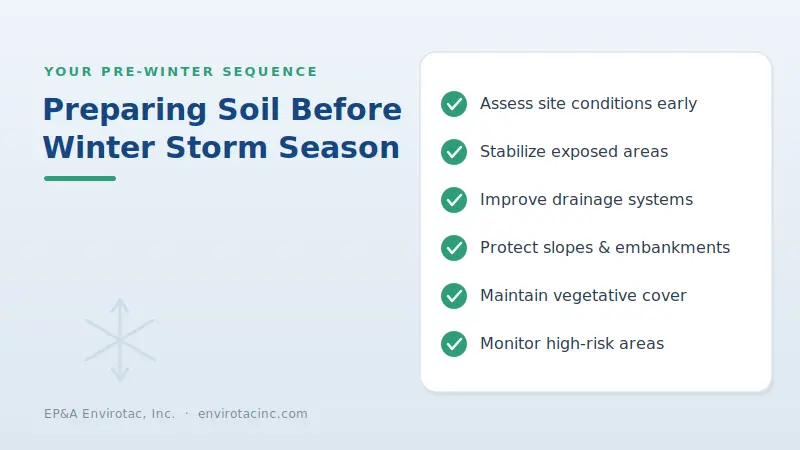
Everything up to this point has been about understanding the problem. This section is about doing something with that understanding. The research is consistent on one point: winter preparation has to start before the first freeze, because once the ground locks up, most stabilization options become far harder — or impossible — to put in place.
Assess Site Conditions Early
The most common mistake is waiting until winter arrives to find out where the soil is vulnerable. A late-fall walkthrough — before the ground freezes — gives enough time to actually act on what’s found.
Look for exposed ground, erosion channels, drainage issues, steep or bare slopes, thin vegetation, and anywhere that gave you trouble last winter. These storms don’t usually create problems from scratch — they find the weak spots that are already there. Catching those in the fall turns winter prep into a checklist instead of a crisis.
Stabilize Exposed Areas
Exposed ground going into winter is about as vulnerable as a site gets — nothing between the soil and whatever rain, runoff, or freezing comes next. Mulch, blankets, temporary seeding, hydraulic mulch, geosynthetics — pick whatever fits the site, but the rule is the same: don’t let bare soil sit through the season. Stabilize sections as soon as they’re finished rather than waiting, since every week soil sits exposed is another chance for winter precipitation or snowmelt to start the erosion process. Anything that’s going to sit inactive through winter should be stabilized before the first major storm.
Improve Drainage Systems
Most winter soil problems trace back to water that didn’t move off the site fast enough. Checking culverts and channels, pulling out sediment and debris, filling low spots that collect water, regrading where slopes aren’t draining, confirming that runoff actually has somewhere to go — all of it matters more than it tends to get credit for.
The goal is straightforward — water should move through and off a site efficiently, not pool or run unchecked across exposed ground. Getting this right ahead of winter reduces soil saturation, runoff, frost heave risk, and the structural stress that comes with all three. Drainage work often doesn’t get the credit it deserves, but it may be one of the most effective stabilization investments available.
Protect Slopes and Embankments
Slopes carry extra risk because gravity amplifies whatever erosion or moisture is already working against the soil. Increased winter moisture lowers soil strength right as runoff is concentrating in the same vulnerable spots — a combination that often leads to failure.
Protective options include erosion control blankets, geotextiles, geocells, vegetative stabilization, diversion channels, and retaining structures where the site calls for it. Left unprotected, slopes are prone to rill erosion, gully formation, washouts, and sediment moving straight into drainage systems — and since winter runoff tends to follow the same paths every time, slopes and embankments deserve priority treatment before the season starts.
Maintain Vegetative Cover
Dollar for dollar, vegetation is still one of the best stabilization tools there is, and it keeps working through winter even after growth slows down. Before the cold hits, that means getting seed down on disturbed areas, putting in cover crops, keeping existing growth intact, maintaining buffer strips, and mulching anywhere that looks exposed.
Even dormant vegetation keeps reinforcing soil through its root systems, slowing runoff and improving infiltration throughout the whole season. Preserved vegetative buffers in particular help filter sediment and slow water before it ever leaves the site — making vegetation maintenance one of the simplest, most affordable moves on this list.
Monitor High-Risk Areas Throughout Winter
Preparation doesn’t end once stabilization measures are installed — conditions change fast during storms, snowmelt, and freeze-thaw cycles, and what looked secure in November can look very different in February.
Keep an eye on steep slopes, drainage channels, culvert inlets and outlets, recently stabilized areas, and anywhere with a history of erosion. Specifically watch for new erosion channels, sediment buildup, standing water, slope movement, damaged stabilization materials, or vegetation loss — and check in after major storms and during thaw periods especially, since that’s when soil movement tends to accelerate. Catching a small problem early is almost always cheaper and easier than fixing a major one later.
The Sequence That Works
Across the research, one pattern holds: sites that follow a clear sequence — assess, stabilize, drain, protect, maintain, monitor — consistently handle winter’s rainfall, snowmelt, and freeze-thaw stress better than sites that react only after damage shows up. Preparation, not repair, is what actually protects a property through winter.
Conclusion
What’s happening to the soil during a winter storm doesn’t come with any visible warning. It just breaks down quietly, and the evidence shows up later. Soil weakens quietly — through saturation, freeze-thaw expansion, and a gradual loss of cohesion — and by the time that weakness becomes visible as erosion or a washout, the underlying damage has usually been building for weeks.
That’s the real shift this article points to: soil stability isn’t a side effect of good landscaping or smart construction — it’s a condition that either holds or doesn’t, and winter is one of the more demanding tests it faces all year. Whether a property holds up well into spring or needs significant repair often comes down to decisions made in October and November, not anything that happens during the storm itself.
The practical implication is straightforward. A site that goes into winter with exposed soil, poor drainage, or a history of erosion is carrying risk that compounds with every freeze-thaw cycle and every storm. A site that’s been assessed, stabilized, and drained ahead of time is simply working with a stronger foundation — one that absorbs winter’s stress instead of accumulating it.
If you’re going to do one thing, do the walkthrough before the ground freezes — check for bare soil, standing water, active erosion, weak vegetation, cracks, and any spot that failed last winter. That usually makes it clear what needs attention and how soon. For a closer look at how different stabilization methods compare and which ones fit which conditions, this guide breaks it down further.
Applications - Dust Control & Soil Stabilization Products

Leave a Reply