
September 17, 2026
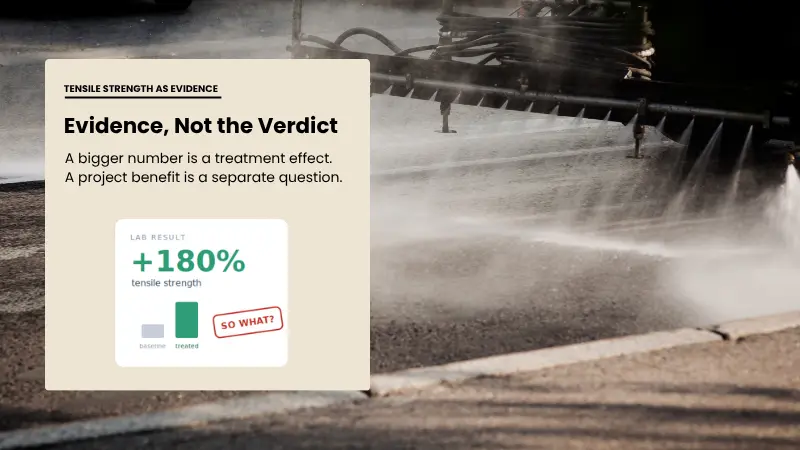
Stronger soil and sufficient soil are not synonyms. The test showed the first. The project needs the second.
A treatment can produce a measurable, reproducible change in the tested material while leaving the important engineering question open: what does that change tell us about the behavior the project needs to control?
That gap between a result and what the result allows you to conclude is what this article addresses: what an improvement in measured tensile strength directly shows, what it may help indicate, what it cannot show alone, how test conditions shape what the result is worth, and where that evidence fits in a stabilization decision.
A Tensile-Strength Gain Is Meaningful Only in Context
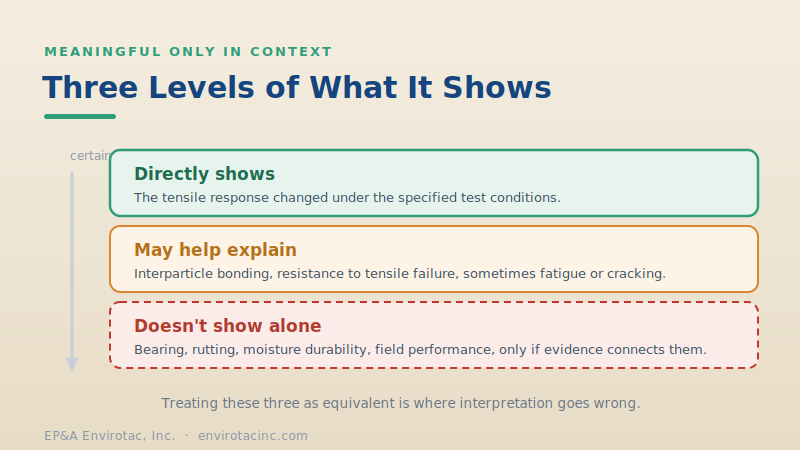
Three levels matter here, and treating them as equivalent is where interpretation goes wrong.
- What the test directly shows: The treated material exhibited a changed tensile response under the specified test conditions. That is what the test directly establishes. Any interpretation beyond that requires additional reasoning or evidence to support it.
- What the result may help explain: Depending on the material and treatment chemistry, a tensile improvement may be consistent with changes in interparticle bonding and may provide evidence of increased resistance to tensile failure. Where the testing supports it, it may also provide context for fatigue or cracking-related behavior, but those inferences depend on what the test was designed to capture and shouldn’t be carried further than the evidence allows.
- What the result does not show alone: A tensile result does not by itself establish bearing adequacy, rutting resistance, durability under moisture variation, field performance under construction loading, or overall pavement behavior. It doesn’t reach those questions unless evidence connects it to them.
The trade-off: magnitude of improvement versus relevance of improvement. A large percentage increase in tensile strength is not automatically a large improvement in stabilization performance. The percentage describes the magnitude of change in the measured property. What the result allows you to conclude specifically, what could not be concluded before the result was in hand, is the question worth asking.
The Test Should Answer a Performance Question
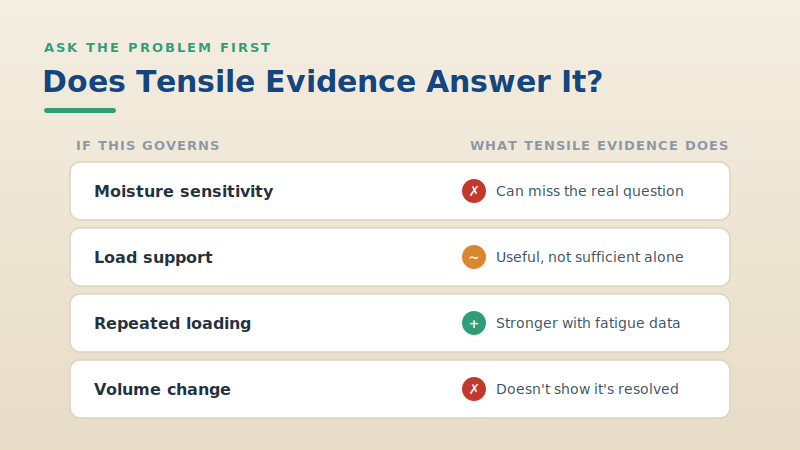
The property we can measure isn’t necessarily the property limiting performance.
Before asking whether tensile strength improved, ask whether tensile behavior is part of what needed to change. What is the material expected to do? What behavior limits that performance? Is tensile behavior part of that problem? If so, what can tensile evidence tell us?
That order, problem first, measurement second, is what makes testing useful rather than merely informative.
- If moisture sensitivity governs performance, a tensile result produced under conditions that don’t illuminate that sensitivity may leave the governing question unanswered regardless of how much the number improved.
- If load support governs, tensile improvement is useful supporting evidence, but it doesn’t demonstrate adequate support by itself. Something else needs to close that gap.
- If repeated loading is the design concern, tensile evidence may become more directly meaningful, ideally when supported by cyclic or fatigue evidence that validates the inference.
- If volume change governs, tensile improvement doesn’t by itself demonstrate that the volume-change problem has been addressed.
An answer to the wrong question, however accurate, doesn’t advance the engineering decision. Whether the problem is an existing failure or a design requirement, the nature of the problem determines what evidence matters.
What a Laboratory Tensile Result Can and Cannot Tell You
A laboratory result can demonstrate a treatment effect without demonstrating field suitability. That’s not a flaw in tensile testing; it’s the nature of controlled experiments. Saying lab conditions differ from field conditions is true but doesn’t get you very far.
The harder question: what would have to remain true outside the laboratory for the measured improvement to retain its interpretive value?
Each of the following conditions matters not because it adds to a list of field variables, but because each one can change what the tensile result is actually telling you.
- Moisture: Does the measured treatment effect persist under the moisture conditions relevant to service? A result produced at one moisture state may not transfer to a field environment where moisture varies seasonally or with drainage.
- Compaction and density: Is the measured response sensitive to the compaction state achievable in the field? Laboratory specimens are prepared at controlled densities; field compaction introduces variability across a project that a single specimen cannot represent.
- Curing: Is the measured response representative of the material’s condition when it will be loaded? Where curing time affects treatment development, a result produced at one curing age may not reflect performance at the age of loading in the field.
- Repeated loading: Does a property measured in a single-application test answer a question about behavior under repeated traffic? That’s a different mechanical question requiring different evidence.
- Material variability: How representative is the tested material of what’s actually being treated? A result from a representative sample is evidence about that sample, not a guarantee across the treated zone.
Consider a polymer treatment that produces a substantial tensile-strength increase in a laboratory specimen. If the project problem is loss of support under saturated conditions, that result demonstrates a change in tensile behavior, but it doesn’t establish whether the treated layer retains adequate support under the project’s wet-condition loading.
The gap isn’t a failure of the test. It’s a signal that points directly to what comes next: the next evidence should address the unresolved performance question under the conditions that govern it.
The useful laboratory test isn’t necessarily the one that tries to reproduce every field condition. It’s the one that captures the behavior that matters for the decision with enough fidelity to act on.
The Right Evidence Removes the Right Uncertainty
More testing is not automatically better testing. Without the discipline of asking what a specific test is meant to resolve, evidence accumulates without getting the decision any closer to what it needs.
Establish the baseline. Identify what behavior limits performance. Determine whether tensile behavior is part of that problem. Measure the treatment effect under conditions that reflect the field application. Be clear about what the result shows and equally clear about what it doesn’t. Then choose the next piece of evidence based on what the most pressing remaining question is, not simply because it is familiar or routinely included.
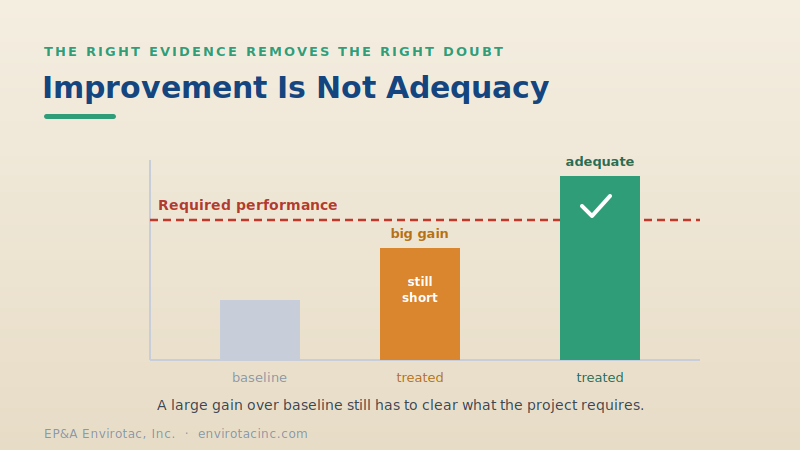
Improvement is not adequacy. A treatment can produce a reproducible tensile-strength increase without showing that the treated material meets the project’s required performance under relevant service conditions. Improvement says something changed. Adequacy requires defined performance criteria and evidence that the treatment satisfies them. Different conclusions, different evidence.
CBR, UCS, and other metrics belong here only where an unanswered question makes them the right next step, not as default companions to a tensile result. They’re answers to questions the tensile result leaves open.
What Does This Mean When Evaluating Polymer Stabilization?
Polymer stabilization shouldn’t be judged solely by whether it produces a stronger laboratory specimen. The demonstrated treatment effect has to address the project’s performance requirement strongly enough to justify the approach.
The difference that makes is visible in how the same result gets read. Without it: “The polymer increased tensile strength substantially; the treatment looks promising.” With it: “The polymer increased tensile strength. That demonstrates a treatment effect. Whether it changes the project decision depends on whether tensile behavior is relevant to the performance problem and whether the treated material meets the project’s required performance under relevant service conditions.” Same number, different conclusion, and the second conclusion is better supported because it makes the performance question explicit.
Does the treatment change the behavior tied to the identified problem? Do the test conditions reflect the field application? Is the improvement sufficient, not just measurable, but adequate for what the project demands? What remains unanswered, and what evidence would address it?
That last question opens a project-level comparison that can get reduced to unit costs when it shouldn’t. If treatment allows in-situ material to remain in place and perform adequately, the comparison may include excavation, disposal, imported aggregate, hauling, equipment, labor, and schedule, not simply treatment cost versus doing nothing.
Independent research establishes what a stabilization mechanism or test result means generally. EP&A Envirotac, Inc.’s testing and field data establish what has been demonstrated for its products and applications. Keeping those claims distinct makes the evidence easier to evaluate.
An increase in tensile strength is a genuine treatment effect. It becomes a project benefit when tensile behavior is relevant to the performance problem. What shouldn’t follow automatically is that the result alone demonstrates project suitability.
The Better Question Isn’t “Did Strength Increase?”
The number moving is not the conclusion. The conclusion is whether the evidence tells you enough to make the next engineering decision.
Define the performance problem first. Determine whether tensile behavior is part of it. Then decide what evidence is needed to show sufficient improvement under the conditions that matter.
Applications - Dust Control & Soil Stabilization Products

Leave a Reply