
November 16, 2026
A road subgrade can meet a specified compaction requirement and still deform under construction traffic. A haul route may perform well in dry conditions but lose support when moisture conditions change. Evaluating these situations requires more than a single soil test. Engineers need to understand the ground’s shear strength, its response to loading, and whether the available test results represent conditions at the site.
Shear-strength parameters help engineers assess slope stability, foundation performance, and the resistance of soil to movement. Their interpretation also informs decisions about prepared construction surfaces, including whether ground improvement deserves further evaluation.
For EP&A Envirotac, Inc., these questions connect geotechnical assessment with road and haul-route stabilization. This article will help you interpret soil shear-strength results, understand what different tests reveal, and use the findings to guide ground-improvement decisions.
A measured strength value is not automatically a design parameter
Soil shear strength describes the resistance of soil to shearing stress. Engineers use strength parameters to assess slopes, foundations, retaining structures, embankments, and other earthworks. Laboratory testing provides essential evidence for selecting and verifying soil shear-strength parameters. Once established, interpret the results in the context of the test conditions, site investigation, and requirements of the intended application.
For a linear Mohr-Coulomb failure envelope under drained conditions, engineers commonly express shear strength using effective-stress parameters:
τf = c′ + σ′n tan φ′
Here, τf is the shear stress at failure, c′ is the effective-stress cohesion intercept, σ′n is the effective normal stress, and φ′ is the effective angle of shearing resistance.
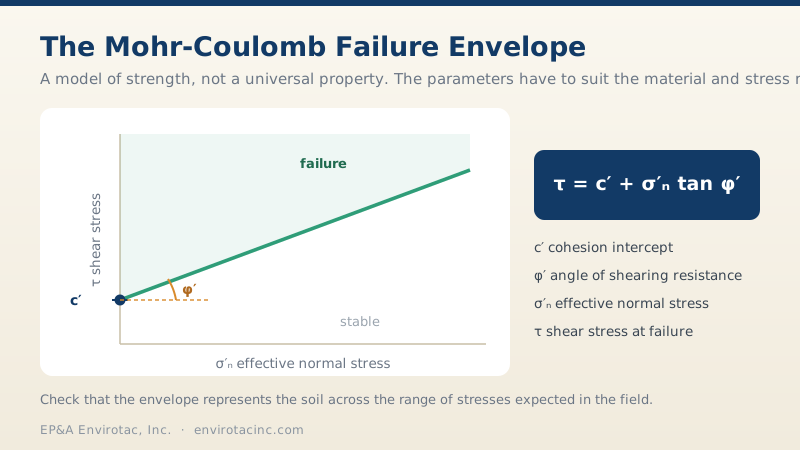
This relationship represents soil behavior through a model. Its parameters must suit the material, stress range, and conditions relevant to the analysis. It is also necessary to determine whether the failure envelope adequately represents the soil across the range of stresses expected in the field.
Soil classification contributes to the assessment. The plasticity index helps characterize fine-grained soils and can inform correlations with engineering behavior. It does not directly measure shear strength. Engineers interpret index properties alongside strength tests, soil structure, stress history, and site conditions.
For road subgrades and prepared construction surfaces, the assessment should establish whether the available evidence represents the anticipated loading. Before adopting a strength parameter, identify the tested material, specimen preparation method, applied stress, drainage conditions, and relevance to the field. If the investigation leaves uncertainty about a layer or condition that could govern performance, additional evidence may be necessary.
Drained or undrained? Start with the loading conditions
The drainage response of soil depends on permeability, drainage distance, and the time available for water to move through the ground. These factors influence changes in pore-water pressure during loading.
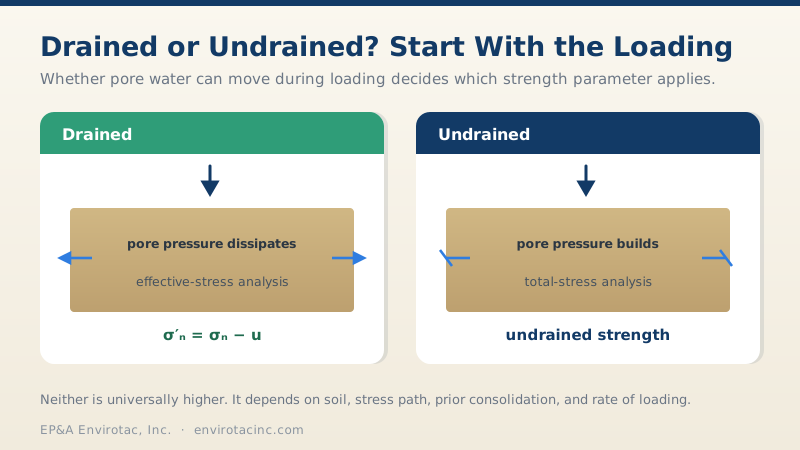
Under drained conditions, excess pore-water pressure can dissipate as loading proceeds. Effective-stress analysis accounts for the stress carried by the soil skeleton. For saturated soil, effective normal stress is commonly expressed as:
σ′n = σn − u
Here, σ′n is the effective normal stress, σn is total normal stress, and u is pore-water pressure. A change in pore pressure changes effective stress and can therefore change the shear resistance calculated using effective-stress parameters.
Under undrained conditions, water cannot drain sufficiently during the loading period. The resulting pore-pressure response influences soil behavior. Engineers commonly use undrained shear strength in total-stress analyses of saturated fine-grained soils when that approach suits the loading scenario.
Neither drained nor undrained strength is universally higher. The appropriate parameter depends on the soil, stress path, prior consolidation, and rate of loading.
Consider an embankment constructed gradually on saturated clay. Drainage may occur as construction progresses, changing the soil’s response over time. Rapid excavation in saturated clay involves unloading, which changes the stress state before drainage and pore-pressure equilibration are complete. Groundwater management also affects the assessment because dewatering can change pore pressure and effective stress.
Similar considerations apply to ground intended to support roads and haul routes. Moisture changes can affect soil response, but their effects depend on the material, loading, drainage conditions, and construction requirements. The geotechnical assessment should represent the conditions expected during the stage being evaluated. Where both short-term and long-term behavior affect stability, each requires an appropriate analysis.
Choose the test for the behavior being assessed
Test selection starts with the engineering question. The required parameter, soil type, loading conditions, and potential failure mechanism determine which tests can provide useful evidence.
Direct shear testing
Direct shear testing measures resistance along a prescribed shear plane under controlled normal loading. The consolidated-drained procedure specified in ASTM D3080/D3080M-23 determines drained shear strength. A fixed plane suits investigations of known interfaces or identifiable weak layers. When the likely failure surface is unknown, the apparatus limits interpretation because the specimen cannot select an unrestricted failure plane. The test also does not establish a complete stress-strain relationship.
Triaxial testing
Triaxial testing allows the engineer to control confining pressure and, depending on the procedure, drainage and consolidation. With appropriate procedures and instrumentation, results can provide information about strength, stress-strain behavior, and pore-water pressure response. Specimen preparation, consolidation conditions, and the imposed stress path must suit the intended assessment.
Compaction testing
Other tests answer different questions about construction-ground performance. Laboratory Proctor testing establishes the relationship between moisture content and dry density, including maximum dry density and optimum moisture content. Compaction testing also includes field methods that assess in-place density and moisture conditions against project requirements. These results help evaluate compaction, but they do not directly establish shear-strength parameters.
Proof rolling
Proof rolling evaluates how prepared ground responds to applied loading. Proof-roll observations can reveal yielding or weak subgrade zones, including areas that density results alone may not identify. Proof rolling does not directly measure shear strength or establish the cause of the observed response.
Polymer-based soil stabilization
For road subgrades and haul routes, polymer-based soil stabilization can improve soil performance and support construction requirements. Laboratory testing and field evaluation help assess the treated soil against project specifications and verify that the selected approach delivers the required performance.
When evaluating a road subgrade or haul route, engineers must interpret each test according to the property it measures. A density result cannot substitute for a shear-strength measurement, and a proof-roll observation cannot establish a complete strength profile on its own. CBR and unconfined compressive strength tests provide additional evidence, each with its own purpose and limitations. None should be treated as a complete account of ground performance.
A suitable test program identifies the required outputs, the soil and conditions to be represented, and the limitations that could affect interpretation. If uncertainty about a weak layer, soil variability, moisture conditions, or stress path could change the design decision, the investigation should address that uncertainty before the analysis relies on an unsupported assumption.
When might peak strength misrepresent the failure mechanism?
Soil resistance can change as shearing continues. Peak strength is the maximum resistance reached during deformation. Some soils retain much of their resistance beyond the peak, while others soften as strain increases. At substantial displacements along an established shear surface, certain clays develop residual strength, which can be substantially lower than peak strength.
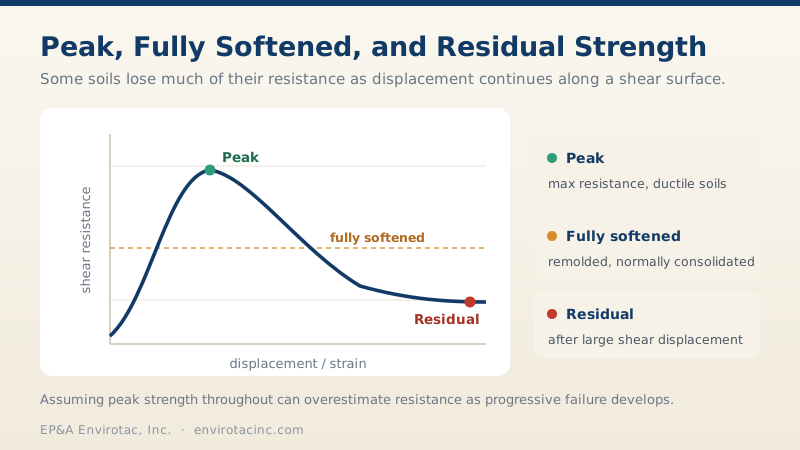
This reduction is crucial to take into account in soils that exhibit brittle stress-strain behavior. Local zones can soften as deformation progresses, allowing failure to spread through the ground. An analysis that assumes peak strength throughout may overestimate the resistance available as progressive failure develops.
Fully softened strength and residual strength describe different conditions. In stiff, fissured clays and shales, fully softened strength is associated with the drained strength of remolded, normally consolidated specimens. Residual strength develops after considerable displacement along a shear surface, where clay particles can become aligned.
The US Army Corps of Engineers’ Slope Stability manual discusses strength selection for these materials. For certain slopes without previous slides, fully softened strength may be appropriate. Where a previous slide has left an established shear surface, residual strength may be required along that surface.
Strength selection depends on the ground’s history and the failure mechanism under assessment. Geological evidence, signs of previous movement, and test results showing how resistance changes with deformation help identify the relevant conditions. Peak strength may be appropriate when the soil exhibits ductile stress-strain behavior, and the assumed strength is compatible with the anticipated deformation and failure mechanism. Where the investigation cannot establish which behavior governs, further testing or specialist geotechnical review may be necessary.
For construction surfaces, determine whether deformation stems from inadequate compaction, moisture-sensitive behavior, or weakness extending deeper into the ground. Surface observations alone may not establish the cause. Stabilization should not be selected solely because the ground deforms under loading; the cause and required performance must first be established.
From ground assessment to stabilization decisions
A defensible ground-improvement decision begins with the site’s conditions and the performance required. Strength parameters should reflect the available evidence, loading conditions, and potential failure mechanism. Compaction, moisture, and other ground characteristics also need evaluation where they affect the intended use.
For road subgrades, haul routes, and suitable prepared construction surfaces, in-place soil stabilization may be an option when the existing soil does not meet project requirements. EP&A Envirotac, Inc. provides road stabilization solutions for relevant construction applications. Suitability depends on soil characteristics, moisture conditions, construction methods, traffic demands, and project specifications.
The decision should follow a clear sequence: establish the ground’s limitations, define the required performance, and evaluate treatments against the project criteria. Geotechnical assessment remains essential wherever stability, bearing capacity, or a potential failure mechanism governs the design.
Applications - Dust Control & Soil Stabilization Products

Leave a Reply