
September 18, 2026
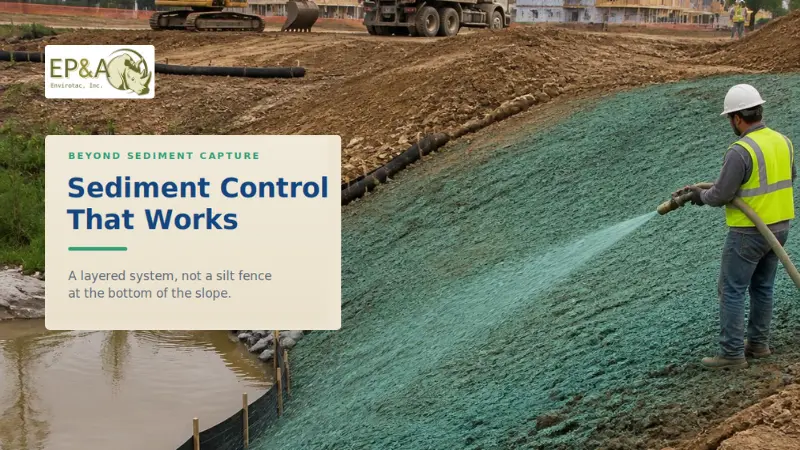
On most construction sites, sediment control is treated as a line item: install the silt fence, add the inlet protection, check the box for the permit. It works well enough to pass inspection, and then a heavy storm arrives and the fence is buried, the inlet is clogged, and sediment is halfway down the street.
The problem usually isn’t the silt fence. It’s the assumption that a silt fence, on its own, is a sediment control strategy. Capturing sediment after it has already moved is the last and least reliable thing a site can do. The sites that stay clean through a wet season tend to think about sediment control very differently: as a system that starts at the source and treats capture as a backstop, not the plan.
Looking Beyond Sediment Capture
Sediment capture is visible, familiar, and easy to specify, which is exactly why it gets treated as the whole job. A silt fence is something you can point to. It satisfies a requirement. It looks like control.
But capture is what happens after sediment is already on the move, and by then most of the options that would have been cheaper and more effective have passed. Keeping soil where it is costs far less than chasing it once water has picked it up. The most effective sediment control work happens before runoff ever reaches a fence, by holding soil in place so there is less to capture in the first place.
Reframing sediment control as a system, rather than a device at the bottom of the slope, changes what gets prioritized. Instead of asking whether the perimeter controls are installed, the better question is how much sediment the site is generating in the first place, and how much of it ever reaches the perimeter at all.
Sediment Control Begins Before Runoff Starts
Every sediment problem starts the same way: soil that was held in place gets disturbed, loses its structure, and becomes available to move the next time it rains. The interval between disturbance and the first storm is where sediment control is either won or lost, and it is the interval most easily overlooked because nothing has gone wrong yet.
Exposed soil is the raw material of every sediment problem downstream. A site that leaves large areas bare and unprotected is generating sediment load with every rainfall, regardless of how robust the perimeter controls are. A site that stabilizes or covers disturbed ground promptly reduces that load at the source, which makes every control downstream more effective simply because it has less to handle.
This is why timing matters as much as specification. Controls installed after runoff has already begun are working against a problem that has a head start. When soil is left exposed and untreated, sediment control quietly shifts from a fixed cost to becoming a cost that compounds with every storm that finds unprotected ground.
Thinking in Layers, Not Individual Controls
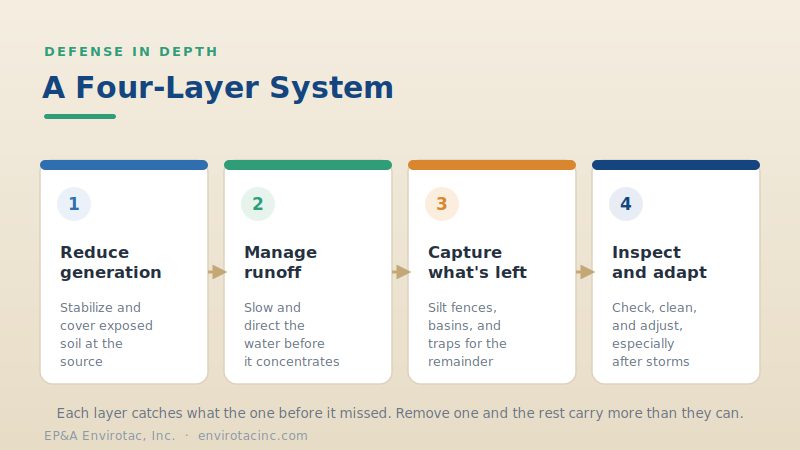
An effective sediment control system works in layers, each one catching what the layer before it couldn’t. No single control is asked to do the whole job, which is what keeps any one of them from being overwhelmed.
Layer 1: Reduce Sediment Generation
The first and most important layer reduces how much sediment the site produces at all. Stabilizing exposed soil, covering disturbed areas, and limiting the extent of open ground at any one time all shrink the load that everything downstream has to manage. This is the layer most often skipped and the one that determines how hard the others have to work. What matters here is what gets applied to disturbed ground and how quickly, because bare soil left waiting is sediment waiting to move.
Layer 2: Manage Runoff Pathways
The second layer manages where water goes and how fast it gets there. Water that is slowed and directed carries less sediment and arrives at the perimeter controls in a form they can actually handle. Concentrated, high-velocity flow does the opposite: it picks up more soil and overwhelms whatever is waiting downstream. Diversions, slope breaks, and stabilized channels are all ways of keeping runoff from turning into a sediment delivery system.
Layer 3: Capture Remaining Sediment
The third layer is the one most people think of first: silt fences, sediment basins, inlet protection, and traps that capture what the earlier layers didn’t. These controls are genuinely useful, but they are a backstop. They work as designed only when the layers above them have already done most of the work. A capture control asked to handle the site’s entire sediment load is a capture control that is about to fail.
Layer 4: Inspect and Adapt
The fourth layer isn’t a control at all. It’s the practice of checking, maintaining, and adjusting the first three as conditions change. Sites are not static: grading advances, exposed areas shift, and controls fill up or wear out. A system that isn’t inspected and adapted is a system slowly drifting out of alignment with the site it was designed for, until the gaps it creates become visible at the worst possible time.
Why the Layers Depend on Each Other
The layers aren’t independent options to choose among. They’re a sequence, and each one assumes the others are doing their part. Skip source reduction and the runoff and capture layers inherit a load they were never sized for. Neglect inspection and the whole system decays quietly until a storm exposes it. The strength of the approach isn’t in any single layer. It’s in the way they cover for each other.
Why Sediment Control Systems Fail
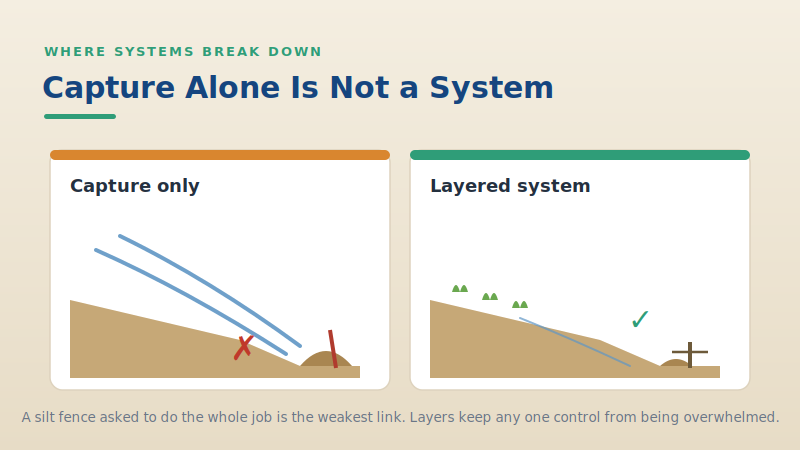
When sediment control fails, the silt fence usually gets the blame. But a buried, breached, or bypassed fence is rarely the cause of the failure. It’s the evidence of a system that asked one control to do the work of four.
The most common failure pattern is over-reliance on capture. When source reduction and runoff management are missing, every storm sends the full sediment load straight at the perimeter controls, and those controls do exactly what overwhelmed controls do: they fill, they clog, and they let sediment through. The fence didn’t fail because it was a bad fence. It failed because it was the only line of defense.
The second pattern is neglect. Controls that were adequate at installation stop being adequate as the site changes and as sediment accumulates, and without regular inspection and maintenance, they degrade until they’re controls in name only. Sediment control holds up when it is treated as an ongoing practice rather than a one-time installation.
Both failures share a root cause: treating sediment control as a set of objects to install rather than a system to operate. The fix isn’t a better fence. It’s treating controls as infrastructure that the site depends on and manages accordingly.
Source Stabilization: Where Polymer-Based Solutions Fit
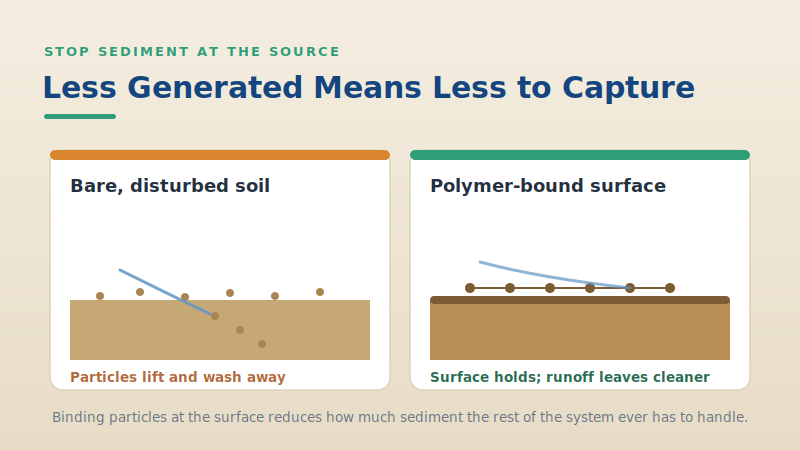
Because the first layer, reducing sediment generation, does the most to determine how well the rest of the system performs, it’s worth looking closely at how source stabilization actually works.
Polymer-based soil stabilization treats the soil surface directly, binding fine particles into a more cohesive layer that resists being picked up by wind or water. Rather than waiting to capture sediment after it moves, this approach works by reducing particle movement at the soil surface, so less sediment is generated for the rest of the system to handle.
This fits the layered model precisely. Source stabilization is Layer 1 in practice: it shrinks the load at its origin, which means the runoff management and capture layers face a smaller, slower, more manageable problem. On sites with large areas of disturbed, fine-grained soil that will sit exposed for weeks or months, that reduction at the source is often the difference between a perimeter that copes and a perimeter that gets buried.
It also pairs naturally with vegetation-based approaches. A stabilized surface holds through the vulnerable early period before cover establishes, then continues to reinforce the ground while roots take over. The point isn’t that polymer stabilization replaces the rest of the system. It’s that it makes the rest of the system’s job smaller.
Turning Strategy into Everyday Practice
A layered sediment control strategy is only as good as its execution on an active, changing site, and the gap between a sound plan and a clean site is usually a matter of practice rather than design.
In practice, that means keeping the extent of exposed soil as small as the schedule allows, stabilizing disturbed areas promptly rather than waiting for a convenient moment, and treating inspection as a routine rather than a reaction to a failure. It means checking controls before forecast storms, not after, and clearing accumulated sediment before it renders a control useless. None of this is complicated. What it requires is treating sediment control as part of how the site runs, not as a permit obligation to be satisfied once and forgotten.
The sites that do this well tend to be the ones where sediment control isn’t anyone’s afterthought. It’s built into sequencing, budgeted as infrastructure, and owned by someone who checks on it. That’s what turns a strategy on paper into a site that stays clean when the weather doesn’t cooperate.
Conclusion
Sediment control works best when it stops being a fence at the bottom of a slope and starts being a system that begins at the source. Reduce how much sediment the site generates, manage where the water goes, capture what remains, and inspect and adapt as the site changes. Each layer makes the others more effective, and the load that reaches the perimeter is smaller because the work started upstream.
Capture will always have a place. It just shouldn’t be the plan. The most reliable way to keep sediment on site is to keep the soil where it started, and that is a decision made early, before the first storm tests everything that was or wasn’t done.
To build source stabilization into a layered sediment control approach, explore EP&A Envirotac, Inc.’s polymer-based erosion control solutions.
Applications - Dust Control & Soil Stabilization Products

Leave a Reply