
May 21, 2026
Summer opens it. Winter closes it. Same wall, same angle, reliable as the weather that drives it.
The instinct is to patch it and move on, but the crack is not the problem — it is the ground’s way of reporting one.
What makes this particular kind of damage simple to misread is that it behaves like a living thing. It opens. It closes. It returns. A crack that moves on a pattern feels like an anomaly when it is actually something considerably more legible — if you know what the ground beneath the structure is doing.
This is not primarily a story about buildings. It is a story about soil.
What Makes Clay Soil Expand and Contract With the Seasons
Sandy soils shift under load and drain freely — moisture passes through them rather than being absorbed into a reactive mineral structure, the way it is in clay. The bedrock and rocky substrates barely move at all. Silty soils hold moisture longer than sand but lack the mineral reactivity that puts clay in a category of its own when it comes to structural damage.
Clay’s behavior originates in its crystalline structure. Minerals like montmorillonite — alongside related smectite-group minerals including illite and bentonite — have molecular layers arranged in a configuration that water molecules enter and force apart. Moisture does not sit on clay the way it sits on sand. It gets between the layers and pushes them apart. The soil mass expands. When moisture leaves, the layers collapse back toward each other, and the soil contracts. This is not a surface phenomenon. It happens throughout the soil body, driven by whatever moisture changes the season brings, and it happens with a force that has nothing to do with the weight of whatever is sitting on top of the soil at the time.
Geotechnical engineers measure this tendency using Atterberg limits, with the plasticity index serving as the primary indicator of how far a soil’s behavior shifts between saturated and dry conditions. A high plasticity index is a reliable forecast of how the soil will perform beneath a structure across seasonal cycles.
Geotechnical assessment also measures shrink-swell capacity through the Coefficient of Linear Extensibility, or COLE. A COLE value above 0.06, meaning 100 inches of soil can expand by roughly 6 inches when fully saturated, is the threshold at which structural damage becomes a real possibility. It is worth noting that soil does not need to be predominantly clay to cross that threshold. If expansive clay minerals make up as little as 5 percent of a soil’s composition by weight, the shrink-swell capacity may already be sufficient to cause meaningful movement in whatever sits above it.
Across the United States alone, shrink-swell soils are estimated to cause around $15 billion in structural damage annually — more than most natural disasters combined and almost entirely preventable with the right ground preparation. That classification is not academic. It is a description of what is going to happen to any structure built on that soil over a long enough timeline in a climate with enough seasonal contrast.
How Deep the Seasonal Movement Goes and Why Surface Fixes Rarely Reach It
The depth range within which seasonal moisture fluctuation actually occurs is called the active zone. Below it, soil moisture stays relatively stable year-round regardless of what is happening at the surface. Within it, the clay responds to every drought and every wet season, expanding and contracting through a range determined by the mineral composition of the soil and the severity of the climate’s seasonal swing.
This matters more than most people realize when they are trying to manage foundation movement through surface interventions. The forces driving the damage are not operating at the surface. They are operating at depth, in a zone that surface water rarely penetrates consistently and that physical barriers rarely contain completely.
What a Dry Summer Does to the Ground Beneath a Structure
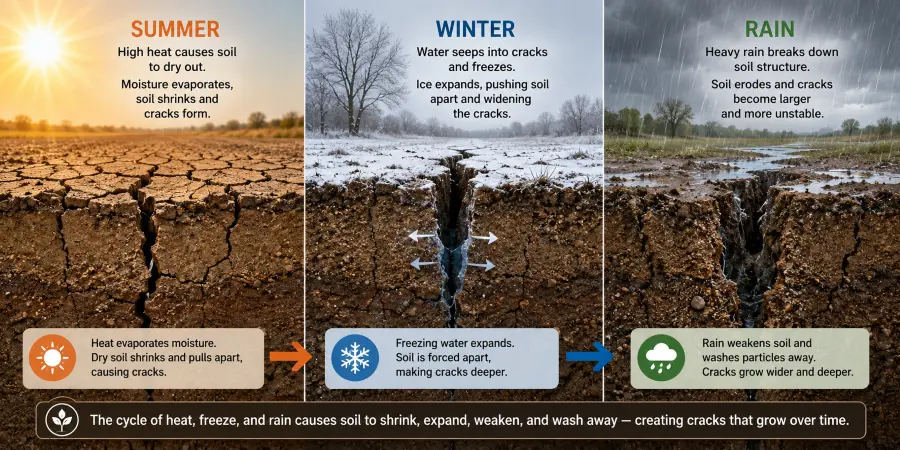
Heat and low rainfall pull moisture out of the upper soil layers through evaporation. Vegetation accelerates this considerably — trees draw moisture from the ground through their root systems at rates that surface evaporation alone does not approach, desiccating the soil around and beneath foundations to depths that no soaker hose is realistically going to address.
As moisture leaves, clay minerals lose the water wedged between their layers. The soil mass shrinks. Critically, this shrinkage is not uniform across a site. The soil at a structure’s perimeter, open to sun and moving air on multiple sides, loses moisture faster than the soil sitting beneath the structure itself, where shade and thermal mass slow the drying considerably.
What the Foundation Does When the Ground Pulls Away From It
When the soil beneath a foundation’s perimeter shrinks and recedes, the edges of the slab or grade beam lose their bearing support while the center remains stable. A concrete foundation is rigid, and a rigid structure that has lost bearing support at its edges while carrying the full weight of everything above it has limited options. The perimeter settles. The structure above racks slightly out of square.
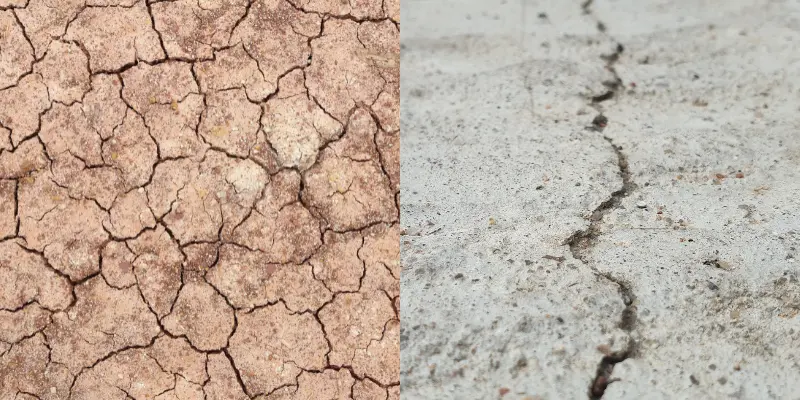
Diagonal cracks appear at the corners of window and door openings because those are the points where a wall’s load path is already interrupted — openings concentrate stress in ways that solid wall sections do not, and a foundation that is moving unevenly finds those concentrations first. Stair-step cracks follow mortar joints in brick and blockwork because mortar has less tensile strength than the masonry units it joins. If the yard around the structure shows wide surface cracks during a dry summer, this indicates the same process occurring above ground — the soil revealing what it is simultaneously doing beneath the foundation.
What Winter Brings Back — And Why It Is Not Good News
When rain returns, dried clay soil absorbs moisture rapidly. The surface cracks that formed during summer become entry channels, allowing water to reach depth faster than it would through intact soil. Clay minerals that had contracted rehydrate and expand. The soil that had pulled away from the foundation perimeter during the summer now pushes back.
The crack that opened in August partially closes in December. This is the moment people often feel a degree of relief, and it is the one worth examining most carefully.
A crack that closes seasonally is not healing. It means the foundation has been bent back in the opposite direction from the one that opened it in the first place. Concrete and masonry resist compression reliably. They handle repeated alternating bending stress across seasonal cycles considerably less well. Concrete and masonry are not designed to absorb force from alternating directions across repeated seasonal cycles, and the cumulative toll of that stress is not visible until it is. A crack that has been opening and closing for several years does not announce the moment it stops recovering — it simply stays open one winter, and the material that could no longer accommodate the cycle is the only explanation needed.
The closing crack is the cycle confirming it is running. That is all it is.
Where the Water Goes Matters
Where moisture re-enters the soil determines what the foundation does with it. Perimeter rehydration — through rainfall, poor grading, or water pooling against the structure — lifts the foundation’s outer edges while the interior holds its position. Moisture migrating beneath the center of a slab through subsurface movement or a plumbing leak produces the opposite condition, doming the center upward while the perimeter stays lower. The crack geometries these two conditions produce are distinct, the door and window misalignment patterns differ, and treating one as if it were the other leads to interventions that address the wrong part of the structure.
What Foundation Crack Patterns Reveal About Soil Movement
Crack geometry carries information. The pattern a crack follows is the structure’s way of describing the direction and nature of the soil movement that produced it, and reading that geometry correctly is the difference between addressing what is actually happening and patching its most visible consequence.
Diagonal cracks at the corners of openings point to differential movement — one section of the foundation shifting relative to an adjacent one, with the stress finding the wall’s weakest point. The direction a diagonal crack runs, and whether it is wider at the top or the bottom, gives a reasonably reliable indication of whether the dominant movement is settlement or heave.
Stair-step cracks in brick or block construction tell the same story through a different medium. Mortar fails before masonry does, so the crack follows the joint lines. The wider end of the stair-step pattern indicates the direction of greater displacement. These tend to appear early in the damage sequence and worsen progressively if the soil movement driving them continues.
Horizontal cracks in below-grade walls are the category that warrants the most immediate attention. They indicate lateral pressure — soil pushing against the wall from outside rather than moving beneath it. A wall developing a horizontal crack is under active lateral pressure from the soil bearing against it from outside, and that pressure does not ease while its source remains. Professional structural assessment is the appropriate response here — not because the situation is necessarily catastrophic, but because the forces involved are not ones that surface repair addresses in any meaningful way.
Hairline cracks — fine surface fractures typically under 1/8 inch wide — often result from concrete curing rather than active soil movement, though they should not be dismissed without monitoring. Any change in width, length, or frequency of occurrence over time warrants closer attention, since hairline cracks in a building on reactive soil can be early indicators of movement that has not yet expressed itself more visibly.
Vertical cracks are generally the least immediately alarming of the group, though on a site with known reactive soil conditions, any crack pattern that widens or lengthens over time deserves the same scrutiny as the more severe types. They often reflect normal concrete shrinkage during curing or minor uniform settlement and are worth monitoring rather than treating as evidence of active soil-driven movement.
Why Moisture Management Alone Cannot Stop Reactive Soil From Moving
Moisture management — keeping soil conditions as consistent as possible through drainage improvement, controlled irrigation during dry periods, and surface grading — has a measurable effect on the amplitude of the shrink-swell cycle. Moderating the seasonal moisture swing does reduce the amplitude of the shrink-swell cycle to some degree, and drainage improvement is genuinely worth doing on any site with reactive soil. The problem is not with the logic. It is with what the logic runs up against in practice.
Reactive clay soils are not permeable materials. Water applied at the surface during a dry summer tends to spread laterally or evaporate well before it reaches the depth at which the active zone is actually shrinking. Tree roots and high evapotranspiration rates during summer pull moisture out faster than surface irrigation replaces it. Meanwhile, physical moisture barriers — vertical membranes buried around a structure — provide some protection against lateral water movement but are vulnerable to root intrusion and to the straightforward fact that water finds its way around physical obstacles given enough time and hydraulic pressure.
These approaches moderate the problem. None of these methods alter the soil’s ability to absorb, swell, release, and shrink, no matter what is above it or the season.
Repairing Damage Versus Stopping the Cause — Why the Distinction Matters
Every intervention that operates at the level of the structure — crack repair, underpinning, drainage correction — is a response to what soil movement has already done. Underpinning transfers structural load to a depth below the active zone, which stops the structure from moving with the soil but does not stop the soil from moving. For a structure that has already experienced significant displacement, underpinning may be necessary. As a long-term solution to a reactive soil condition, it is a bypass rather than a fix.
Changing the soil’s behavior means treating the soil.
How Polymer Stabilization Transforms Reactive Soil Into a Reliable Foundation Base
Recognized chemical stabilization methods for expansive soils include lime, Portland cement, fly ash, and polymer-based additives. Lime, cement, and fly ash primarily improve soil behavior through pozzolanic reactions that increase strength and stiffness, whereas polymer-based treatments modify interparticle interactions and soil structure, influencing cohesion and hydraulic properties such as permeability and moisture response. The mechanical behavior of polymer-treated soils is governed by the specific polymer chemistry and formulation.
When an acrylic co-polymer solution is introduced into reactive soil, it operates at the particle level. The polymer binds soil particles together and fills the micro-voids and interparticle gaps that would otherwise allow water to move freely through the soil matrix. The practical result is a material that is physically less permeable to moisture movement and structurally more cohesive.
A soil whose particles are bound into a more unified matrix cannot absorb and release water as freely as untreated soil. Its capacity to expand when wet and contract when dry is reduced — not because the moisture changes stop happening, but because the soil’s physical ability to respond to those changes has been altered. Seasonal rainfall and drought continue. The soil’s volume response to them does not continue at the same rate.
This process is a different mechanism from moisture management. Moisture management works against the soil’s reactivity by controlling the environment around it. Polymer stabilization of the soil changes the soil itself, reducing its reactivity regardless of the surrounding moisture environment.
Polymer soil stabilization also performs under freeze-thaw cycling, which matters for infrastructure in colder climates where the primary winter damage mechanism is frost heave rather than clay rehydration. The reduction in soil permeability that limits moisture-driven volume change in clay also limits the water infiltration that feeds frost expansion when temperatures drop below freezing.
Why Pre-Construction Stabilization Delivers Better Outcomes Than Post-Damage Intervention
Before construction is the clearest answer. When the active zone is accessible before a foundation is poured or a sub-base is laid, treatment can be applied uniformly across the full area at risk. The structure begins its operational life on ground whose reactivity has already been addressed. The seasonal cycle starts immediately after construction is complete, and stabilized soil enters that cycle from a fundamentally different position than an untreated one.
For existing structures already showing seasonal movement, stabilization stops the damage cycle from continuing to accumulate. It does not reverse displacement that has already occurred or repair cracking that is already there. In those situations, it works alongside structural assessment and repair — addressing the cause while the structural work addresses what the cause has already produced.
What to Do When Seasonal Movement Is Already Visible in a Structure
Diagonal cracks at openings, stair-step patterns working their way up masonry walls, doors, and windows that stick in summer and free themselves in winter, floors that feel subtly wrong in ways that shift with the season — none of these resolve without addressing what the soil is doing. The cycle that produced them will run again next year on the same schedule it ran this year.
It is also worth knowing that standard insurance policies typically do not cover foundation damage attributed to soil movement or settling, which means the full cost of structural repair falls on the building owner and makes pre-construction stabilization a considerably more defensible investment than it might initially appear against the alternative.
Before any intervention is selected, the ground itself needs to be understood — whether movement at the site is still active, how much cumulative displacement has built up, and what the soil composition and moisture conditions actually are. Those answers shape everything that follows, including whether soil stabilization, structural repair, or a combination of both is appropriate and in what sequence.
EP&A Envirotac, Inc. has spent over two decades developing acrylic co-polymer solutions applied across construction, infrastructure, road, and industrial projects on reactive and unstable soils worldwide. If seasonal soil movement is a factor on your site — whether you are planning new construction or managing a structure already showing the signs — contact the EP&A Envirotac, Inc. team to discuss what ground stabilization looks like for your specific conditions.
Frequently Asked Questions
The crack in our building’s wall disappears every winter. Why does it keep coming back each summer?
Because the ground beneath the structure is running the same moisture cycle every year, in summer, clay soil loses moisture, shrinks, and pulls away from the foundation perimeter — causing it to settle slightly and open cracks in the structure above. In winter, the soil rehydrates, expands, and pushes those edges back up, closing the cracks. The cycle repeats because the soil’s reactivity has not changed. Patching the crack addresses the symptom of one cycle. It does not affect the next one.
Should we be more worried about cracks that stay open or cracks that open and close?
Counterintuitively, a crack that opens and closes seasonally can indicate a more active and ongoing problem than one that has stabilized in an open position. Seasonal opening and closing means the foundation is being flexed repeatedly in alternating directions — a form of stress that concrete and masonry handle poorly over time. Material fatigue accumulates with each cycle. The crack that behaves itself for several years and then stops closing is the end result of a process that was running the whole time.
How do we know whether our site has soil with high shrink-swell potential?
A geotechnical assessment is the reliable answer. Soil scientists and geotechnical engineers can analyze samples to determine plasticity index and shrink-swell capacity using established laboratory methods. Visual field indicators can also suggest high shrink-swell potential — polygon-shaped surface cracking in dry conditions and a soil surface that becomes notably sticky and plastic when wet are both characteristic of expansive clay. The USDA Natural Resources Conservation Service maintains soil survey data that covers much of the United States and can provide a useful starting point for site-specific research.
We have improved drainage around our building. Is that enough?
Drainage improvement moderates the seasonal moisture swing and is a worthwhile measure on any site with reactive soil. Whether it is sufficient depends on the severity of the soil’s shrink-swell capacity and the magnitude of the seasonal moisture variation at the site. In climates with pronounced wet and dry seasons and soils with high plasticity indices, drainage management alone generally does not eliminate meaningful foundation movement — it reduces the amplitude of the cycle rather than changing the soil’s capacity to run it.
What is the practical difference between stabilizing the soil before construction versus after a structure is already showing damage?
Pre-construction stabilization addresses the soil’s reactivity before any structure is placed on it, providing the most complete and uniform protection. Post-construction stabilization stops the movement cycle from continuing to add damage to what already exists but does not undo displacement or cracking that has already occurred. For existing structures with active movement, stabilization and structural repair are complementary — one addresses the ongoing cause, the other addresses the accumulated effect. For new construction on reactive ground, pre-treatment is the more cost-effective path by a considerable margin.
Applications - Dust Control & Soil Stabilization Products

Leave a Reply