
October 20, 2026
Ground stabilization changes the ground by modifying the soil itself or by introducing reinforcement that changes how the soil-aggregate system responds to load. Geogrid and polymer-based stabilization are distinct interventions, with different material dependencies and different construction requirements.
What either intervention produces in the ground isn’t determined by the product specification alone. A treatment can change soil properties without addressing the condition governing the project. Reinforcement can develop its intended mechanical interaction while a material or site condition remains controlling. The relationship between intervention and outcome runs through the material, the configuration or treatment conditions, and what construction actually realizes.
The engineering question isn’t only whether the intervention performs as intended. It’s whether the behavior it creates in the ground addresses the problem governing the project.
Geogrid Works Through Interaction With the Surrounding Material
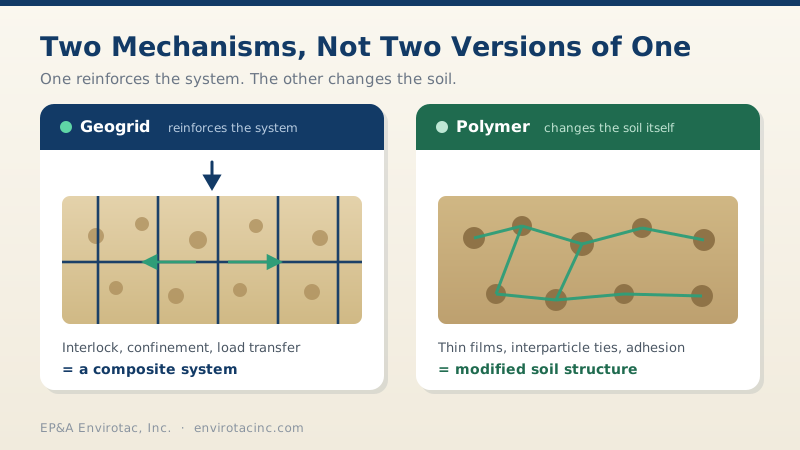
Geogrid doesn’t work simply by taking the load. Its engineering effect develops through the interaction between the reinforcement and the material surrounding it, and the presence of reinforcement and the mobilization of reinforcement are not the same thing.
When geogrid is embedded in soil or aggregate, its apertures allow surrounding particles to interlock with the reinforcement, creating mechanical engagement between grid and material. Transverse ribs generate passive resistance as material attempts to displace relative to the reinforcement. Junctions transfer that load into the geogrid’s primary tensile members. In tested GRS and aggregate configurations, what results isn’t a stronger grid carrying load on behalf of weaker soil; it’s a composite system with different mechanical behavior than either component produces independently.
Tensile capacity is part of that mechanism, but it does not replace the interaction needed to mobilize reinforcement. A geogrid that cannot mobilize adequate interaction with the surrounding material cannot develop the reinforcement effect that tensile capacity alone might suggest. Lateral restraint, confinement, and load transfer aren’t discrete mechanisms; they’re the composite system working.
That composite behavior is central to the performance those configurations are designed to achieve. Reinforcement acts on the surrounding material, the surrounding material conditions the reinforcement, and the system that develops is what gets built.
Polymer-based stabilization works differently. Rather than introducing a reinforcing element the surrounding material must engage with, it changes the soil itself, altering structure and interparticle interaction through mechanisms the polymer and soil determine together.
Strength Is Not Interchangeable With Reinforcement Configuration
Product-centric evaluation can produce the wrong question here.
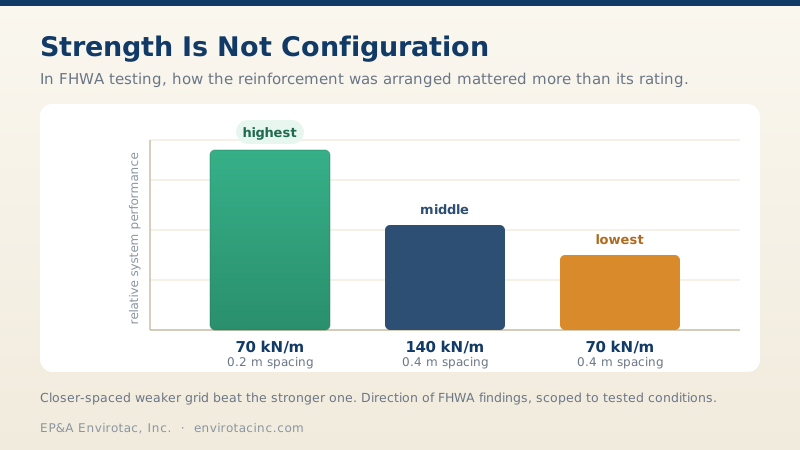
The FHWA data is instructive. The same 70 kN/m reinforcement tested at 0.2 m and 0.4 m spacing produced approximately twice the ultimate applied pressure and materially higher stiffness at closer spacing: same product, different configuration, but substantially different system behavior. The same testing found that 70 kN/m reinforcement at 0.2 m spacing produced a higher ultimate applied pressure than 140 kN/m reinforcement at 0.4 m spacing. Those findings are scoped to tested conditions. They aren’t a universal design rule, but they establish this directly: a higher tensile-strength value doesn’t constitute equivalent system performance when reinforcement configuration changes.
When a proposed solution gets evaluated primarily on product strength, the configuration question often goes unasked. Spacing, number of layers, depth of placement, relationship to load geometry, and material thickness aren’t secondary details. They’re part of the reinforcement argument, and in some applications they can materially affect performance.
A stronger geogrid isn’t a substitute for an appropriate reinforcement configuration. The question is what configuration produces the required system behavior, and what evidence supports it.
A headline product property, like tensile strength for geogrid or dosage for polymer, carries meaning only in relation to the material and conditions through which its mechanism operates in the ground. The material is part of the mechanism.
The Material Is Part of the Mechanism
Grid and surrounding material govern geogrid interaction; what either contributes depends on what the other brings.
Aperture geometry is one part. The relationship between aperture size, rib geometry, and particle size distribution influences how effectively interlocking develops, and no single aperture-to-particle-size ratio establishes compatibility across all materials and applications. The engineering significance of any aperture geometry comes from its interaction with the specific material being reinforced. The aperture dimension alone is an incomplete basis for that judgment.
Change the aggregate characteristics, and the grid-material interaction changes with them. Confinement, loading, placement depth, and the stiffness of the surrounding material further shape how that interaction develops and what mechanical behavior results. In tested aggregate configurations, localized stiffened zones developed above the geogrid, their extent shaped by confinement, aperture size, and aggregate characteristics, consistent with the system behaving as a composite rather than as independent layers.
Polymer demands the same from the material it treats. Polymer changes soil structure and interparticle interaction through mechanisms including thin films, interparticle ties, and adhesion, but which mechanisms develop and how effectively depends on the polymer and the soil. Soil characteristics, moisture conditions, polymer concentration, and treatment conditions all govern whether the intended interaction occurs. Evaluating a polymer treatment independently of the soil it must work in leaves the most important part of the engineering question unanswered.
The question for both isn’t which product fits this material. It’s what interaction needs to occur in this material for the required behavior to develop, and what supports it.
Specified Performance Is Not Necessarily Realized Performance
A stabilization solution designed on paper and a physical condition realized in the field aren’t automatically the same thing. Construction is part of the mechanism, not the stage after design.
For geogrid, installation can subject reinforcement to stresses and damage mechanisms that aren’t represented in nominal laboratory strength testing: tracked plant traversing exposed reinforcement, aggregate placement and spreading, and compaction operations. Tensile-strength reductions occur under realistic installation conditions, with the extent varying by product type, aggregate characteristics, equipment, and field conditions, which is precisely why individual study figures shouldn’t travel as universal reduction factors.
For polymer-based stabilization, the intended treatment must be realized under the conditions its mechanism requires: application and distribution, treatment depth, soil condition at the time of treatment, moisture, mixing or incorporation where needed, and curing where applicable. These are the conditions the mechanism depends on, not variables that make treatment inherently uncertain, but conditions that need to be specified, controlled, and verified.
The design assumes the treatment or reinforcement performs as specified. When the as-constructed condition differs from the design assumption, the performance assumption changes with it, and that gap needs to be closed in the engineering, not discovered after the fact.
This doesn’t mean construction variables always undermine the design. It means the distance between specified and realized is an engineering variable, not an execution footnote.
The Governing Problem Comes Before the Intervention
The preceding sections establish how each mechanism works, what material conditions it requires, and what construction must realize. The question they don’t answer is whether the mechanism addresses the behavior the project actually needs to change.
Start there. What is the performance requirement, and what condition governs it? A road showing rutting under load presents a symptom; the distress itself doesn’t establish what’s governing it. Subgrade bearing capacity, drainage-related weakening of the subgrade, deformation in the aggregate layer, or a combination may each be contributing. Reinforcement changes the mechanical response of the soil-aggregate system. Polymer modifies the treated soil’s structure and interparticle behavior. Neither changes what isn’t within its mechanism to change.
If the governing condition is one the proposed intervention can address, the next question is whether the material and construction conditions support the mechanism. An intervention technically suited to the problem still depends on the material allowing the mechanism to develop and construction realizing the assumed condition. That is the chain the preceding sections describe.
Where other conditions like drainage, cover depth, geometry, or loading remain controlling alongside or instead of what the intervention addresses, that requirement doesn’t disappear because stabilization was added. The engineering judgment has to account for what the intervention changes and what it doesn’t.
Where distinct project requirements call for both mechanisms, geogrid and polymer stabilization can be evaluated together, not because combined use is inherently superior, but because the project may present requirements that different mechanisms address more directly.
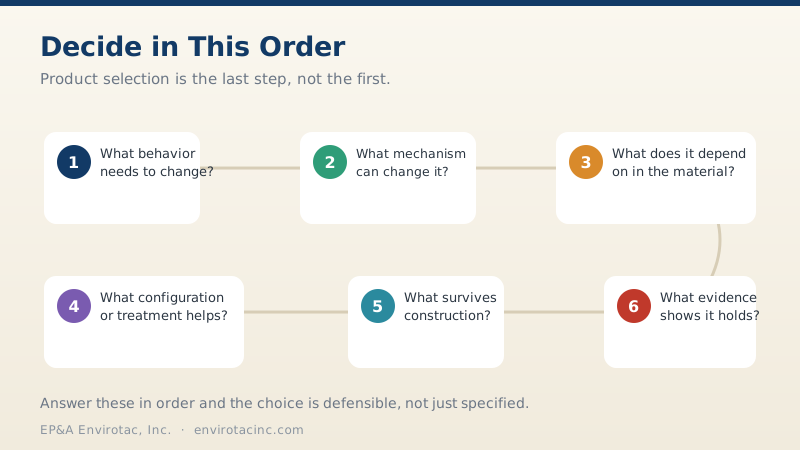
Product selection is the implementation of the engineering decision, not the starting point for it.
Conclusion
Neither geogrid nor polymer resides in the product alone. Performance develops through what the intervention does in the actual material, under actual conditions, and through actual construction, and whether that serves the behavior governing the project.
What behavior needs to change? What mechanism can change it? What does that mechanism depend on in the material? What configuration or treatment conditions support it? What survives construction? What evidence demonstrates that the proposed system can produce and retain the required behavior?
Those questions don’t simplify the decision. They make it defensible and more likely to hold in the ground, not just on the specification sheet.
EP&A Envirotac, Inc. applies that evaluation to soil stabilization projects. Talk to us about what’s governing yours.
Applications - Dust Control & Soil Stabilization Products

Leave a Reply