
June 26, 2026
Stability usually goes unnoticed. Dust does not.
In communities near gravel roads, construction corridors, and industrial haul routes, the signs tend to build slowly over time. Storefront windows stay dusty no matter how often they are cleaned. Fresh grading stops lasting very long. Loose gravel drifts back toward the shoulder after another dry week of truck traffic. The wheel path starts breaking apart again.
Most of the time, dust is only what’s visible. Below it, surfaces are losing cohesion, crews keep coming back to the same stretches, and the people living nearby absorb the disruption.
Dust control helps reduce airborne particulate matter while keeping roads cleaner, safer, and more stable over longer operating periods.
Why Dust Control Matters for Communities
Dust from gravel roads, industrial traffic routes, construction corridors, and haul roads usually affects nearby communities long before full reconstruction work becomes necessary.
In smaller towns, people often notice the same patterns repeating during dry weather. Dust settles back onto storefront windows by late afternoon. Outdoor seating areas need constant cleaning. Drivers slow down because certain stretches become rough enough to shake vehicles around even at moderate speeds.
Some roads hold together reasonably well despite regular traffic. Others begin loosening quickly once heavy trucks start moving consistently through the area.
A freshly graded road can look fine for several days. That doesn’t mean it is. Fines keep migrating, the surface keeps shifting, and the next round of truck traffic finishes what the last one started.
Road dust forms once repeated movement breaks apart dry surface material and removes the particles that help bind aggregate together. As more fines disappear, loose gravel starts moving more aggressively across the roadway.
Truck traffic usually speeds the process up. Roads built with weaker local aggregate often deteriorate faster during extended dry periods, especially where drainage already causes material movement along the surface edges.
Visible dust often appears alongside broader roadway instability. Washboarding, rutting, potholes, loose aggregate, and recurring material loss generally signal that the road surface is no longer compacting evenly under traffic.
Some public works crews spend dry seasons reshaping the same corridors over and over, each time buying a few weeks before the same stretch starts loosening again. The road smooths out for a short period, then begins loosening again after heavier traffic returns.
Nearby communities eventually deal with recurring maintenance activity, rougher driving conditions, and periodic lane disruptions along the same routes.
Road stabilization affects more than dust levels alone. Roads that remain compact longer usually require less reshaping and fewer repeated material deliveries over time.
The Health and Air Quality Benefits of Dust Control

Dust rarely stays confined to the road where it starts. People living near mining routes, industrial corridors, and unpaved traffic networks breathe what the road gives off. During dry periods with steady truck traffic, that’s often quite a lot.
Roadway dust is usually discussed in terms of PM10 and PM2.5 particles.
PM10 particles irritate the respiratory system. PM2.5 particles are smaller, fine enough to reach deeper into the lungs and pass into the bloodstream.
The particles form once the dry surface material fractures under traffic pressure or becomes airborne through equipment movement and wind exposure. Wind takes dust well past the road. By the end of a dry afternoon, it has settled across sidewalks, parked cars, storefronts, patios, and anywhere that sits downwind of steady traffic.
Businesses near heavily traveled gravel roads often end up cleaning the same surfaces repeatedly once traffic increases during dry conditions.
Short-term exposure irritates the eyes, throat, and airways. Over longer periods, repeated particulate exposure has been linked to worsening asthma, reduced lung function, and increased cardiovascular strain.
Children, outdoor workers, older adults, and people with respiratory conditions generally face greater sensitivity to airborne particulate exposure.
Certain industrial and mining environments create additional concerns. Roads built with aggregate containing crystalline silica or other respirable mineral particulates can release finer hazardous dust once repeated traffic keeps disturbing the surface.
Under those conditions, dust control becomes tied closely to worker safety and operating conditions across the site.
Many transportation agencies now place more attention on stabilization because roads holding together longer generally create fewer recurring maintenance problems.
How Dust Control Improves Road Safety and Transportation Reliability
Road safety issues often start showing up before major structural failure becomes obvious.
Drivers usually notice visibility problems first. Dust builds rapidly behind moving traffic once loose gravel starts spreading across the road surface. On narrower gravel roads, visibility sometimes collapses within seconds behind heavier vehicles.
Surface instability creates additional problems at the same time. Loose gravel doesn’t just feel uncomfortable under the tire. It changes how a vehicle handles. Braking distances stretch. Cornering gets unpredictable, especially on curves and grades where industrial traffic runs heavy.
Fresh grading may improve ride quality temporarily. Some gravel roads look stable for several days after grading, then begin loosening again once heavier truck traffic returns.
Roads may appear smoother immediately after maintenance while still lacking the material balance needed to stay compact through continued traffic cycles.
The effects extend beyond driving comfort. Freight movement slows down. School transportation routes become less reliable during dry periods. Emergency-response vehicles may also encounter rougher access conditions once road surfaces begin deteriorating more aggressively.
Industrial hauling operations face additional pressure when haul roads deteriorate rapidly. Excessive dust reduces visibility for equipment operators and increases wear across vehicle fleets.
Roads that hold together longer under traffic usually remain easier to manage across longer operating periods.
Dust Suppression Methods Used on Roads and Industrial Corridors
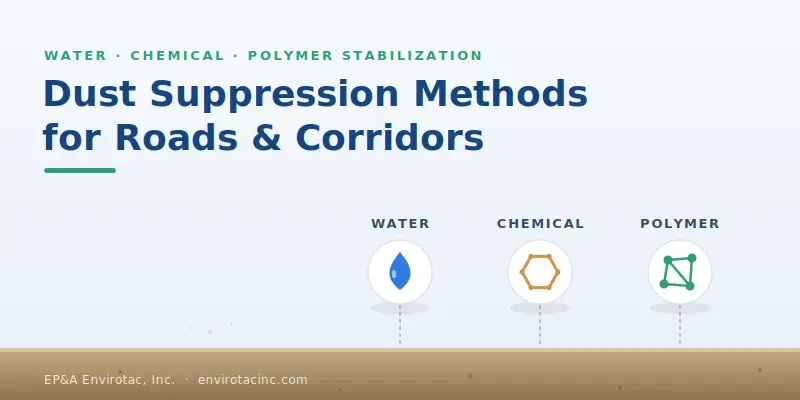
Different roads usually require different dust-control approaches. A treatment that performs reasonably well on a lightly traveled rural road may break down quickly once heavy truck traffic starts moving through the same surface every day.
Some operators rely on watering programs during dry periods. Others move toward stabilization-focused treatments designed to hold fines in place longer under traffic. In mining and industrial settings, the decision often depends on hauling intensity, material behavior, maintenance access, and how quickly the road surface begins loosening again after grading.
Water trucks remain common because they provide immediate short-term suppression. The limitation is that moisture disappears quickly during hot or windy conditions. Roads carrying steady truck traffic may need repeated watering throughout the day once the surface starts drying out again.
Some corridors hold moisture reasonably well for several hours. Others dry out quickly enough that dust returns not long after the truck passes through.
Chemical suppressants work differently. Instead of relying only on temporary surface moisture, many treatments attempt to either bind fine particles together or reduce how easily the surface material becomes airborne under traffic.
Common dust suppressants include:
- Calcium chloride
- Magnesium chloride
- Lignosulfonates
- Synthetic polymers
- Organic binders
- Petroleum-based suppressants in certain industrial environments
Performance varies considerably depending on traffic volume, aggregate quality, drainage conditions, weather exposure, and how the roadway was prepared before treatment.
Road preparation usually matters more than some operators expect. A badly shaped surface with poor drainage may continue deteriorating quickly even after treatment application. In those situations, suppressants sometimes reduce visible dust temporarily without solving the underlying instability causing repeated material loss.
That becomes especially noticeable on roads carrying sustained heavy truck traffic. Surface fines continue migrating out of the roadway while graders keep returning to reshape the same stretches repeatedly.
Some agencies place more emphasis on stabilization instead of repeated short-term suppression cycles. The goal is not simply to reduce visible dust for a few days. It is keeping the surface compact longer, so the roadway does not start unraveling again immediately after maintenance.
Certain industrial corridors create additional complications. Roads built from abrasive aggregate or exposed to continuous haul traffic often wear treatments down faster than lower-volume rural routes.
Dust control programs also tend to evolve over time. Some operations begin with basic watering cycles, then gradually shift toward longer-duration stabilization once repeated maintenance starts consuming more labor, aggregate, and operating time.
Road Stabilization and Long-Term Surface Performance
Road stabilization usually becomes part of the conversation once repeated grading no longer keeps surfaces stable for very long.
Some gravel roads begin loosening again only days after maintenance crews reshape them. Washboarding returns. Loose aggregate migrates back toward the shoulder. Dust levels rise again once dry traffic cycles continue.
At that point, the problem often extends beyond airborne dust alone.
Stabilization approaches attempt to improve how the surface holds together under repeated traffic loading. Different methods target different problems. Some focus more heavily on moisture retention. Others improve particle binding or reduce surface displacement under traffic.
No single approach performs the same way across every road condition.
Traffic intensity changes outcomes considerably. So does aggregate composition. Roads carrying steady industrial hauling usually deteriorate differently from lower-volume rural roads, where traffic remains lighter and less concentrated.
Drainage also changes long-term performance more than many people expect. Roads that trap water or lose shape during wet conditions often break apart faster once dry weather returns.
In some cases, stabilization reduces how often crews need to reshape the roadway. Material loss slows down. Corrugation becomes less aggressive. Some corridors remain serviceable longer between maintenance cycles.
Other roads remain difficult to manage even after treatment, particularly where weak aggregate, steep grades, drainage failures, or extremely heavy haul traffic continue stressing the surface.
That is one reason dust-control programs often evolve through field adjustment rather than staying fixed around a single treatment plan.
Some operators eventually discover that road behavior changes more from preparation quality and drainage correction than from the suppressant itself.
Maintenance Realities and Operational Tradeoffs
Dust-control programs rarely stay static for long. Conditions change too often.
A treatment performing well during one season may behave differently once traffic increases, weather patterns shift, or road material begins deteriorating more aggressively. Industrial haul routes often create the most difficult conditions because traffic remains heavy for long periods without giving the surface much recovery time between cycles.
Maintenance crews usually end up balancing several problems at once. Dust reduction matters, but surface stability, grading frequency, material loss, equipment wear, and operating costs all affect long-term decisions.
Some roads consume large amounts of aggregate every year simply because fines continue to disappear from the surface under traffic. Regrading may temporarily improve ride quality while still leaving the underlying instability unresolved.
Watering programs create their own operational limitations. Frequent watering may control dust reasonably well during certain weather conditions, though repeated application increases labor demands, equipment usage, fuel consumption, and scheduling pressure across active road networks.
Chemical suppressants may reduce some of those repeated cycles, but treatment performance still depends heavily on roadway conditions before application. Poor drainage, weak shaping, or unstable base conditions can shorten treatment life considerably.
Certain industrial operators eventually shift toward broader stabilization programs once repeated maintenance begins consuming more time than expected. Others continue using shorter-duration suppression methods because traffic patterns, budgets, or site conditions make longer-term stabilization less practical.
There is rarely a completely permanent solution. Some roads remain difficult to control under continuous heavy hauling, regardless of the treatment approach.
That reality shapes a lot of field decision-making more than idealized product performance claims sometimes suggest.
Environmental Considerations and Community Impact
Dust-control decisions can also affect surrounding soil conditions, drainage behavior, vegetation, and nearby waterways, depending on how treatments are applied and maintained over time.
Some suppressants remain relatively localized within the roadway surface. Others may migrate more easily during runoff events or repeated wet weather cycles. Application rates, drainage design, and roadway slope all influence how material moves once conditions begin changing.
Communities living near heavily traveled gravel roads often pay close attention to those outcomes, especially where runoff concerns overlap with agriculture, roadside vegetation, or nearby water sources.
Environmental review requirements vary considerably depending on location, roadway type, and treatment selection. Industrial operations, mining corridors, and municipal transportation networks may all operate under different regulatory expectations.
Some agencies place tighter restrictions on chloride-based products near environmentally sensitive areas. Other operations focus more heavily on reducing airborne particulate exposure near residential corridors, schools, recreation areas, or active work zones.
Road behavior still matters in those discussions. A badly deteriorating surface may continue releasing airborne particulate matter regardless of whether treatment choices appear environmentally preferable on paper.
That is one reason some transportation departments increasingly approach dust control and stabilization together rather than treating them as separate maintenance issues.
In practice, many communities end up evaluating dust-control programs based on visible roadway performance over time. Residents notice whether roads stay stable longer, whether dust levels improve during dry periods, and whether maintenance activity becomes less disruptive across the corridor.
Conclusion
Dust is usually the first sign a road has already started losing ground. Communities along those corridors feel it before anyone files a formal complaint — through rougher drives, dirtier surroundings, and maintenance crews showing up to the same stretches again and again without the surface ever quite holding.
Roads that stay stable long-term generally need more than repeated suppression. They need the surface itself to stop breaking down. For municipal departments, mining operations, and industrial sites caught in the same deterioration cycle season after season, that difference shows up in budgets, schedules, and the communities nearby.
If the same roads keep demanding attention, it may be worth looking at what a longer-term approach offers. EP&A Envirotac, Inc. specializes in polymer-based dust control and soil stabilization built around surface performance rather than repeated intervention. Visit envirotacinc.com to learn more.
Applications - Dust Control & Soil Stabilization Products

Leave a Reply