

October 3, 2026
The application looked right. Dust was down, the site was under control, and the next decision was already waiting.
But what happens after that first good result is where a dust program either holds or quietly starts to drift. And when dust does come back, the fact that you can see it again doesn’t actually explain why.
It won’t tell you whether the strategy can hold through the conditions that matter. It won’t tell you what’s going to make performance slip, or whether the real limit is how the product was applied, what the site throws at it, or whether the approach was ever the right fit for the operation. And it won’t tell you what your crew will have to keep doing, week after week, to hold the result in place.
A strong first result confirms one thing: control has started. That’s worth having. It just isn’t the same as knowing the strategy suits the job ahead.
Once Initial Performance Is Good Enough, the Comparison Shifts
A strong immediate result matters, and on some jobs it’s non-negotiable. But once two or three approaches all hit the level of control you need, comparing them at that single moment tells you surprisingly little about which one is actually better suited to what comes next.
Clearing the bar proves an approach is viable. It doesn’t prove which of the viable ones holds up once the site starts applying the pressure that separates them.
The more revealing comparison happens later, after the treatment has taken what the operation really throws at it: traffic, disturbance, weathering, drying cycles, repeated loading. Two treatments can look nearly identical on day one and then pull apart over the following weeks. Not because one failed out of the gate, but because the conditions that would have told them apart simply hadn’t shown up yet.
Before Comparing How Long Dust Control Lasts, Compare What It Lasted Through
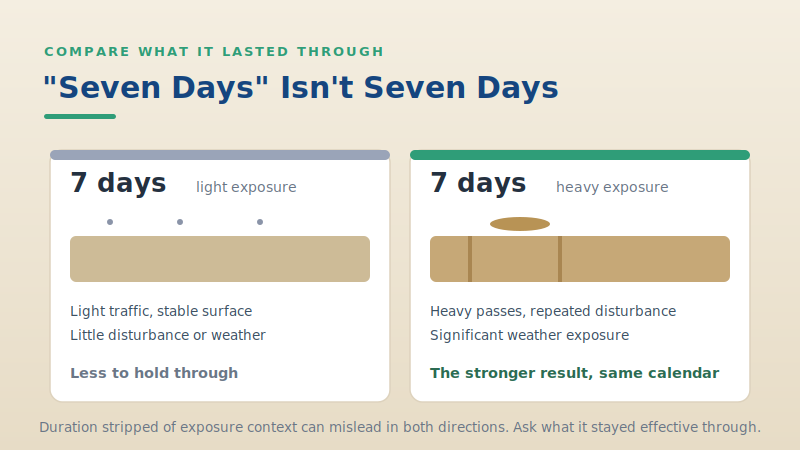
“Seven days of control” is a data point. It isn’t the whole story.
Those seven days might mean light traffic on a stable surface. Or they might mean heavy vehicle passes, repeated disturbance, and a stretch of bad weather. Same number on the calendar; completely different conditions underneath it.
Duration gets used constantly to compare dust-control approaches, and on its own it can mislead you in either direction. A treatment that held seven days under heavy operating stress may be the far stronger performer, even though it posted the same number as one that coasted through a quiet week. The reverse happens too.
So the better question isn’t really how long control lasted. It’s what the treatment stayed effective through before the next intervention was needed. A haul road under continuous truck traffic is a different test than a transfer point or a stockpile perimeter. Spell out that context before you draw conclusions from a duration figure, and a shaky comparison turns into a defensible one.
Persistence is only worth as much as the operating window it actually has to cover.
Dust Returning Tells You That Control Is No Longer Enough, Not Why
Visible dust is an outcome, not a diagnosis.
When it comes back, it’s telling you the current level of control has stopped meeting the requirement. What it isn’t telling you is what changed, or what was never quite right in the first place. Two sites can look exactly the same from the cab and have entirely different problems underneath, and the fix for one won’t necessarily touch the other.
Maybe the application was short from the start: thin coverage, the wrong dilution, not enough penetration where it mattered, or timing that didn’t line up with how the site was being used. If that’s the case, the treatment never got the chance to perform to its real capability.
Or maybe it did perform as intended at first and then wore down under exposure heavier than the application could carry. That’s a different problem, and it points to a different answer.
There’s a third possibility too: the surface itself changed over time, so the material the original treatment was built to control isn’t quite the material that’s there now.
And these aren’t mutually exclusive. A single site can have two of them running at once.
The same reappearing dust means different things depending on which one is driving it. If coverage was the issue, tightening up application practice might be enough. If the treatment held and then degraded under traffic or weather, the reapplication schedule is probably what needs another look. If the surface has shifted, or the exposure now outruns what the current mechanism was built for, the real question becomes whether the approach still fits at all. Reaching for more product, applying it sooner, or swapping to a different one without reading the condition first fixes what you can see without necessarily fixing what caused it.
How deep you dig depends on how much is riding on the decision.
Better Execution Can Make the Wrong Strategy Work Better Without Making It Right
Application quality often decides whether an otherwise sound approach performs the way it should. Thin coverage, the wrong dilution, weak penetration, or poorly timed application can all drag a perfectly suitable treatment down, in ways that look a lot like the wrong product was chosen. When execution is the real constraint, cleaning it up fixes the problem directly.
But there’s a second situation that deserves just as much attention.
A treatment can be applied correctly, hit the initial result everyone expected, and still fall short of what the operation actually needs, not because the crew did anything wrong, but because the approach was picked to answer the symptom rather than the conditions behind it. Sharpening execution there might nudge performance up a little. Or it might just make the operation really efficient at running an approach that was never going to meet the requirement.
Execution problems and fit problems can live side by side. So the useful question isn’t “which one is it?” It’s which one is actually holding back the level of control you need right now, and whether better execution would move that answer or leave it exactly where it is.
Dust Control Doesn’t Just Reduce Work. It Shifts Where the Work Goes
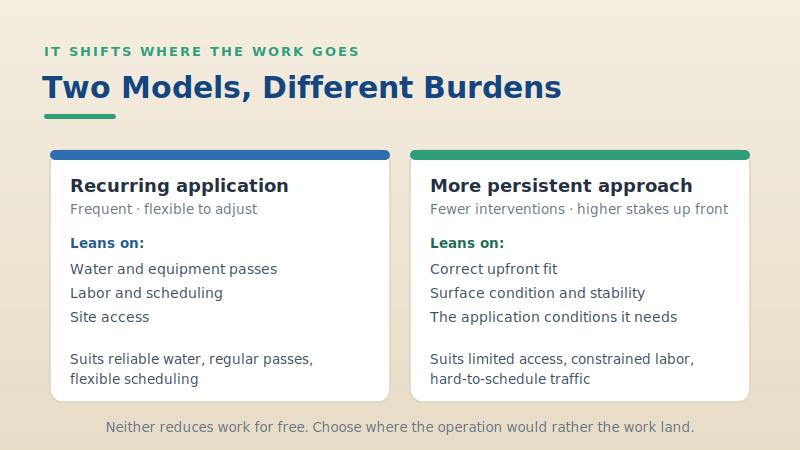
The question an operation usually asks about dust control is “Does it work?” The one that shows up later is “What do we have to keep doing for it to keep working?”
Different strategies build in different kinds of ongoing work. One leans on recurring application: water, equipment, labor, scheduling, access. Another cuts the frequency of all that, but in exchange it makes the upfront fit, the condition of the surface, and a different sort of ongoing attention matter a lot more. These aren’t just two points on a scale from “more effort” to “less.” They’re different ways of distributing the work, landing on different parts of the operation at different times.
Picture two sites. The first has reliable water, equipment already making regular passes, and a schedule with some give in it. For that operation, a recurring model barely adds anything, and the freedom to adjust frequency, coverage, or timing on the fly is worth something a duration number never captures. The second site has narrow access windows, labor it can’t spare, and traffic that makes scheduling a headache. A more persistent approach can lift or shift part of that burden, but it raises the stakes on everything you have to get right at the start: the fit, the surface condition, and the conditions the application itself demands.
Neither model wins by default. Recurring work isn’t inefficient just because it recurs, and persistence doesn’t automatically mean less total effort. The real question is which burden the operation is genuinely set up to carry, and where it would rather that work show up.
Focus on the Condition, Not Just the Symptom

Visible dust can tell you the current level of control isn’t where it needs to be. What it can’t do is define what the strategy has to accomplish, or point you to the mechanism worth considering. For that, it helps to work through four questions before you get to the one about products:
- What’s actually limiting control? Not just “there’s dust,” but which condition, or mix of conditions, is keeping you from the performance you need. Application quality, surface condition, traffic load, disturbance patterns, and weather can all play a part, and which one dominates shifts from site to site and even from one phase to the next.
- What does the strategy have to hold through? The performance window is specific to your operation: the traffic, disturbance, weather, and production demands the treatment needs to survive before the next planned intervention. Define that window first, and the list of viable options changes.
- What operational burden can the operation carry? Intervention frequency, water and equipment, labor, scheduling, access, the whole maintenance model you can realistically sustain. A treatment that only shines under conditions you can’t reliably provide isn’t really performing well on your site.
- Which mechanism fits? Only once the first three have clearer answers does this one come into focus. Where the job is about holding particle binding or surface integrity through real disturbance, and a less-frequent approach suits both the operation and the surface it’s working on, a polymer-based treatment is one mechanism worth weighing against the others. Where the requirement is different, something else may fit better. It’s the reasoning in front of the choice that makes the choice defensible.
Conclusion
Visible dust is telling you something. It might mean you need more control, or different control, or that what you’ve got in place has stopped doing the job. What it won’t tell you is what’s limiting performance, what the treatment has to stay effective through, or which operational trade-off makes sense for what your site actually demands.
Three questions get you closer:
- What’s limiting control?
- What does the treatment need to stay effective through?
- What burden is the operation prepared to carry to keep that performance going?
The goal isn’t the strategy that looks best right after application, or the one boasting the longest duration under conditions nobody specified. It’s the approach whose mechanism, performance window, and trade-offs actually line up with the conditions your operation has to manage day to day.
If a polymer-based approach looks like it could fit your operation’s conditions, Dust Control Plus is one option to evaluate against the questions above.
Applications - Dust Control & Soil Stabilization Products

Leave a Reply