
May 1, 2026
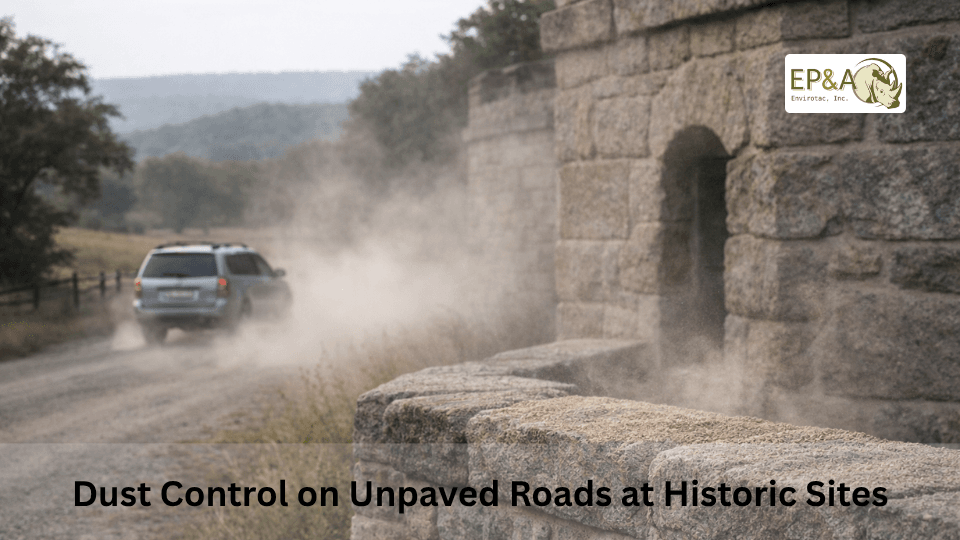
A vehicle passes, dust lifts, and then it settles into joints, onto stone, against surfaces where it can be difficult to remove. Nothing looks different at first. But layer by layer, that material changes how the surface interacts with moisture, temperature, and time.
At historic sites, that process has a specific origin. Unpaved access roads and footpaths generate fugitive dust continuously under normal operations, and the materials on the receiving end—masonry, carved stone, timber, and applied finishes—can retain deposited dust, especially where surfaces are rough or porous. The question is not just about whether dust from an access road reaches the structures around it. It is what happens after it does and whether the source is being managed or left to run.
This article covers the deterioration that dust drives at historic sites and what a long-term, responsible approach to controlling it at the source actually looks like.
Why Dust Is a Different Problem at Historic Sites
Most dust control conversations start and end with visibility. A cloud behind a passing vehicle. A film on a surface. A visitor complaint. At historic sites, that framing misses the actual problem by a wide margin. Dust at heritage locations is doing something most site managers are not fully accounting for. It can work through multiple pathways at once, and the damage can compound over time and become difficult to fully reverse.
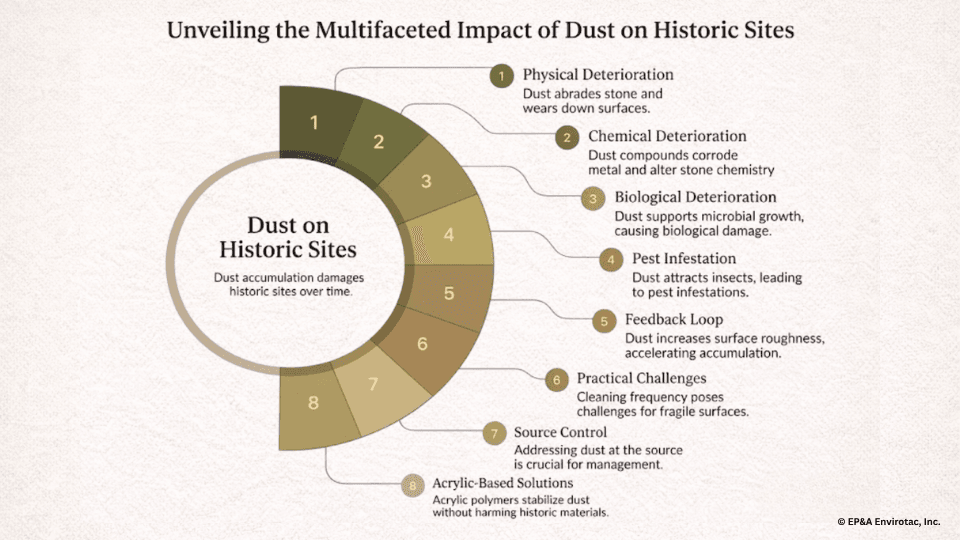
On a physical level, some dust particles are abrasive. Mineral particles such as silica can contribute to the abrasion of stone and carved surfaces, particularly during cleaning. The damage often happens not from dust sitting still but from the attempt to remove it. Cleaning it off fragile masonry or decorated surfaces often demands more force than the material can take without some loss. Deposits can become more difficult to remove over time. Dust can penetrate pores and crevices, making later removal harder and increasing the risk of substrate loss during cleaning.
The chemical side of this is where things get compounded. Dust can carry sulfur compounds, nitrates, and soluble salts that contribute to gypsum crusts on calcareous stone and corrosion on nearby metals when moisture is present. Then there is the moisture problem. Dust containing hygroscopic materials such as salts can retain moisture. It feeds crystallization cycles inside the stone itself, the kind that push outward as they expand and leave cracks behind when they contract.
Dust can contain nutrients that support microbial growth under suitable conditions. Dust may contain organic material such as fibers and debris. The mechanism runs deeper than surface staining. Outdoor masonry sitting under a dust layer is also sitting under retained moisture, and that combination gives microbial colonies what they need to get established. Microbial colonies can contribute to the biodeterioration of mortar, porous stone, wood, and finishes under suitable conditions. What shows on the surface is the least of it. The damage they cause is not cosmetic. Removing the organism does not undo what it changed in the material. The chemistry has already shifted. Accumulated dust and organic debris can contribute to conditions that may support some pests, especially in enclosed or damp environments. Some pests, such as wood-boring beetles and moths, depend on suitable materials and environmental conditions. Pest problems inside structures depend on multiple site-specific factors. Moisture and organic debris can contribute to conditions favorable to some pests, though multiple factors influence pest activity.
The thresholds set for human health and the concentrations at which heritage materials actually begin deteriorating are not the same number. Heritage materials may be affected by particulate deposition even when levels meet human-health standards. Safe air for humans is not necessarily safe for heritage materials. That distinction matters when evaluating how seriously to treat a dust source that might otherwise seem minor.
What makes this particularly difficult to manage is the feedback the problem creates. The deposition of dust usually increases the surface roughness of whatever it settles on. A rougher surface has a greater adhesion area, which means subsequent particles attach more readily and in greater volume. Dust accumulation is not linear. Surfaces that already carry dust collect more of it faster. Dust deposits can make surfaces more retentive, and rougher surfaces can provide more opportunities for particles to adhere. Outdoor surfaces at historic sites are pulling in somewhere between 7 and 30 grams per square meter every month under typical conditions, and that intake rate climbs as the existing layer thickens. Over years and decades, what began as loose particulate matter becomes a chemically and biologically active layer that bears little resemblance to the fine particles that first settled there. Studies have shown that reducing particulate transport can lower deposition rates by up to 62 percent. That figure matters because it quantifies what prevention actually achieves, and prevention is substantially less damaging than intervention after the fact.
There is also a practical paradox that site managers know well. Cleaning too often puts fragile surfaces through mechanical stress they were not built to handle repeatedly. Leave it too long, and what you are dealing with has bonded, gone biologically active, and bears little resemblance to what originally landed there. Both ends of that spectrum carry a cost. Which is why getting to the source matters more than staying on top of what has already reached the surface.
Where the Dust Actually Comes From
The dust at most historic sites has a fairly consistent origin. Unpaved access roads and footpaths generate it continuously, with every vehicle pass and every footstep on dry ground sending fine particles up into the air. Wind carries them. They settle on nearby structures, exposed stonework, outdoor features, and any surface within range.
Unpaved roads generate continuous particulate output under normal site operations, and the volume increases proportionally with traffic. Maintenance vehicles, staff on foot, tour groups, delivery runs—the traffic mix at a working historic site is varied, and it does not stop. Each of those movements over an unpaved surface is putting particles into the air, and that output runs alongside or directly through material environments that have been standing for generations.
Where dust actually lands is not predictable from the road alone. Particle size, wind speed, surface moisture, and local topography—all of it affects where things end up. The finest particles, which also happen to be the most chemically reactive and the most likely to get into porous materials, carry the furthest and land the most broadly. A dirt access road that appears to be a safe distance from a historic structure may not be providing the separation it appears to offer.
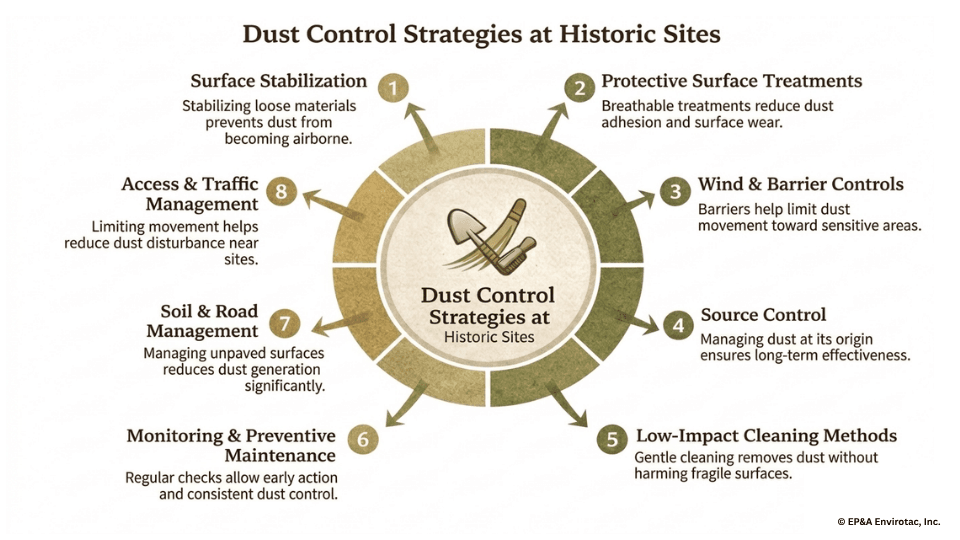
Addressing the symptom, dust that has already settled on surfaces, without addressing the source, means the problem renews itself continuously. Source stabilization is where effective dust management at historic sites actually begins.
What an Appropriate Solution Looks Like in This Context
Historic sites operate under constraints that most other facilities do not. For federally managed properties, those constraints have names. The Secretary of the Interior’s Standards for the Treatment of Historic Properties provide the baseline for preservation decision-making at the federal level, and the National Park Service applies those standards across its managed sites. Any product or treatment introduced to a historic site under federal oversight needs to be defensible within that context, which means the selection criteria go beyond performance alone.
At federally managed or grant-funded sites, this is not discretionary. Compatibility with preservation standards gets documented, and those records matter to oversight bodies and funders alike.
Runoff potential matters
Some products leave something behind in surrounding soils beyond what they do to the road surface itself. Chlorides and soluble salts migrating into soil near historic masonry or metal create their own set of problems. At sites where access roads run close to structures or sensitive ground, runoff behavior during rain or irrigation deserves as much scrutiny as dry-weather performance.
Reapplication frequency matters
Every maintenance visit to a historic site carries disruption costs, whether that is traffic through sensitive areas, labor demands, or the compounding wear of repeated vehicle access. A solution that requires frequent reapplication trades one problem for another. Long-term performance between applications is a preservation consideration as much as an operational one.
Disturbance footprint matters
Treatment stays on the road. Defined access routes and parking areas are the appropriate scope, and the line between those surfaces and the surrounding historic fabric should be drawn clearly before application begins and held to after. Any product that migrates, spreads, or requires expanding the treatment area over time works against the site’s preservation obligations.
These criteria, taken together, narrow the field considerably. They also provide a clear basis for evaluating any solution being considered, regardless of what that solution is.
Why Acrylic-Based Polymer Suppressants Fit This Context
Acrylic-based polymer suppressants work by binding the fine surface particles of an unpaved road into a stabilized layer. The acrylic polymer gets into the road surface rather than just coating it, bonding particles at the level where they would otherwise be lifted by traffic or wind. The treated surface remains functional as a road while generating significantly less particulate lift.
A stabilized road surface requires far less frequent reapplication than water-based suppression, which evaporates and must be repeated continuously to maintain any effect. Fewer reapplication visits mean less maintenance traffic, less operational disruption, and a more predictable site environment. Over a full season, the difference in site disturbance between a water program and a polymer program is substantial.
Acrylic-based formulations do not bring chlorides or salts into the equation, which matters here because chloride-based suppressants, effective as they are in other road contexts, have a documented track record of secondary damage near masonry and metal. For sites where treated roads run close to historic structures, that distinction has material consequences.
Performance under federal scrutiny is another relevant consideration. Acrylic-based polymer suppressants have been used in demanding, regulated environments by the US Department of Defense and the US military, where road surface performance, site sensitivity, and product reliability are evaluated under rigorous operational standards. That record transfers directly to contexts where performance under pressure and accountability to higher standards are part of the operating environment.
For sites where the access road problem needs a long-term answer and introducing new risks to the surrounding historic fabric is not acceptable, acrylic-based polymers have the field record and the technical basis to deliver that.
Practical Guidance for Application
Treatment should be applied exclusively to defined access roads, service paths, and designated parking areas. The treated zone should not expand into areas adjacent to artifacts, exposed archaeological features, or historic structures. That separation is a fundamental part of responsible site management and should be documented as such.
Before application, the road surface condition should be assessed. Acrylic-based polymer suppressants perform best on surfaces that have been graded and are free of standing water or saturated subgrade. Application to a prepared surface produces more consistent penetration and longer-lasting stabilization than application to a degraded or uneven one.
Longevity between reapplications depends on traffic volume, surface composition, and local climate conditions. Site managers should expect meaningfully longer intervals between treatments compared to water-based programs but should establish a monitoring schedule rather than assuming fixed reapplication timing. Visual inspection of road surface condition after periods of heavy traffic or significant weather is a practical baseline.
Contractors applying the product should follow product-specific guidance on application rate and method. Coverage that is too light will not achieve full surface stabilization. Coverage that is too heavy adds cost without proportional benefit. The goal is consistent penetration across the treated surface, not surface saturation.
For sites with multiple access road segments, prioritizing high-traffic routes and vehicle entry points typically delivers the greatest reduction in fugitive dust relative to the treatment area. Not all segments need identical treatment intensity. What gets treated, and at what intensity, should follow actual traffic patterns and how close each segment runs to sensitive areas.
Frequently Asked Questions
Will acrylic-based polymer suppressants affect the historic character of unpaved roads at our site?
Applied correctly and confined to access roads and parking areas, acrylic-based suppressants stabilize the road surface without altering its visual character. The treated surface retains its unpaved appearance. Treatment is not extended to areas of historic fabric, exposed features, or archaeological zones.
How long does treatment last before reapplication is needed?
Longevity varies based on traffic volume, surface composition, and climate. Acrylic-based polymer suppressants significantly outlast water-based programs, which require continuous reapplication to maintain any suppression effect. A site monitoring schedule is more reliable than fixed interval assumptions, since actual conditions vary between sites and seasons.
Are there risks to surrounding soils, vegetation, or masonry from treated road surfaces?
Acrylic-based formulations keep chlorides and soluble salts out of surrounding soils entirely. This distinguishes them from chloride-based suppressants, which carry documented secondary risks near masonry and metal. Runoff potential and proximity to sensitive areas should always be part of the site assessment before application.
Can this approach be documented for compliance or grant reporting purposes?
Yes. Product specifications, application records, and treatment area maps all belong in site management documentation. For federally managed properties or those operating under the Secretary of the Interior’s Standards, that paper trail is what accountability to oversight bodies and funders actually looks like in practice.
Work With EP&A Envirotac, Inc.
Road conditions, traffic patterns, proximity to sensitive areas, and preservation obligations—these vary enough between sites that a single general recommendation does not hold up. What works at one property may not be the right call at another.
EP&A Envirotac, Inc. works with site managers, federal facilities teams, and contractors to assess dust control needs and identify acrylic-based polymer solutions appropriate for the site. Contact EP&A Envirotac, Inc. to discuss your site’s conditions and get matched to the right product for your access roads.
Applications - Dust Control & Soil Stabilization Products

Leave a Reply