
August 1, 2026
As Benjamin Franklin put it, “An ounce of prevention is worth a pound of cure.”
Few construction activities prove that principle more clearly than demolition. Preventing dust from leaving the site is far easier, and far less expensive, than dealing with complaints, enforcement actions, or project delays after the fact.
Effective dust control for demolition sites demands more than turning on a water truck and resuming work. The variables shift constantly (demolition phase, weather, site layout, neighboring properties, water availability), and what works on day one can fall short by week two. The challenge isn’t finding suppression methods. It’s figuring out which combination fits your site, holds up across the full project, and adapts as conditions change.
This article is built for professionals managing real projects. It covers how to compare suppression methods, select appropriate equipment, build a workable dust control plan, verify performance, and avoid the implementation problems that create compliance risk and operational disruption.
Why Dust Control Matters on Demolition Sites
Getting dust control right on a demolition site carries consequences across several operational dimensions simultaneously. Regulatory exposure is the most immediate: many jurisdictions require active dust suppression, and visible off-site dust migration during inspections creates enforcement risk regardless of how well the project is otherwise managed. Complaints from neighboring businesses or residents can trigger stop-work orders that cost more in lost time than an effective suppression program would have.
Beyond compliance, uncontrolled dust affects the site itself. Haul roads coated in fine material become hazardous for vehicles and workers. Dust settling on equipment accelerates wear. Visibility problems around active demolition create safety risks that compound quickly in busy multi-crew operations.
Community impact is a dimension that experienced site managers weigh early. Urban demolition projects operate in close proximity to occupied buildings, and dust that crosses a site boundary, even briefly, damages relationships with neighbors and local authorities that matter for future work. Proactive suppression is easier to maintain than a reactive program built around complaints.
Where Demolition Dust Actually Comes From
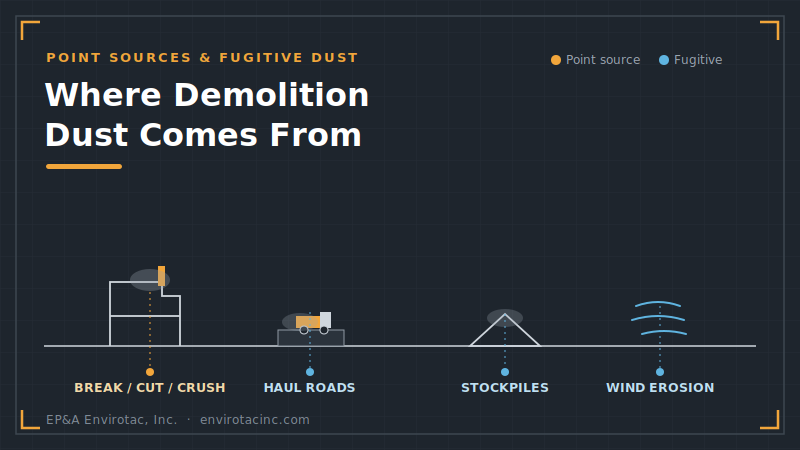
Spreading suppression resources evenly across a site typically means under-controlling the highest-risk areas. The starting point is mapping which activities generate the most dust during each project phase, then directing controls toward those sources first.
Two sources tend to get underestimated in site planning: haul roads and stockpiles. Haul roads generate continuous fugitive dust from vehicle movement throughout the project, not just during active demolition phases. Stockpiles left uncovered between phases or over weekends contribute significant wind-driven emissions with no active suppression in place.
Point sources (breaking, cutting, crushing) are controllable because they occur at fixed locations and can be targeted directly. Fugitive dust from haul roads, vehicle movement, and wind erosion is harder to manage because it’s diffuse and continuous. An effective program addresses both categories rather than focusing exclusively on the visible dust from demolition impact.
Map your site’s active dust sources by project phase before selecting suppression methods. The sources generating the highest loads during each phase should drive equipment positioning and method selection.
Dust Control Methods: Comparison of Available Approaches
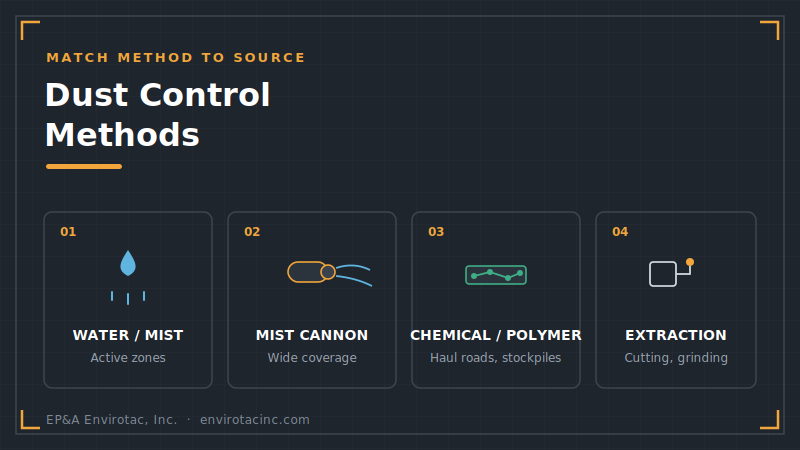
No single suppression method handles every dust source well, and most effective programs combine a primary method with one or more supplementary approaches. The comparison below covers practical performance across the criteria that matter most on active demolition sites.
Water-only programs frequently struggle on sites with active crushing operations, high winds, or extensive haul road networks. Water evaporates quickly in heat, disperses in wind, and requires continuous reapplication on haul roads, meaning supply logistics can become a limiting factor before suppression performance does.
Chemical suppressants earn their cost on haul roads and inactive stockpiles, where they reduce water truck frequency and maintain suppression between applications. For active demolition zones, targeted water or mist systems generally offer better coverage and flexibility.
The combination that often works across most mid-to-large sites is a primary water-based system for active demolition zones, chemical treatment, polymer-based road stabilization on haul roads, and extraction or enclosure at cutting and grinding operations. The right mix shifts as demolition phases change, which is why method selection is a phase-by-phase decision, not a one-time project setup.
How to Choose the Right Dust Control Strategy
With the available methods understood, the decision shifts to your specific project. These variables most significantly influence which strategy fits.
- Project scale and demolition method (mechanical vs. manual)
- Proximity to neighboring properties and sensitive receptors
- Available water supply and refill logistics
- Site layout: open versus confined
- Project duration and phase sequence
- Prevailing weather conditions and seasonal variation
Three scenarios show how project conditions drive different selections.
Urban mid-rise demolition: Neighboring businesses and residents make community impact the primary constraint. Shrouding or enclosure at impact points, mist cannons positioned toward the site perimeter, and vacuum extraction or water-suppressed saws address that concern while maintaining productivity. Water truck passes on interior haul routes manage vehicle-generated dust.
Industrial site, large footprint: With few nearby receptors and significant open space, a mist cannon covering active demolition zones combined with chemical treatment on the haul road network can provide efficient, cost-effective coverage. Water supply becomes the key logistics challenge at this scale.
Small building demolition, limited infrastructure: Manual water spraying with chemical suppressant applied to access routes is often sufficient. A physical enclosure or dust screen around the immediate work area reduces neighbor impact without significant equipment investment.
The most common strategy mismatch is applying a single-method program to a project with multiple distinct dust sources. A mist cannon handles a crusher well but does nothing for saw cutting happening across the site. Identifying all active source types before committing to a strategy prevents that gap from appearing mid-project.
Dust Control Equipment: Selection and Use
Equipment selection follows strategy. Choosing equipment before defining a strategy typically produces either over-specified tools or mismatched ones.
Coverage area, water supply capacity, site access for equipment movement, and maintenance capacity on site are the factors that most often determine whether a well-chosen method can be implemented as planned. Equipment that performs well on one site configuration can be impractical on another with different access or water constraints.
Equipment placement matters as much as equipment choice. A mist cannon positioned downwind of demolition activity generally suppresses little dust, regardless of its output. Vacuum extraction units placed too far from cutting operations lose effectiveness quickly. Revisit equipment positioning whenever the active demolition area moves; that’s when suppression gaps most commonly appear.
Factors That Influence Dust Control Effectiveness
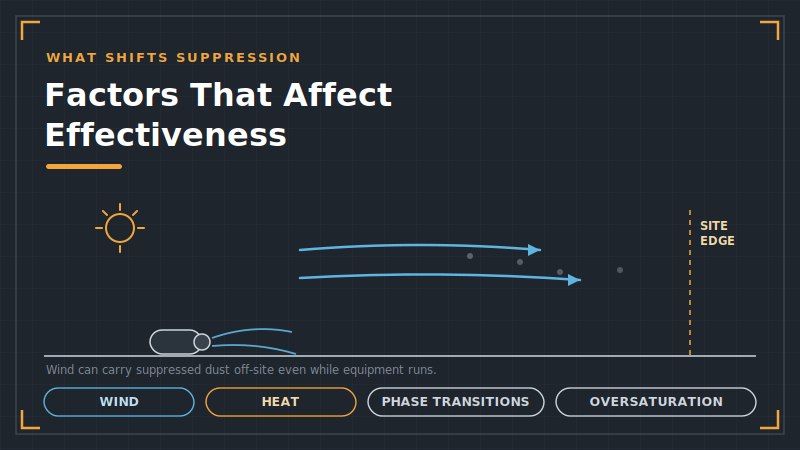
A strategy and equipment combination that performs well one day can fall short the next. Weather, site conditions, and demolition phase transitions all affect how much suppression a given setup actually delivers.
Wind is the variable that most consistently forces mid-project adjustments. High wind doesn’t just reduce suppression effectiveness; it can redirect dust toward neighboring properties even when suppression equipment is running. Repositioning mist cannons and adding temporary windbreaks or barriers where they best intercept dust movement are among the most immediate responses.
Demolition phase transitions create a different kind of adjustment trigger. Dust generation patterns shift significantly between structural demolition, crushing, and site clearance. Equipment positioned correctly for structural work often needs repositioning as crushing begins, and the lag between when the active work area moves and when suppression equipment follows is one of the more consistent sources of field compliance gaps.
Oversaturation deserves attention as a genuine operational problem. Excessive water application reduces worker traction, creates muddy haul roads, and can affect partially demolished structures. Effective suppression uses enough water to bind dust particles, calibrated to source intensity rather than maximized for visible effect.
Creating a Dust Control Plan for a Demolition Project
A dust control plan that lives only in a document rarely survives contact with active demolition. The plans that hold up are operational tools built around daily routines, clear responsibilities, and defined responses to the conditions that actually change during a project.
Dust Control Planning Workflow
- Site assessment: Identify all dust sources by project phase, map neighboring receptors, confirm water supply capacity and refill logistics
- Method and equipment selection: Apply the strategy and equipment frameworks to your site conditions
- Responsibility assignment: Designate who operates, monitors, and maintains each control measure; assign a daily responsible person
- Contingency planning: Define responses to adverse weather, equipment breakdown, and water supply interruption before they occur
- Crew communication: Brief all crews and subcontractors on dust control responsibilities before demolition begins
- Daily review: Evaluate performance each day; adjust equipment positioning and suppression intensity as work progresses
Daily Dust Control Checklist
- Inspect all suppression equipment before operations begin: check nozzles, hoses, water supply
- Confirm water truck fill level and schedule refill if needed
- Check weather forecast; note wind speed and direction
- Reposition mist cannon or spray equipment to align with today’s active work area
- Apply chemical suppressant to haul roads if required by weather or traffic conditions
- Brief crew on dust control adjustments for the day
- Monitor perimeter and neighboring properties during high-dust operations
- Document any dust events, equipment issues, or complaints received
- Confirm stockpile covers are in place at end of the shift
- Review suppression performance at end of day and note adjustments needed tomorrow
Plans tend to break down during the highest-intensity operations, when demolition productivity is at its peak and adjusting suppression feels like a secondary priority. Treating the daily checklist as a non-negotiable operational step keeps implementation consistent when the pressure to push through is greatest.
Monitoring, Inspection, and Regulatory Compliance
Monitoring answers one essential question: are the controls working under current conditions? The answer changes as weather shifts, demolition phases transition, and equipment performance varies.
Visual monitoring may be sufficient for some smaller sites when suppression is working, and there are no sensitive neighboring receptors. It becomes inadequate when regulatory limits apply, when neighbors have raised concerns, or when operations generate significant fine particle dust that isn’t visible at a distance. Those conditions call for instrumented monitoring that can detect what visual observation misses.
Compliance Checklist
- Dust control plan documented and available on site
- Regulatory notifications submitted as required before demolition
- Suppression equipment operational before demolition begins each day
- Haul roads and site exits managed to prevent dust tracking off-site
- Stockpiles covered or stabilized when not actively worked
- Monitoring records maintained and dated
- Complaint log maintained with response documentation
- Equipment inspection records available
- Corrective actions documented when dust events occur
- Plan reviewed and updated when project scope or conditions change significantly
Current documentation protects contractors during inspections more reliably than reconstructed records do. Regulators often respond better to sites that can demonstrate an active, ongoing dust management program: records that are kept daily rather than compiled after the fact carry significantly more weight.
Common Mistakes and How to Avoid Them
Most dust control programs that fall short share a common pattern: the suppression setup was built around anticipated conditions and never adjusted as actual conditions changed.
Two situations illustrate how early adjustments prevent larger problems.
On a multi-building demolition, a mist cannon is positioned effectively for the first structure. As work moves to the adjacent building, the cannon stays in its original position for three days while the crew focuses on demolition progress. Dust complaints from a neighboring business arrive on day two. Moving the cannon at the start of each phase transition would have closed that gap before it opened.
On a second project, a water supply interruption hits mid-morning with no contingency in place. Suppression lapses for two hours during active crushing. Pre-arranging an emergency water delivery and maintaining a reserve tank significantly reduce that vulnerability before the project begins.
Frequently Asked Questions
What is the most effective dust control method for demolition? Effectiveness depends on the dust source, project scale, weather, and site layout. Crushing operations respond well to atomized mist at the source; haul roads respond better to water trucks or chemical suppressants; cutting operations are typically controlled with vacuum extraction. Most sites require a combination matched to the specific sources present.
Can multiple suppression methods be used simultaneously? Yes, and on many mid-to-large sites, combining methods is necessary rather than optional. A mist cannon covering the active demolition zone, water truck passes on haul roads, and extraction at cutting operations can run concurrently without interference.
How often should dust control measures be adjusted? Review positioning and suppression intensity at the start of each day. Adjust within the day when weather changes significantly, when the active work area moves, or when visual monitoring indicates controls are underperforming. Phase transitions are the highest-risk adjustment points.
Does weather significantly affect dust suppression performance? Wind is the most significant variable for most suppression methods. High wind disperses spray and mist before it reaches the dust source and can carry suppressed dust off-site despite active controls. High temperatures accelerate water evaporation, reducing the effective suppression window after each application.
Is water always required for demolition dust control? Water-based suppression is the most common approach but not the only option. Chemical suppressants, physical enclosures, and vacuum extraction all provide suppression without continuous water application. On sites with limited water availability, combining chemical treatment with enclosure or extraction at high-risk operations can be effective.
How early should dust control planning begin? Before demolition begins, during project planning. Identifying water supply logistics, equipment requirements, neighboring receptor locations, and phase-specific dust sources before work starts avoids reactive decision-making once demolition is underway.
What factors most influence equipment selection? Strategy comes first, then the site’s physical constraints. Coverage area, available water supply and refill logistics, site access for equipment movement, and maintenance capacity on site are the most practically significant factors. Equipment that performs well in one project configuration can be impractical on a different site.
How do I know if my dust control program is working? Start with visual observation at the site perimeter during active high-dust operations. If dust is visibly leaving the site boundary or reaching neighboring properties, the program needs adjustment. On urban sites or sites near sensitive receptors, real-time dust monitors provide earlier warning and create a defensible record for inspections.
Conclusion
Effective dust control on demolition sites comes from working through a consistent process: assessing the site, identifying sources by phase, selecting methods that address them, matching equipment to strategy, adapting as conditions change, and monitoring whether controls are holding. No single method or piece of equipment produces those results on its own.
Treat the dust control program as a live operational system rather than a fixed plan. The projects that manage dust well tend to be the ones that build daily review into their operations and adjust early rather than after problems appear. That discipline helps keep suppression effective, sites compliant, and neighbors manageable across the full project lifecycle.
Because on demolition sites, an ounce of prevention is still worth far more than a pound of cure.
Every demolition project presents different dust challenges. If you’re evaluating suppression methods, selecting equipment, or looking for a longer-lasting solution for haul roads and stockpiles, the EP&A Envirotac, Inc. team can help you identify the approach that best fits your site conditions. Contact us today to discuss your project and find the right dust control solution.
Applications - Dust Control & Soil Stabilization Products

Leave a Reply