
July 21, 2026
Dump sites generate dust from multiple directions at once, and the sources shift depending on what is happening on the ground at any given hour. A haul road that was manageable in the morning can become a visibility problem by midday once traffic picks up and surface moisture burns off.
Controlling dust in these environments is considerably more complex than scheduling water trucks, as water-based suppression alone requires frequent reapplication and may not provide lasting control across all site areas.
This article covers where dust originates on active dump sites, why conventional suppression has inherent limitations, and what a more lasting solution looks like when suppression and surface stabilization work together.
Why Dust Deserves More Than Periodic Attention
Dust on a dump site is discussed as an environmental issue, but it also carries immediate operational and safety consequences. Reduced visibility on haul roads affects how safely and efficiently vehicles can move, especially during high-traffic periods or in dry, windy conditions. Dust that accumulates on equipment can enter filters and mechanical systems over time, contributing to component wear and potentially increasing maintenance requirements.
There are less obvious costs too. Sites generating visible dust beyond their boundaries can draw complaints from neighboring communities and increased regulatory scrutiny, which in some jurisdictions may affect permit compliance or operating conditions. Workers exposed to dust over extended shifts face health considerations that responsible site management cannot sidestep. Dust control, viewed this way, is a productivity and continuity issue as much as a cleanliness one.
Where Dust Actually Comes From
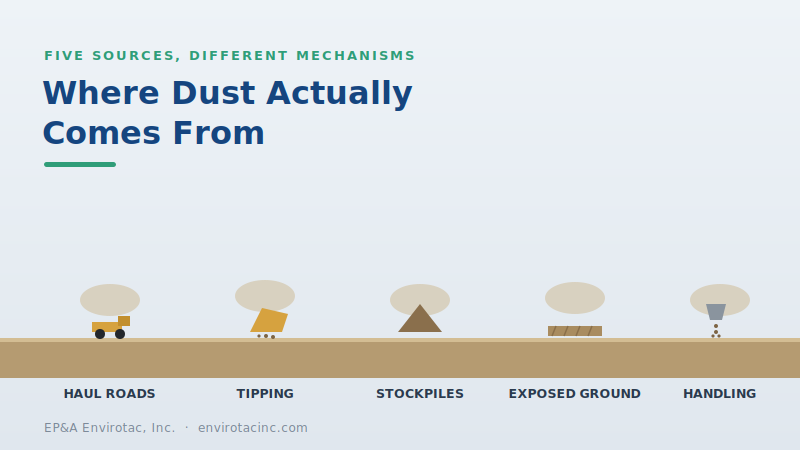
Different areas on a dump site generate dust through different mechanisms, and a control that works well for one source may be less effective for another. Sites that apply the same suppression across all areas find themselves working harder than the results justify, not because the effort is wrong, but because it is not matched to what each source actually requires.
Haul roads are where this gap becomes most visible. The assumption is that more frequent watering will bring road dust under control, and for a time, it does. What that assumption misses is that every vehicle pass disturbs loose fines on the road surface, and those fines do not disappear between passes. They accumulate, dry out, and become available for the next disturbance. Higher vehicle speeds increase the volume of fines displaced per pass, and poorly maintained road surfaces generate more loose material to begin with. The road surface continually produces new loose fines, which is why water-based suppression on haul roads so often requires repeated application regardless of schedule consistency.
Active tipping areas generate dust through a different mechanism: the mechanical disturbance of dry material during unloading and equipment movement across ground with no stable surface crust. Severity depends on the moisture content of incoming material, the type of waste being handled, and wind conditions at the time of tipping. These variables shift daily, which is why tipping area dust can feel unpredictable even when suppression is applied consistently.
Stockpiles can generate dust through both wind erosion and material handling, and each requires different control measures. When idle, exposed stockpile surfaces shed material under wind at a rate shaped by surface texture, moisture content, and wind speed. During loading and unloading, mechanical disturbance adds to that wind-driven loss. Tall, steep-sided stockpiles are more susceptible to wind erosion than lower, well-managed piles under similar conditions because of the surface geometry they present to moving air.
Inactive and exposed areas can become persistent sources of windblown dust if left unstabilized. Ground that has been disturbed but not yet covered or treated loses fine particles continuously under wind with no equipment activity required. Because these areas produce dust gradually rather than during active operations, they can be overlooked until the dust becomes more noticeable and the accumulated material loss more significant.
Material handling points generate dust in proportion to drop height and material dryness. The longer material falls freely before hitting a surface, the more kinetic energy disperses on impact. Drop height is one of the primary factors influencing dust generation at these points and can be reduced through engineering measures, often alongside suppression systems where the layout allows.
Why Suppression Keeps Falling Short
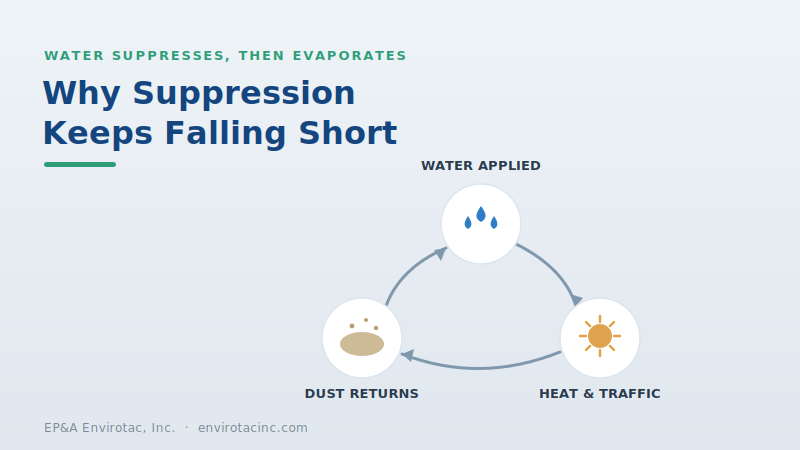
A common response to dust complaints is to increase watering frequency. It is a reasonable first move: water suppresses dust immediately, it can be deployed quickly, and the results are visible. The decision to keep relying on it makes operational sense until the same surfaces require repeated attention despite consistent watering schedules.
In many of these situations, water is addressing airborne dust without changing the underlying surface conditions that contribute to repeated dust generation. Applied to a dry surface, it binds particles together and prevents them from becoming airborne. What it generally does not do is provide lasting improvement to the surface condition producing those particles. Once evaporation and vehicle traffic expose dry fines again, dust returns unless additional controls are used alongside the suppression program.
This matters most on heavily used roads and active working areas where vehicle passes continuously disturb and dry the surface between applications. For untreated surfaces, the underlying condition often remains unchanged between applications; the dust was only temporarily suppressed. A site that has been watering the same road twice a shift for months without lasting improvement may be dealing with more than a watering-frequency issue. It may be facing a surface condition problem that cannot be resolved by more frequent suppression alone. That gap, between what suppression can do and what the surface actually needs, is what this examination of water-based dust control limitations works through for operators deciding whether the current program is addressing the underlying condition or managing around it.
Controlling Dust at Its Source
Many sites initially apply dust controls broadly and increase them where dust is most visible. That approach can distribute effort inefficiently if it does not account for where dust is actually being generated. Haul roads, active tipping areas, exposed stockpiles, and unsealed perimeter areas are among the site’s most significant dust sources despite occupying only part of the site. Concentrating resources on these areas reflects a source-based approach, where controls are directed toward locations with the greatest dust generation potential.
Address vehicle speed and road surface condition together
Most operators address haul road dust by increasing water truck frequency or reducing vehicle speeds. Both contribute. Speed reduction limits the volume of fines displaced per vehicle pass, which directly reduces dust generation at the source. The gap in this approach opens when road surface condition is left out of the equation. A deteriorated road surface with significant aggregate breakdown generates more loose material than a well-maintained one, although vehicle speed also influences how much of that material becomes airborne. Long-term dust control on haul roads is more effective when speed and surface condition are managed together, because how the surface degrades under sustained vehicle movement determines how quickly suppression alone falls behind the rate of dust generation.
Stabilize disturbed ground before the loss accumulates
Many sites prioritize active work areas before addressing disturbed ground, which is operationally practical but can allow dust risks to increase over time. Disturbed ground begins losing fine particles as soon as it is exposed to wind or vehicle disturbance. The longer those surfaces remain untreated, the more material becomes available to become airborne. Prompt stabilization through temporary covers, compaction, or vegetation establishment where site conditions support it limits that material loss before it compounds. Active sites have real competing priorities, and stabilizing disturbed areas competes with ongoing tipping and earthworks schedules. Factoring in the accumulated dust generation and the eventual remediation effort against that deferral changes the calculation for many sites.
Adjust water application to surface conditions
Fixed watering schedules exist for good reason: they are predictable, they simplify staffing, and they require less per-shift judgment. Shifting application timing toward pre-traffic periods and adjusting frequency based on observed surface dryness can improve dust control and water-use efficiency, particularly during the high heat, strong wind, and heavy traffic that expose the limits of fixed schedules most sharply. Avoiding over-application matters alongside timing: saturated surfaces that produce runoff are not suppressing dust more effectively than properly moistened ones, and the runoff creates secondary problems at site boundaries.
Reduce mechanical disturbance at handling points
Drop height is one of the primary variables at transfer and handling points, and lowering it reduces the kinetic energy dispersed on impact. Controlling unloading rates and covering transfer areas where site layout allows adds to that reduction. Stockpile surfaces require attention around loading sequences and periods of wind exposure when idle, where the mix of mechanical and wind-driven loss determines which adjustment produces the most improvement. The specifics of managing both loss types across the stockpile cycle are worth understanding before deciding where to focus on sites where stockpile dust persists.
Remove accumulated fines from paved surfaces
Paved access roads and gate areas can become secondary dust sources as fine material accumulates from tracked-out soil. Vehicles track material from unpaved areas onto these surfaces continuously, and wind redistributes it back across the site. Regular sweeping of paved areas and measures to reduce track-out from unpaved zones interrupt that redistribution before it compounds into a secondary generation problem that demands its own suppression effort.
What Surface Stabilization Changes
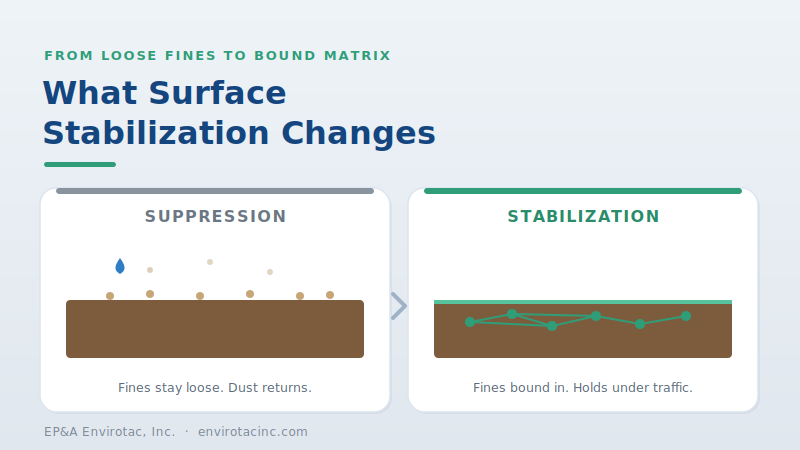
Many sites arrive at stabilization after working through the frequency argument: the road has been watered more often, speeds have been reduced, the surface has been graded, and dust keeps returning on the same schedule. The conclusion most operators reach at that point is that something about the surface itself needs to change, not the program applied to it.
Surface stabilization addresses that directly. Polymer-based treatments bind fine particles into the road matrix rather than leaving them loose on the surface. Vehicle passes disturb significantly less material because the fines are no longer as available to be displaced. Suppression manages what the surface produces. Stabilization changes what the surface produces. The effect persists through traffic loading rather than degrading between applications, which is why the reapplication cycle that defines water-based programs does not apply in the same way.
Stabilization requires more upfront coordination than routine suppression: application timing, surface preparation, and cure periods all need to be managed. On roads with high daily vehicle counts, that coordination reduces ongoing maintenance demands considerably once the treated surface is performing. Inactive areas and capped sections follow the same logic. A stabilized crust on an idle stockpile or closed area eliminates a recurring suppression task rather than deferring it to the next shift. For sites deciding where stabilization fits relative to existing suppression schedules, this comparison of how both perform across different surface types and traffic conditions covers the practical considerations in longevity and application that determine which surfaces are the strongest candidates.
A Dust Management Plan That Holds
Sites that manage dust effectively are not necessarily the ones with the largest suppression programs. They are the ones that have mapped where dust actually comes from, matched their response to each source, and built in enough review to catch when conditions shift faster than the program accounts for.
A workable plan for a dump site involves:
- Identifying the highest-generating areas and directing resources accordingly
- Matching suppression and stabilization to the characteristics of each area
- Setting inspection intervals so surface conditions are assessed before problems become visible
- Adjusting for seasonal shifts in wind patterns, temperature, and precipitation that affect how quickly surfaces dry
- Distinguishing between areas that need more frequent application and those where the method itself is mismatched to the surface conditions or traffic levels
For many sites, this last point is one of the more challenging aspects of dust management. Increasing application frequency is a straightforward operational adjustment. Concluding that a surface needs a different approach entirely requires stepping back from the program that is already running and asking whether it was designed for the conditions it is actually facing. Whether dust control remains effective over time depends on how different methods perform under sustained traffic, weather exposure, and site conditions, which is what this look at long-term dust control performance covers for operators working through that decision.
Where Plans Fall Short
Dust management commonly falls short in several recurring ways:
- Relying on water as the only tool across all site areas, including surfaces where traffic volume or wind exposure makes consistent moisture retention difficult to achieve
- Treating haul roads as low priority, when they are among the site’s highest dust-generating surfaces by volume of disturbance
- Leaving disturbed ground untreated for extended periods, allowing wind erosion to remove material that would otherwise remain stable
- Relying solely on fixed schedules instead of adjusting controls to surface conditions and weather
- Using the same method across every site area regardless of traffic level, surface type, or exposure
- Delaying stabilization of newly disturbed areas, which allows loose material to accumulate and creates a larger problem to address later
Getting Dust Control Right
When a site keeps generating dust in the same locations despite a suppression program that is running as designed, the program itself is worth examining. A schedule that works on a lightly trafficked access road may not be sufficient for a heavily used haul road, and recognizing that difference helps direct dust management toward what each location actually requires rather than what the program was originally built around.
Operators considering long-term stabilization options will find polymer-based solutions among the more established choices for demanding dust control environments. EP&A Envirotac, Inc. specializes in this area.
Applications - Dust Control & Soil Stabilization Products

Leave a Reply