July 3, 2026
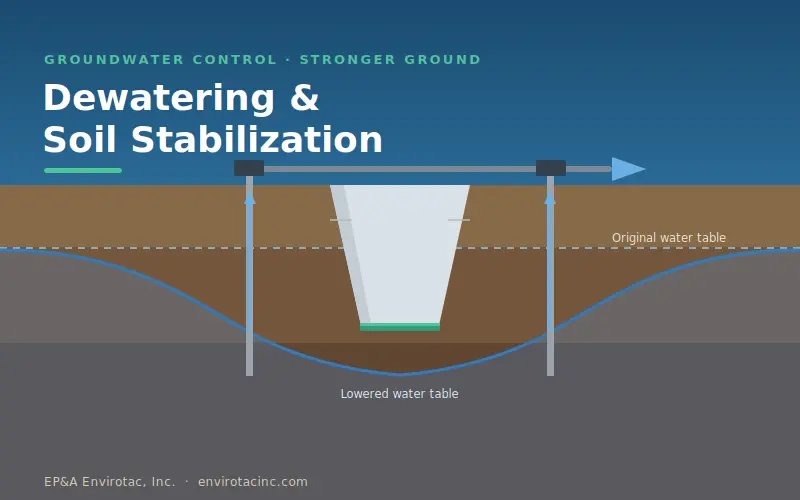
Walk onto a deep excavation a day after heavy rain. The sides have started to slump, the base is soft underfoot, and somewhere nearby, a pump that should’ve shut off overnight is still grinding away. Water causes the most expensive surprises on a geotechnical project. That’s why engineers spend so much time managing it.
High groundwater brings a familiar set of headaches. Soil that is tested fine and dry turns soft and unworkable once it’s saturated. The settlement that should’ve been minor gets uneven and hard to predict. Walls that looked stable on the drawings start sloughing off after a storm, and schedules slip while crews sit around waiting for the ground to dry enough to build on.
Most people describe dewatering as a way to keep a pit dry, and that’s true enough. But there’s more to it. Done properly, dewatering changes how the soil behaves underground — not just how wet the surface looks.
This article gets into how dewatering works, why water has such a strong effect on soil stability, and where that control over water actually pays off across foundations, roads, embankments, and soft soil projects.
What Is Dewatering?
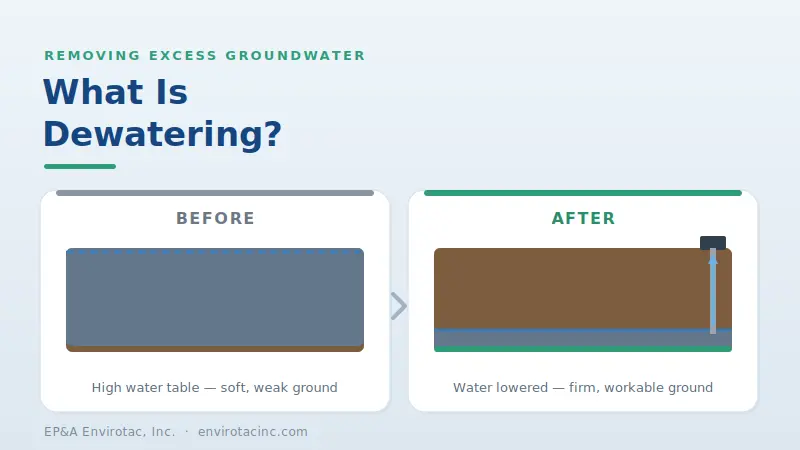
Dewatering means removing or lowering excess groundwater from soil, usually by pumping it out before or during construction. The goal is simple: bring the water table down far enough that construction can happen on ground that holds up.
It shows up across a range of project types:
- Excavations — keeping pits and trenches workable below the natural water table
- Foundations — creating stable, load-bearing conditions before footings go in
- Tunnels — controlling water inflow during underground construction
- Roads — improving subgrade conditions before paving
- Embankments — speeding up consolidation of soft, water-saturated soil
There are a few main techniques, and each fits a different situation. Wellpoints are a series of small wells tied into a header pipe, pulling water from shallow depths — common in sandy soils and shallow digs. Deep wells scale up the same idea: individual wells with submersible pumps, used when the water needs to come down a lot or across a big area.
Sump pumping is about as basic as it gets. Water collects somewhere low, and a pump sends it out. Cheap, easy, but limited — it deals with water after it’s already shown up rather than controlling the table itself. Vacuum dewatering goes the other direction, pulling water out with suction when the soil won’t drain on its own. That’s the fix on fine-grained sites where a sump pump just isn’t enough.
Soil type, depth, and the volume of water involved usually decide which one fits.
Why Dewatering Matters in Modern Construction
The pressure to get dewatering right keeps growing. Cities are building on tighter, lower-lying land that crews would have once avoided. Basements, parking structures, transit tunnels — all of it now routinely sits below the natural water table. Good ground is harder to find, so more projects end up on marginal sites with poor drainage to start. And schedules have gotten tighter too. A week lost to a flooded pit is a week most projects can’t spare.
Why Water Affects Soil Stability
Two excavations can look almost the same on the surface and behave completely differently once work starts. Usually, it comes down to one thing: how much water is sitting between the soil particles.
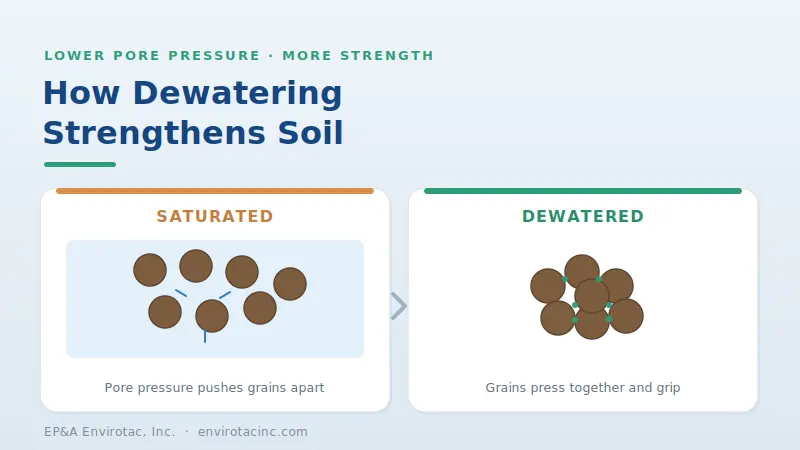
Engineers call this “effective stress,” and the short version goes like this — soil gets its strength from particles gripping each other. Water in the gaps between particles doesn’t add any of that strength. If anything, when pore water pressure builds, it pushes particles apart and loosens the grip. Loosen the grip, and the soil gets weaker.
Think about dry sand versus wet sand. Press into dry sand, and it holds its shape. Try the same with saturated sand, and it just gives way — the water isn’t holding anything up; it’s just sitting in the way.
Saturation changes the picture too. Fully saturated soils have every pore filled with water, so pore pressure has the most influence on strength there. Partially saturated soils still have some air in the pores, which usually means better strength behavior, although the soil is never fully off the hook for being water-sensitive.
On a job site, the consequences are predictable enough. Bearing capacity comes in lower than the report promised. Slopes won’t hold their angle after rain. Settlement happens unevenly instead of cleanly. Subgrade material never quite dries enough for the compactor to do its job properly. A report that calls the ground “competent” can still leave you fighting the site for three weeks straight after a wet spell.
This relationship — pore water pressure up, effective stress down, strength dropping along with it — sits at the center of how geotechnical engineers think about ground behavior. Lower the pore pressure, and the opposite happens. That’s a big part of why dewatering improves how the ground performs.
How Dewatering Improves Soil Strength and Performance
Most people picture dewatering as drying out an excavation, and sure, that’s part of it. But the real benefit happens where nobody’s looking — underground, as the water table drops and the soil itself starts acting differently.
Sometimes the first sign of trouble has nothing to do with a lab report. It’s hauling trucks suddenly leaving ruts where they weren’t leaving them the day before.
Less water pressure in the pores means particles press harder against each other, and that grip is what actually carries the load. So, effective stress goes up. Shear strength follows — the soil resists sliding and shifting better than it would if saturated.
Groundwater plays a direct role in all of this. High water levels raise pore pressure and chip away at the effective stress soil depends on for strength. That’s the whole reason groundwater management sits at the center of so many stabilization and excavation-support jobs.
In compressible soils, dewatering also speeds up consolidation — the gradual squeezing out of water that drives long-term settling. Push that process to happen early, before construction starts, and there’s a lot less of it left to deal with once a structure is sitting on top. Drier, denser soil ends up holding more weight, whether that’s a foundation load or just equipment rolling across the site without tearing it up.
There’s a more immediate upside too. Dry ground is just easier to work on. Excavation comes out cleaner. Compaction equipment gets traction instead of churning soil around. Crews stop slogging through standing water all day.
A practical example: on a foundation job, the difference between lowering the water table properly and not bothering can come down to pouring footings on firm ground versus pumping a pit out every single morning and hoping the concrete sets before water seeps back in.
An infrastructure example: on a highway embankment over soft ground, dewatering can push consolidation forward enough that settling finishes before paving begins — instead of happening slowly under the finished road and showing up later as cracks and dips.
Common Dewatering Techniques Used in Ground Improvement
Choosing a method is mostly about matching the technique to what’s actually happening underground. Wellpoint systems work best in shallow excavations through sandy or permeable soils — fast to install, but they only reach so deep. Deep well systems take over once the water needs to come down a lot, or across a footprint too big for wellpoints.
Sump pumping stays cheap and simple, good for localized seepage, but it’s usually a supporting player rather than the main method. Vacuum dewatering steps in specifically when fine-grained soils won’t release water fast enough for gravity alone to handle.
A few factors drive the decision: soil type and permeability, how deep and how much groundwater there is, excavation depth, project scale, and the timeline. There’s no single right answer — it depends on the site. Here’s a quick comparison:
| Technique | Best For | Limitation |
| Wellpoints | Shallow sandy soils | Limited depth |
| Deep Wells | Deep excavations | Higher cost |
| Sump Pumping | Localized water removal | Poor groundwater control |
| Vacuum Dewatering | Fine-grained soils | Specialized equipment |
Applications of Dewatering in Soil Stabilization and Ground Improvement
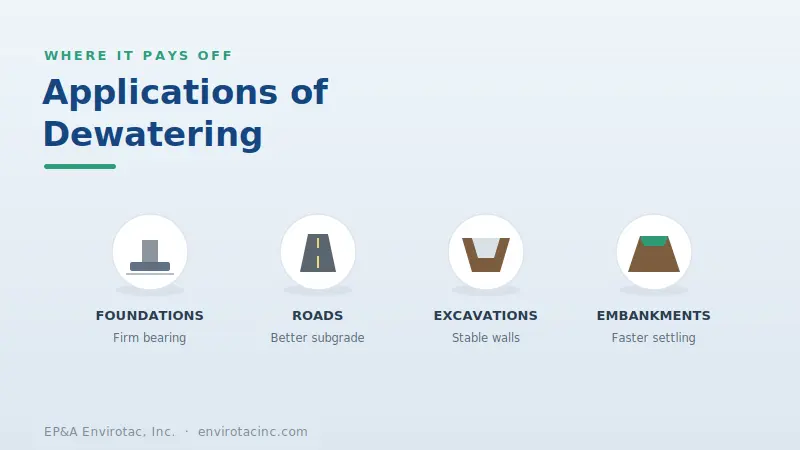
In foundation work, dewatering gives footings the firm bearing conditions they need — built on ground that’s actually been confirmed solid, not ground that might hold up if the water stays away long enough for the concrete to cure. For roads and pavements, drier subgrade compacts better, and a subgrade that never gets dry enough is one of the more common reasons a “fully compacted” road starts rutting within its first year.
During excavation, dewatering keeps two specific risks at bay: instability in walls and slopes, and base heave, where pressure pushing up from below lifts the excavation floor. For embankments and earth structures, faster consolidation in the soil underneath means the whole structure settles into stability sooner, rather than slowly shifting for years after it’s already in service.
Soft soil improvement is where dewatering rarely flies solo. It usually gets paired with preloading (a temporary load that pre-compresses the soil before final construction), vertical drains (which shorten the distance water has to travel to escape compressible layers), or chemical stabilization (additives that change the soil’s properties directly).
Dewatering Combined with Other Ground Improvement Methods
The real payoff with dewatering often shows up once it’s teamed with something else. Pair it with preloading, and soil consolidates faster under a temporary surcharge — compressed before the actual structure ever puts weight on it. Pair it with vertical drains, and the water has a much shorter path out of compressible clay layers, turning a process that might otherwise take years into one measured in months. Pair it with chemical stabilization, and lowering the water content first lets additives like lime or cement actually bond with the soil instead of fighting wet ground the whole way.
Dewatering takes care of the water. Whatever it’s paired with takes care of the strength gain that water removal alone usually can’t pull off by itself.
Research on prefabricated vertical drains backs this up. Shortening the distance pore water has to travel through soft, low-permeability soil cuts consolidation timelines dramatically compared to natural drainage alone — settlement periods that might otherwise take years can shrink down to months in the right ground conditions, while the soil also gains strength faster along the way.
Polymer-based soil stabilization fits into this picture too. Dewatering works by pulling out moisture and raising effective stress. Polymers do something different — they bond particles together, boost load-bearing capacity, and make soil more resistant to moisture-related breakdown over time. When long-term performance matters, pairing groundwater control with the right stabilization treatment often holds up better than either one alone.
A hypothetical example: picture a highway crossing a stretch of soft clay. Engineers bring in dewatering, vertical drains, and a preload phase together, letting the soil consolidate and gain strength months before the road surface ever goes down. Skip that step, and the alternative shows up later — pavement settling unevenly over ground that never actually finished settling in the first place.
Challenges and Limitations of Dewatering
Dewatering isn’t perfect, and most engineers who’ve run a system long enough can point to exactly where it falls short. Stop pumping, and groundwater levels usually climb back toward where they started — a process called rebound — so the improvement doesn’t always stick without some follow-up work. Very low-permeability clays barely respond to pumping at all, no matter how long the system runs.
There are real costs involved, too. Lowering groundwater across a wide area can pull settlement into nearby buildings or utilities that were never part of the original project. Pumps running nonstop for months bring genuine maintenance demands, plus the risk of something failing at exactly the wrong moment. Large-scale water removal can shift surrounding water tables and affect the ecosystems tied to them, which is worth weighing before committing to an aggressive pumping schedule.
Given all this, dewatering tends to work best paired with other ground improvement techniques rather than being relied on by itself.
Key Takeaways
- Dewatering lowers groundwater levels and pore pressure.
- Lower pore pressure increases effective stress.
- Increased effective stress improves soil strength and bearing capacity.
- Dewatering reduces settlement and improves constructability.
- It is most effective when combined with other ground improvement methods.
Conclusion
Dewatering and soil stabilization go hand in hand. Controlling groundwater improves the conditions soil needs to perform under load, and the payoff is consistent across project types — stronger soil, settlement that’s easier to predict, smoother construction, and better long-term performance.
But dewatering is usually just one piece of the puzzle. Depending on the site, the performance requirements, and environmental factors at play, a project might also need stabilization methods that boost strength, cut down on maintenance, and improve durability over time. More often than not, the best outcome comes from combining groundwater management with a stabilization approach built around the site’s actual conditions.
If you’re sizing up groundwater control, soil stabilization, or ground improvement options for an upcoming project, Contact Us to talk through your site’s challenges with the Envirotac team and find a practical approach built around what your project actually needs.
Applications - Dust Control & Soil Stabilization Products