
October 26, 2026
Construction near retained trees requires coordinated decisions about access, loading, excavation, ground preparation, and finished levels. These decisions affect the construction method and the conditions around tree roots.
In the UK, BS 5837:2012 provides a framework for considering trees in relation to design, demolition, and construction. Its Root Protection Area (RPA) helps establish the area requiring protection during development. Site conditions and the proposed work still need project-specific assessment.
Ground stabilisation and erosion control may form part of the construction response where access, exposed soil, or surface instability must be managed. Their suitability depends on the intended use, installation requirements, soil conditions, and arboricultural constraints.
A defensible design begins by establishing what the project needs to achieve, then assessing which construction approaches can meet those requirements while maintaining the agreed protection of retained trees.
1. Establishing the RPA and Assessing the Proposed Works
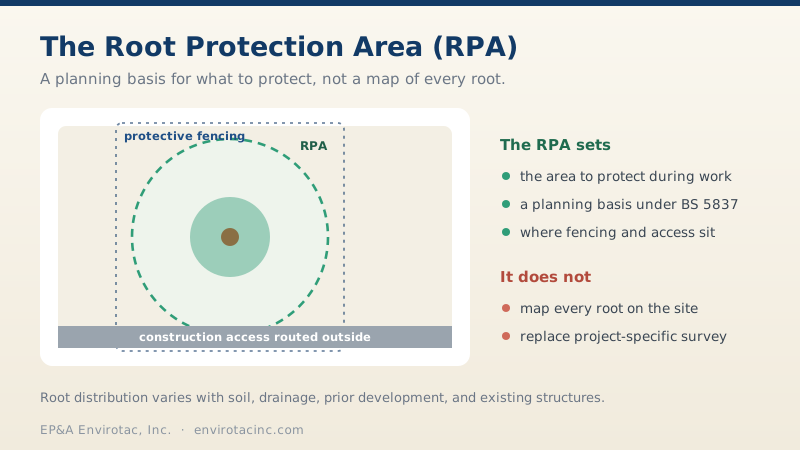
The RPA is a designated area used to establish the extent of root protection required for a retained tree during development. Under BS 5837, its calculation provides a planning basis for protection. It does not map every root or establish the precise location of roots across the site.
The assessment should consider the tree information, site conditions, proposed construction activity, and the likely extent of ground disturbance. Root distribution can be influenced by soil conditions, drainage, previous development, existing structures, and other site-specific factors. Where the proposed work creates uncertainty about roots or ground conditions, further investigation may be required under the project arboriculturist’s direction.
The proposed activity should be described in practical terms:
- Location and dimensions of the work.
- Excavation depth and extent of ground preparation.
- Expected vehicle and equipment loads.
- Traffic frequency, turning movements, and duration.
- Changes to existing and finished levels.
- Drainage and surface-water arrangements.
- Access and material-handling requirements.
These details establish the conditions against which construction methods can be assessed. They also help identify whether the proposed work can be relocated, reduced, or redesigned before a ground treatment is selected.
2. Establishing the Construction Requirement Before Selecting a Method
A construction route or working area should be assessed against its operational requirements. Width, load capacity, turning space, traffic frequency, duration, and finished levels may each affect the design.
Where the route serves temporary access, its alignment, length of use, vehicle movements, or required width may be open to adjustment. Permanent works may have tighter constraints because they must meet design levels, accessibility, drainage, and service requirements.
The project team should establish which requirements are fixed and which can be revised. This provides a defined basis for considering alternatives such as relocating the route, reducing its footprint, changing the construction sequence, or selecting a different surface arrangement.
The resulting design brief should state the loads, ground conditions, dimensions, expected use, and arboricultural constraints. Without those inputs, a proposed stabilisation system cannot be assessed against a clear project requirement.
3. Ground Stabilisation, Excavation, and the Rooting Environment
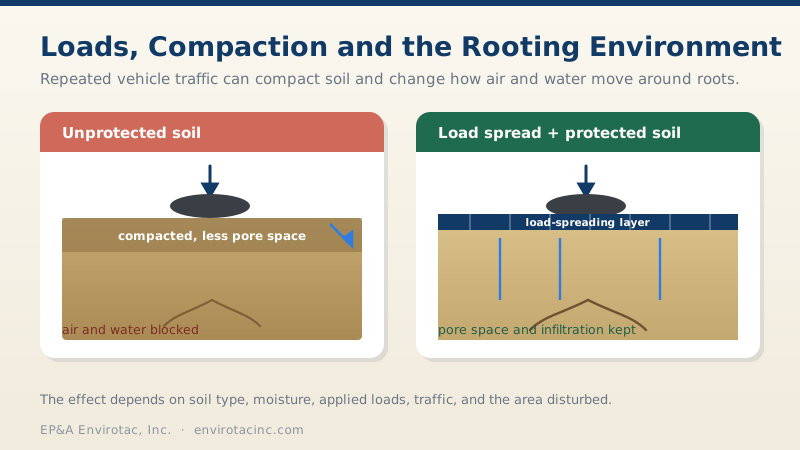
Ground stabilisation near retained trees involves both the performance required for construction and the effects of the proposed work on the soil. Vehicle loading, repeated traffic, excavation, compaction, and changes to water movement can affect the rooting environment.
Compaction can reduce soil pore space and alter the movement of air and water through the soil. The extent of the effect depends on soil type, moisture condition, applied loads, traffic, and the area disturbed. Design and construction decisions should therefore account for the existing ground and the condition required after installation.
Geogrids and cellular confinement systems may be considered for load distribution or ground stabilisation. Their suitability depends on system design, loading, subgrade conditions, required build-up, and installation method. A system that permits a shallow construction build-up may reduce excavation in a particular design, but this must be established from its actual section and preparation requirements.
Assessment should cover:
- Required load capacity and allowable deformation.
- Existing ground strength and moisture conditions.
- Excavation and preparation depth.
- Materials and equipment required for installation.
- Finished levels and edge details.
- Surface-water infiltration, drainage, and water movement.
- Effects on roots and the protected soil area.
Infiltration performance depends on the surface, underlying soil, compaction, and drainage arrangement. These factors determine how much water enters the ground and where it moves.
Erosion control becomes relevant where exposed or disturbed soil, slopes, runoff, or grade changes create a risk of soil loss. The selected treatment should match the site conditions and intended application. Its use near retained trees also requires review against the project’s arboricultural requirements.
A stabilisation or erosion control product should not be specified for an RPA solely from a general construction application claim. Product data, installation conditions, performance evidence, and compatibility with the tree protection requirements need to be reviewed for the proposed use.
4. Installation Requirements and Their Implications for Root Protection
The installation method influences the disturbance introduced by a construction system. Design drawings should therefore be reviewed alongside the proposed sequence of work, access arrangements, equipment, and material handling.
The method statement should address:
- Access for plant, delivery vehicles, and installation crews.
- Movement and storage of construction materials.
- Removal or preparation of existing surfaces.
- Levelling and placement of the proposed system.
- Edge restraints and transitions to adjoining surfaces.
- Protection measures during each stage of the work.
- Arboricultural supervision and communication arrangements.
- The response required if roots or unexpected ground conditions are encountered.
Installation sequencing deserves particular attention where construction traffic must cross or operate beside a protected area. The access route used to install a ground protection system may itself create disturbance. The proposed sequence should identify how that movement will be controlled and how the protected area will be maintained.
Where roots are exposed or unexpected conditions arise, the method statement should define who has authority to assess the situation, what work must pause, and how the next step will be agreed. The response should follow the project-specific arboricultural and construction requirements.
These arrangements should be resolved before work begins. They form part of the design’s delivery requirements and should be reflected in site documentation.
5. Selecting an Approach Under Defined Conditions
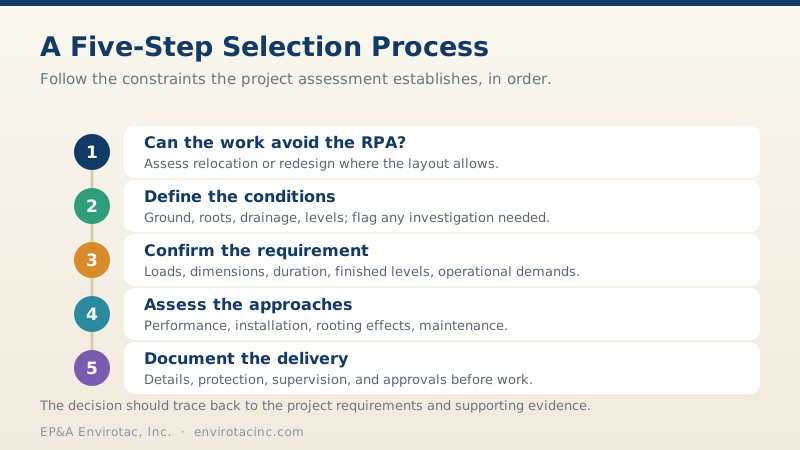
The selection process should follow the constraints established by the project assessment.
First, establish whether the work can avoid the RPA. Relocation or redesign should be assessed where the project layout permits it.
Next, define the ground and arboricultural conditions. Where root location, soil strength, drainage, or existing levels remain uncertain, identify the investigation needed before selecting a method.
Then, confirm the construction requirement. Establish the loads, dimensions, duration, finished levels, and operational demands that the design must accommodate.
Assess the available approaches against those requirements. This may include changing the route, reducing excavation, using a ground protection arrangement, or considering a stabilisation system. Each option should be reviewed for structural performance, installation demands, effects on the rooting environment, and maintenance requirements where applicable.
Finally, document the conditions for delivery. The selected approach should have defined construction details, protection measures, supervision arrangements, and a response process for unexpected site conditions. Required arboricultural and engineering approvals should be established before implementation.
The decision should be traceable to the project requirements and supporting evidence. This gives the design team, arboriculturist, contractor, and approving parties a shared basis for reviewing the proposed work.
Conclusion
Construction near retained trees calls for an assessment that connects the proposed activity with ground conditions, structural requirements, and arboricultural protection. The RPA establishes a framework for that assessment, while the construction design must address the specific loads, excavation, levels, drainage, and installation sequence involved.
Soil stabilisation can contribute to construction access and ground-management requirements where the selected system is supported by appropriate design and application evidence. Erosion control may also be relevant where exposed soil, runoff, or slopes create a defined need.
The resulting approach should be supported by project-specific engineering assessment, arboricultural input, and clear installation requirements. This allows construction needs to be addressed with defined responsibilities and a documented basis for protecting retained trees.
Discuss Soil Stabilisation and Erosion Control with EP&A Envirotac, Inc.
Construction projects involving temporary access, exposed ground, or erosion-prone areas may require stabilisation or erosion control treatments suited to site conditions and intended use.
EP&A Envirotac, Inc. offers soil stabilisation and erosion control products for construction and ground-management applications.
Contact the team to discuss your application requirements, site conditions, loading needs, and exposure conditions, and request relevant product and technical information.
Product suitability for work within a tree RPA should be established through project-specific technical review and arboricultural assessment.
Applications - Dust Control & Soil Stabilization Products
Leave a Reply