
September 28, 2026
The Question Most Assessments Stop Short Of
Freeze-thaw damage is one of the more extensively studied problems in pavement engineering, which can make it easy to mistake familiarity with the phenomenon for precision in diagnosing it.
The standard variables, namely whether freezing occurs, whether the subgrade is frost susceptible, and whether visible distress has developed, are crucial. But on their own, they are insufficient.
What they tend to leave unexamined is what happens to the pavement-foundation system during the period when it is most exposed: what changes across that window, what those changes do to the system’s capacity to carry load, and whether any treatment applied to one component of that system preserves the performance that matters when that window arrives.
These are related questions. They are not the same question, and treating them as interchangeable can lead an assessment astray before a single measurement is taken.
The Frozen State Is Not the Vulnerable State
A pavement-foundation system is not a single material. It is a layered assembly, surface, base, subbase, and subgrade, whose components interact under load and whose collective behavior during freeze-thaw cycling reflects that interaction rather than the properties of any one layer in isolation. That framing shapes how the seasonal cycle should be read.
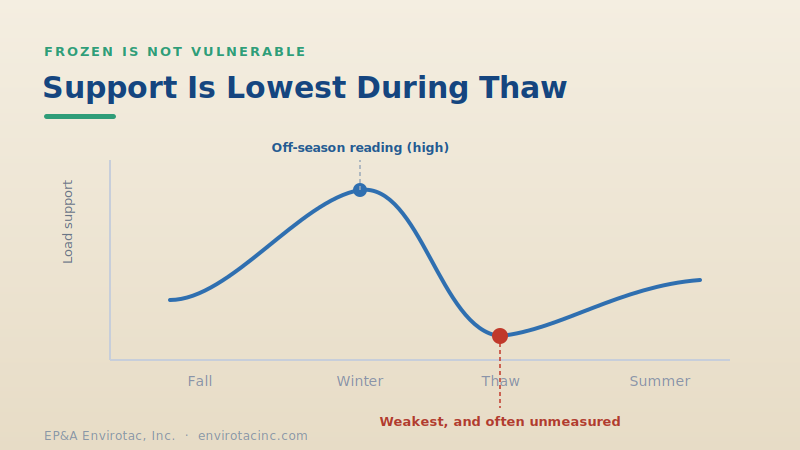
Frozen ground can exhibit substantially increased stiffness. Measurements taken during that period are accurate; the material genuinely behaves differently when it is frozen. The limitation is not their accuracy. It is what they are measuring, and when.
As thaw penetrates the section, changes in moisture distribution and effective stress can reduce the foundation’s load-bearing capacity, particularly where excess moisture remains within the section during the transition. The capacity that held during freezing can deteriorate over a period short enough to pass between routine assessments, while traffic continues and load keeps being applied to a system whose behavior has shifted considerably from what an off-season measurement recorded.
Seasonal deflection research and instrumented pavement studies show that thaw can coincide with the lowest-support period of the annual cycle. The scale of that reduction cannot necessarily be inferred from measurements taken at other points. A modulus value from late summer describes the material accurately under those conditions. It says relatively little about what the same system does when thaw is progressing through the section under load.
A period of greatest seasonal vulnerability may be neither the strongest condition the pavement experiences nor the condition captured by routine off-season measurements. Evaluating freeze-thaw performance without characterizing it leaves the most exposed part of the problem unexamined.
Surface Movement and Structural Capacity Loss Are Not the Same Problem
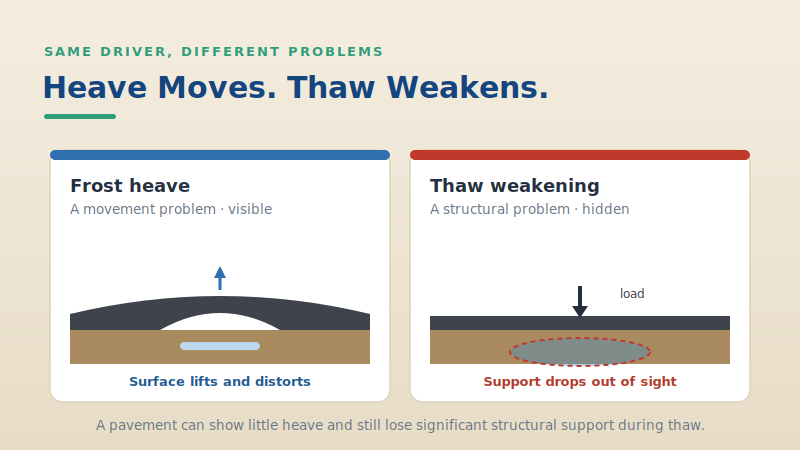
Frost heave and thaw weakening share an environmental driver. In most other respects they are distinct problems, and the distinction shapes everything from how distress is diagnosed to what intervention is warranted.
Frost heave is a movement problem. Ice-lens formation in the underlying soil lifts and displaces the pavement, producing differential elevation, surface irregularities, and degraded rideability. These are genuine engineering concerns, and where heave is the primary issue, the consequences are visible and attributable.
Thaw weakening is a structural problem. As thaw progresses, changes in moisture and effective stress can reduce the foundation’s load-bearing capacity, particularly where excess moisture remains within the section. Deflection increases, and repeated traffic loading can accelerate damage while the foundation is weakened. Neither the onset nor the scale of this process is necessarily evident at the surface.
A pavement can exhibit limited visible heave and still experience significant loss of structural support during thaw. The two can diverge substantially in magnitude and consequence. Where the performance concern is structural, such as rutting that appears earlier than the traffic record would suggest, distress despite seasonal load restrictions, and fatigue cracking that doesn’t add up, those patterns warrant investigation into what the foundation was doing while they developed. Surface displacement measurements, on their own, answer a different question.
Frost Susceptibility Is One Input Into a Larger Problem
Frost susceptibility describes a material tendency: the propensity to develop ice lenses and volume change when the necessary water and freezing conditions are present. As a screening tool, it has real value. It identifies materials that warrant closer attention and informs decisions where alternatives are available.
What it does not do is predict field performance on its own. Whether that susceptibility produces a performance problem on a given project depends on the conditions the pavement will actually experience: water availability and source, temperature conditions and duration, moisture movement pathways through the section, soil density and structure, drainage, loading, and site geometry. Change any of those, and the risk profile shifts, sometimes substantially, even with the same classified material in the same position in the section.
The field conditions that determine whether susceptibility becomes a performance problem matter to the intervention decision as much as the classification itself. The classification opens an inquiry. What that inquiry needs to establish is whether frost action will produce a specific consequence under the conditions that the project will actually see, and that requires more than the classification to answer.
Drainage Diagnosis Has to Precede Drainage Prescription
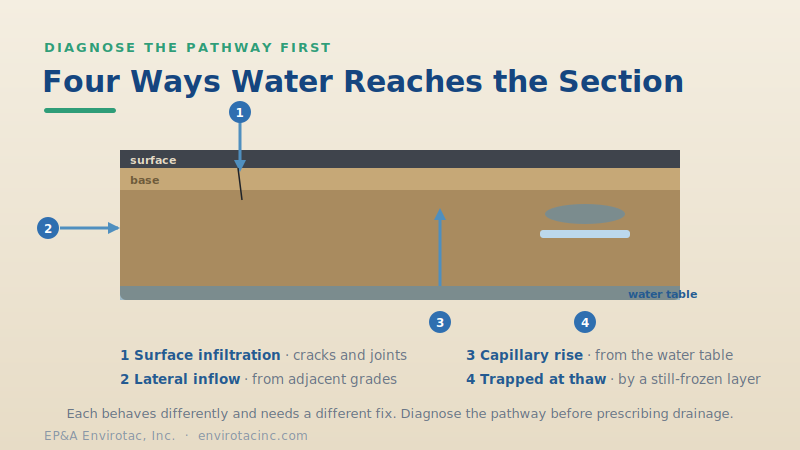
Water is not incidental to freeze-thaw damage; its availability and movement can determine whether frost action becomes consequential at all. Modifying the water regime can be the right intervention when water is driving the problem, and when correctly targeted, it can provide durable protection.
The step that gets compressed is identifying which water pathway is driving the problem. Water reaches and moves through pavement sections in distinct ways: surface infiltration through cracks and joints, lateral inflow from adjacent grades or cut slopes, capillary rise from an underlying water table, and moisture trapped during thaw by still-frozen or lower-permeability material. Each behaves differently and responds to different interventions. A lateral interceptor addresses lateral inflow. Better surface integrity reduces infiltration. Neither directly addresses capillary rise.
Timing matters as much as source. The question is not simply whether water is present but when it accumulates, where it sits, and how that coincides with thaw progression and traffic. Some sections need drainage. Some need material modification to reduce moisture sensitivity. Some need both. Where diagnosis is skipped, the prescription, however sound in execution, is working from an assumed problem rather than a found one.
From Diagnosis to Intervention: What in the System Actually Needs to Change
Pavement behavior under freeze-thaw conditions is a system response. How components interact, how moisture moves through the section, and how the seasonal cycle loads the assembly at its weakest point shape the outcome more than any single material property does. That is what makes the intervention question harder than selecting a treatment from a menu of options.
Stabilization is often framed as strength improvement, and in some cases that framing is warranted. But a subgrade that retains reasonable dry-state strength and loses significant stiffness or load-carrying capacity when saturated has a moisture-sensitivity problem. A treatment that raises its dry-state strength further without changing its moisture response may improve a property that was not limiting performance under the conditions that drove the problem.
Different mechanisms require different targets. Resistance to deformation under load during the thaw-weakened period is not the same property as dry-state compressive strength. Moisture sensitivity describes yet another aspect of that behavior. And the structural configuration of the section, layer thicknesses and stiffness distribution across components, can be the binding constraint in ways that modifying one material layer cannot fully address. A treated subgrade is still one component of a system. Where the problem resides elsewhere in that system, improving the subgrade changes one variable without reaching the one driving performance loss.
The performance objective deserves equal scrutiny before the intervention is chosen. Eliminating frost penetration entirely, limiting thaw-related deflection to a tolerable range, and designing explicitly for reduced subgrade support during the vulnerable period are three different engineering objectives. They reflect different standards applied to different project contexts, and the treatment suited to one does not transfer automatically to another. The standard should come from the project. The intervention follows from that.
What a Treatment Does Initially and What It Retains Are Different Questions
Initial measurements of unconfined compressive strength, California Bearing Ratio, and resilient modulus at the time of testing show how a treatment changed the material and allow comparison across treatments under controlled conditions. They are useful for those purposes and should not be set aside. They answer one question: what does this treated material do before it encounters what it was applied to address?
What survives freeze-thaw exposure is a different question. The properties driving field behavior during the vulnerable period, namely strength, stiffness, deformation resistance, and moisture response, need to be assessed after cycling under conditions that approximate the actual exposure, not only before. Initial strength and post-cycling performance answer different questions; using one as a stand-in for the other carries real risk.
For polymer stabilization, the picture is further complicated. Polymer systems differ in chemistry, in how they interact with soil particles, in moisture response, and in freeze-thaw behavior.
Performance established for one formulation under one set of conditions does not, by itself, establish performance for a different formulation, a different soil, or a different exposure environment. What a project actually needs to know is how a treatment performs when applied to the soil in question, through an exposure that approximates what the site will produce, and whether the improvement that drove the treatment decision is still present at the end of that exposure, not just at the beginning.
How Evidence Should Be Read
A study can be carefully controlled and methodologically sound and still fall short of answering what a project needs answered if it measures performance before exposure rather than through it, or tests under conditions that bear little resemblance to the site. How well research is conducted, and how directly it speaks to a specific decision, are different qualities; evidence that has one does not automatically have the other.
Three questions make research useful in a freeze-thaw application:
- Does the study measure the property driving the failure mode being addressed?
- Was the treatment tested under temperature cycling, moisture exposure, and loading that approximate the field environment?
- Does the reported improvement survive that exposure, or does it describe performance before it begins?
For polymer stabilization, where formulation diversity is wide and broad category claims can be unreliable, those questions matter more acutely. A finding about one polymer system under one set of soil and exposure conditions is evidence for that combination. Extending it across formulations or soil types requires supporting data, not inference alone. Where that extension happens without supporting data, the treatment decision is resting on assumption, and the assumption tends to go unexamined until field performance makes it visible.
Conclusion
The problem with freeze-thaw assessment is not that material classifications, surface symptoms, or initial test results are wrong. It is that none of them, alone, describes what happens to the pavement-foundation system when thaw is progressing through the section under load, which is the period the assessment ultimately needs to address.
That gap appears at every level of the evaluation. In each case the measurement is real; what it cannot do, on its own, is answer the question the engineering decision actually requires.
| The measurement | What it doesn’t describe on its own |
| Frozen-state measurement | The thaw state |
| Surface movement | Structural support |
| Susceptibility classification | Field consequence |
| Dry-state strength | Retained performance |
| The polymer category | Specific treatment behavior |
| A rigorous study | The decision at hand |
For stabilization decisions, including those involving polymer systems, the question is whether the pavement-foundation system retains the performance the project requires when the seasonal cycle reaches its weakest point and the load continues to be applied.
Everything else feeds into that question. None of it replaces it.
Applications - Dust Control & Soil Stabilization Products

Leave a Reply