

September 23, 2026
“Works” Is Not Yet an Engineering Conclusion
A treatment can produce a large improvement in a measured property and still leave unanswered whether it solved the problem the road had.
This happens when “works” is treated as self-evident rather than as a judgment with a required referent. Stabilization can serve different objectives, such as strengthening weak soil, limiting volume change, reducing moisture-related susceptibility, and providing a construction platform, and different factors govern performance depending on which objective controls the project. The same word, “works,” can describe very different outcomes depending on what the project needed.
The question is not “did something improve?” It is: what improvement was required, and does this result establish that it happened?
Define What “Better” Means Before Asking Whether a Treatment Works
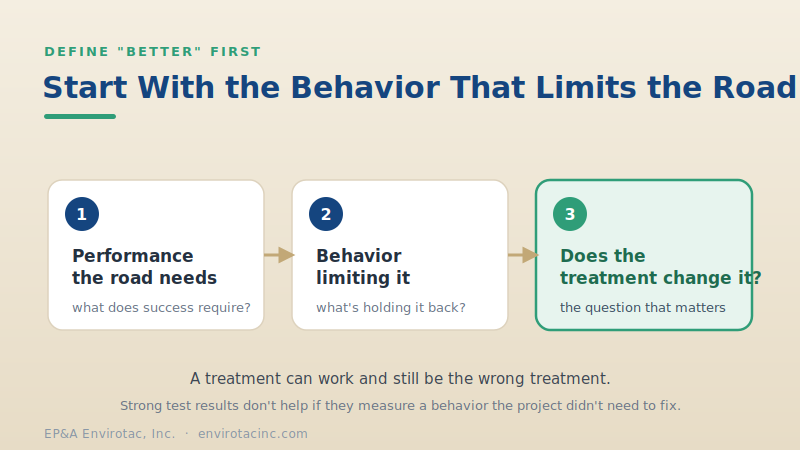
A treatment is not necessarily better simply because one measured property improved. The improvement has to address the behavior limiting the road’s performance.
Start with the performance the road needs, identify the behavior preventing it, then ask whether the treatment changes that behavior. A treatment optimized for strength gain in a swelling-soil context, or for moisture resistance on a project that needed a construction platform, can produce strong test results and still be the wrong answer. A treatment can work and still be the wrong treatment.
The trap is optimizing for the property that generates the clearest result rather than the behavior controlling performance. That is not a reflection on any particular metric, but on how narrowly the question gets framed before testing begins.
What Decision Does the Evidence Support?
A measured result is valuable in proportion to the decision it can support, not in proportion to how large the number is.
Different kinds of evidence answer different questions. A decision requires knowing what a given change allows you to conclude about the project’s requirement:
| Evidence | What it establishes | The question it answers |
| Product information | What the material is | What am I using? |
| Performance claims | What it is said to do | What does the maker say it does? |
| Treatment results | What happened under the tested conditions | What happened in the test? |
| Performance metrics | What changed in the behavior they measure | What behavior changed, and by how much? |
| The engineering decision | What that change means for the project | Does this establish what the project needs? |
Each level answers a different question, and the decision depends on whether the available evidence is sufficient to answer the questions that matter for the project.
CBR provides a standardized way to quantify a bearing-related strength response, which is precisely why its boundaries matter. A substantial CBR improvement is meaningful evidence of a change in that strength response. The engineering questions that follow go beyond whether the result is credible; they concern what produced it and what it establishes for the project. What soil was treated, at what rate, under what moisture and compaction conditions, with what test method and conditioning protocol? And is bearing-related behavior the performance dimension the project needs to resolve?
The mistake is not measuring CBR. The mistake is asking it to answer a question it was never designed to answer.
Polymer-treated soils evaluated across swelling, unconfined compressive strength, and hydraulic conductivity show that strong performance on one measure does not necessarily carry across to another. A treatment that looks less favorable on strength-related evidence can be more favorable on volumetric or permeability measures, and vice versa.
Declaring a treatment “better” before identifying the controlling performance requirement is both premature and logically incomplete. The significance of that evidence changes depending on which behavior the project needs to resolve.
What Would Have to Be True for That Evidence to Transfer to This Project?
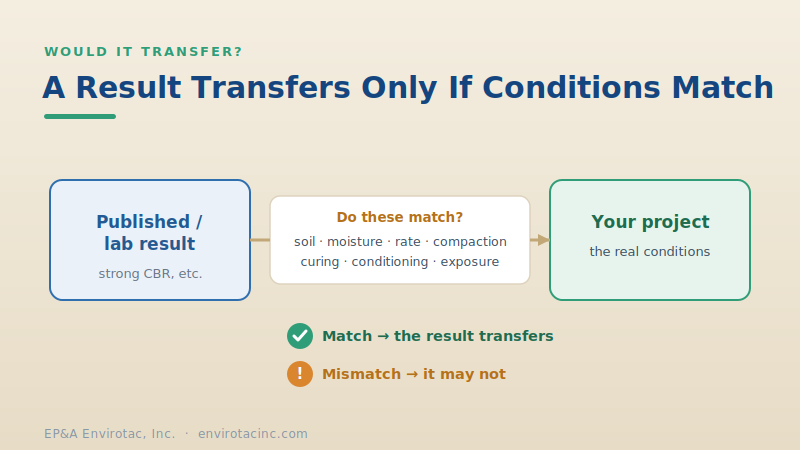
A valid result can establish treatment potential without answering every question about field applicability. What matters is which conditions, if different on the project, would change the inference.
Depending on the treatment and project, those conditions may include soil characteristics and spatial variability, moisture, application rate, compaction, curing, conditioning, construction consistency, and environmental exposure. Not every condition matters equally for every treatment-soil combination, but the ones that do can substantially change what a controlled result predicts about project performance.
How far a result travels depends on how closely the conditions behind it match the conditions the project presents. Stabilization choices and application rates vary with soil type and expected load-bearing requirements, which is why the conditions behind a published result must be checked against the conditions the project presents.
Additional investigation can reduce uncertainty, but it also adds time and cost. The question is whether the uncertainty it addresses is capable of changing the decision. Investigation that cannot change the decision may add cost without adding corresponding decision value.
What Does Each Approach Ask the Project to Give Up?
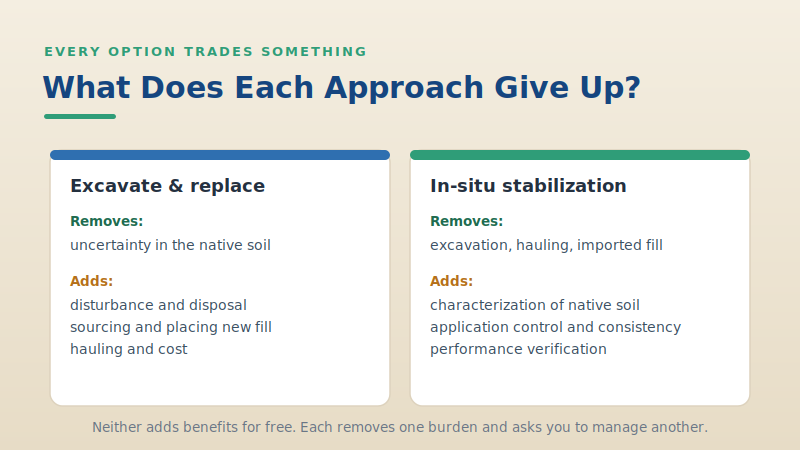
Stabilization choices redistribute material, construction, uncertainty, and performance burdens. They do not simply add benefits.
Excavation introduces disturbance, disposal requirements, and the need to source and place replacement material. In-situ stabilization generally leaves the native soil in place. Avoiding material removal does not make the variability in that soil disappear; it changes which burdens the project must manage. Characterizing, treating, and verifying the in-situ material becomes more consequential, not less.
In-situ treatment may reduce excavation, hauling, and imported material requirements. Uniform treatment delivery and construction consistency carry greater weight in return. Neither option eliminates every management burden. They trade some for others.
An established approach may carry institutional familiarity, existing specifications, and a more familiar approval process. A less familiar treatment may require stronger project-specific evidence to reach equivalent confidence. That is a real factor in scoping the evaluation.
What burden did this option remove, and what did it make the project manage instead?
When Does Polymer Stabilization Make That Trade Worthwhile?
Polymer stabilization deserves consideration when its demonstrated performance and trade-offs align with the soil, the limiting behavior, the required outcome, and the conditions under which the treatment can be delivered.
The first question is what performance deficiency needs to change. A project dominated by inadequate bearing support calls for different evidence than one dominated by volumetric instability or moisture susceptibility or, in some projects, simply achieving a workable construction platform. That determination isn’t preliminary housekeeping. It governs which results deserve weight and which may be secondary, regardless of how favorable they look.
From there, the evidence question becomes specific. CBR can provide evidence relevant to bearing and support behavior; UCS can inform strength behavior; swelling measures can characterize volumetric response; moisture-conditioned testing can reveal susceptibility that a dry or unconditioned result may not. Where multiple behaviors can limit performance, a treatment’s profile across the relevant measures is more informative than its performance on any single one, and the controlling requirement determines which measures carry the decision. More than one measure may be relevant, because improving one limiting behavior does not necessarily resolve another.
Substantial CBR improvements in polymer-treated soils have been reported under specific soil, treatment, and test conditions. Because treatment response can vary with the soil, treatment formulation, moisture, and curing conditions, results from one context cannot automatically be transferred to another. This is not a limitation unique to polymer stabilization; it is the same transferability question raised above, applied here specifically.
The trade-off runs in the other direction as well. In-situ treatment may reduce material movement and retain suitable native soil. It places greater weight on characterization, application control, treatment consistency, and performance verification in the measures the project requires. Does this treatment demonstrate the performance the project needs, under conditions applicable to it, with enough evidence to justify what the approach introduces? That is the decision.
The Engineering Decision
Good stabilization decisions are not built around the strongest number. They are built around the evidence that answers the decision that has to be made.
A strong CBR result may matter. A product specification may matter. A field case study may matter. Each answers a different question. The engineering decision comes from knowing what question each piece of evidence can answer, and from not asking any single result to answer more than it was designed to.
For a closer look at how polymer-based soil stabilization can improve soil conditions, and why soil and project conditions matter to the treatment approach, read How Polymer-Based Soil Stabilization Improves Soil Conditions.
Applications - Dust Control & Soil Stabilization Products
Leave a Reply