
August 19, 2026
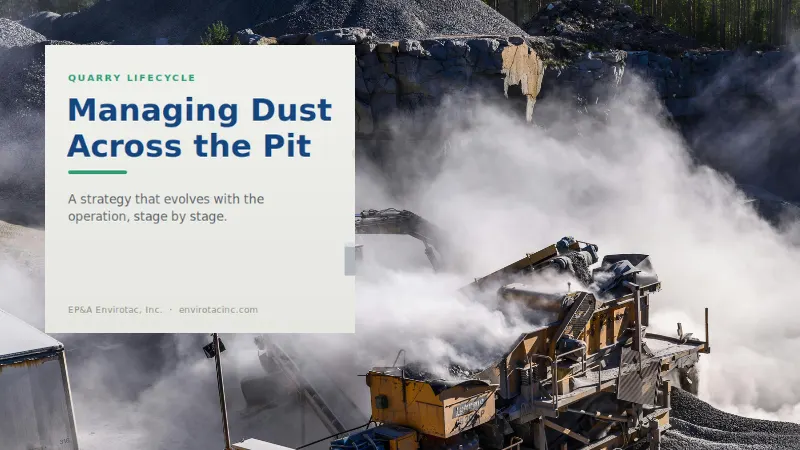
A dust control strategy that works well in year two of a quarry’s life can become a liability by year ten. Not because it was wrong to begin with, but because the operation it was designed for no longer exists. Traffic patterns shift, exposed surface areas grow and then contract, production intensity climbs, water availability gets more constrained, and community expectations sharpen. Each of these changes can reduce the effectiveness of the dust control approach that was originally put in place.
The challenge is not always a lack of attention to dust management. It’s that dust control programs may not evolve continuously while the operations around them keep moving.
What follows is a look at how dust control priorities can evolve at each stage of the quarry lifecycle and why treating that evolution as a strategic question, rather than a maintenance task, is what separates efficient programs from expensive ones.
Early Operations: Building a Dust Control Strategy Before Production Peaks
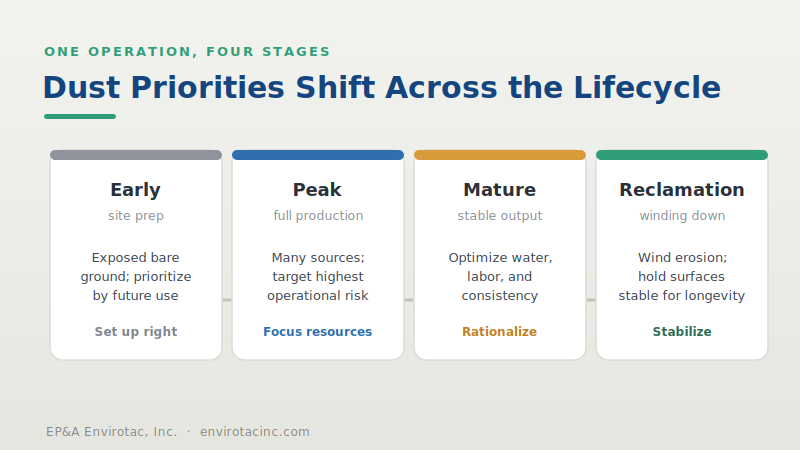
The first dust problems at a quarry usually don’t come from crushing or blasting. They come from scrapers, graders, and trucks moving across newly stripped ground. Site preparation and early earthmoving expose large areas of bare soil before permanent dust-control infrastructure is fully established.
This is also when decisions get made that operators will live with for years. Temporary haul roads laid down during site preparation may remain in service longer than intended, making proper surface treatment and drainage increasingly important. Soils disturbed during stripping and grading remain fugitive dust sources long after the equipment that created them has moved on.
The smarter approach during early operations isn’t to apply controls everywhere; it’s to prioritize based on what the operation is going to become, not just what it is right now.
Three questions to ask:
- Which access routes will carry the heaviest traffic at peak production?
- Which disturbed areas are closest to site boundaries or prevailing wind directions?
- Which surfaces are likely to remain exposed for months rather than weeks?
Early decisions made with production in mind reduce the corrective work required later. A haul road built and treated correctly at the start usually costs less to maintain over time than one that’s repeatedly patched because its initial condition was never quite right.
As Production Increases, Dust Priorities Shift
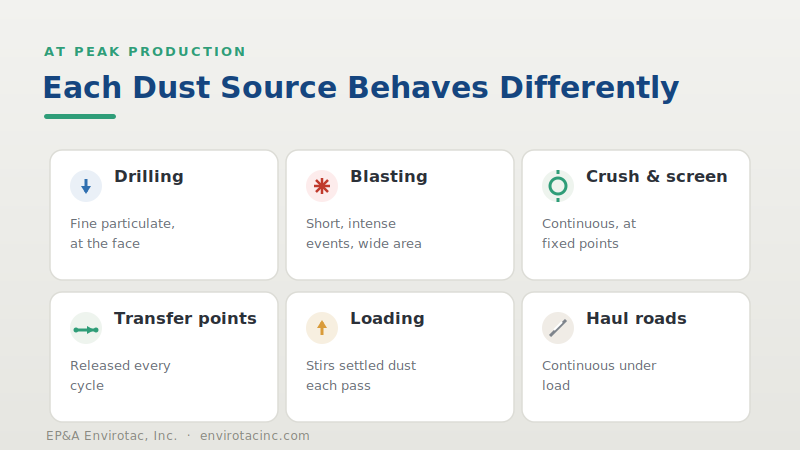
A quarry at peak production is a different environment than a quarry in its early stages. The relative importance of its dust sources changes too. Drilling creates fine particulate. Blasting generates short, intense dust events across large areas. Crushing and screening produce continuous emissions at fixed points. Transfer points and conveyor systems can release material with every cycle. Loading operations stir up settled dust each time a truck pulls through.
Each of these sources behaves differently. A blast event requires different thinking than a transfer point. A screen deck has different management needs than a loaded haul road. Applying the same suppression approach across all of them doesn’t reflect how the operation actually works. It may lead to programs that overinvest in some areas while leaving meaningful risks unaddressed in others.
What changes at peak production isn’t just the volume of dust. It’s the operational consequence of not controlling it. Poor visibility near a crusher affects personnel movement and equipment cycles. Dust accumulation at transfer points creates maintenance demands and can affect material quality. Unmanaged emissions near site perimeters become community issues that distract operational management.
The goal at this stage isn’t to suppress every dust source equally. It’s to identify which sources carry the highest operational risk (safety, equipment wear, throughput, and neighbor relations) and concentrate resources there. That means regularly asking whether the current control program reflects current production realities or whether it was designed for an earlier version of the site.
Haul Roads: Where Long-Term Thinking Delivers the Greatest Returns
Haul roads sit at the center of most quarry dust programs, and for good reason. They’re active whenever production is running, they deteriorate continuously under load, and they often require more water to suppress than almost any other source on site.
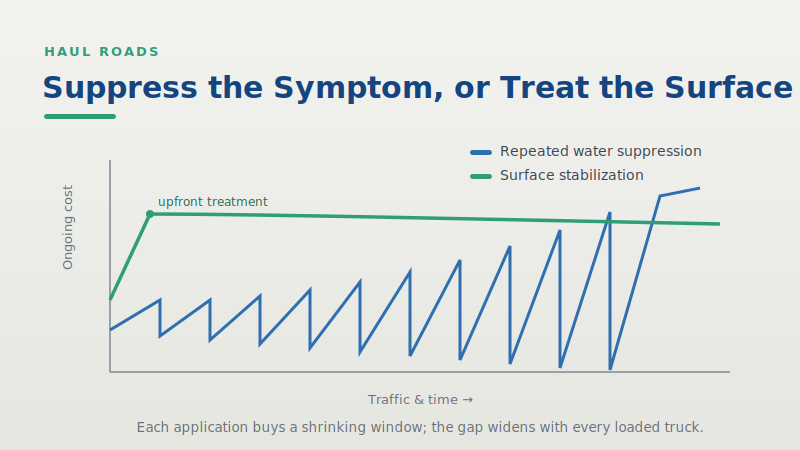
But the reason haul roads deserve the most strategic attention isn’t their size. It’s the compounding cost of managing them reactively. Every application of water buys a window of suppression, and then the road dries out, traffic breaks the surface down further, and the next application becomes less effective than the last. As traffic volumes increase, the frequency required to maintain acceptable dust levels climbs with them. Water consumption rises. Labor demands increase. Road surfaces continue to degrade. And operational continuity, visibility, safe speeds, and truck availability become harder to maintain consistently.
This is where residual stabilization starts to change the calculus. Rather than suppressing dust that’s already been generated from a deteriorating surface, stabilization treats the surface itself, binding material together so that it holds up under traffic rather than breaking down into dust. The initial investment is higher than a water application. The ongoing resource demand is lower, sometimes substantially.
The question worth asking at any stage of quarry development is whether the current haul road program is managing dust or managing the symptoms of a surface that was never treated to handle the traffic it’s carrying. As production increases, that distinction matters more, because the gap between the two approaches widens with every truck that runs the route.
Not every haul road justifies long-term stabilization. A temporary bypass road that’ll be closed in three months probably doesn’t. A primary crusher access route running hundreds of loaded truck cycles a day almost certainly does. The strategic value comes from making that distinction deliberately, rather than applying the same approach across the entire road network.
Mature Operations: Optimizing Rather Than Expanding Dust Control
At some point, a quarry’s dust control program stops growing and starts consolidating. Production patterns are established. The road network is set. The highest-impact dust sources are well understood. The question shifts from “what do we need to control?” to “how do we control it better?”
In mature operations, the pressure points are usually water, labor, and maintenance consistency. Water availability becomes a genuine constraint, especially in drier seasons or regions where competing operational demands increase. Application crews carry real costs. And dust performance that varies day to day creates operational uncertainty that experienced site managers find harder to tolerate than the dust itself.
A mature dust control program responds to these pressures by targeting efficiency rather than expanding coverage. That might mean moving higher-traffic areas from frequent water applications to longer-lasting stabilization methods, freeing water trucks for sources that genuinely require ongoing suppression. It might mean consolidating application schedules so that maintenance resources are concentrated where they have the most impact. Or it might mean revisiting which inactive or lower-traffic areas are still receiving the same treatment frequency they did during peak production and asking whether that’s still the right allocation.
Community expectations also tend to sharpen as a quarry matures. Neighbors who accepted a certain level of dust impact when the operation was new have less patience for it a decade later. The operational value of consistent dust performance, not excellent on some days and poor on others, becomes more tangible.
A mature program isn’t necessarily a larger one. It’s one that’s been rationalized around current operational realities, where resources follow impact rather than habit.
Reclamation: Dust Control Doesn’t End When Production Slows
Production slowdowns and phased reclamation introduce a dust challenge that’s easy to underestimate: large areas of disturbed surface that are no longer being actively managed. When haul roads stop carrying traffic and extraction areas go inactive, the maintenance attention they once received goes with them. But the surfaces remain, and exposed, unbound material doesn’t need truck traffic to generate dust. Wind does the job instead.
The dust control objective during reclamation is fundamentally different from what it was during active production. It’s not about maintaining visibility for equipment operators or reducing wear on truck components. It’s about holding surfaces stable long enough for conditions to change, whether that means revegetation establishing, material being relocated, or a temporary closure running its course.
Wind erosion from inactive areas can affect active operations nearby, reach site boundaries, and undermine the reclamation progress being made elsewhere. A stockpile that’s been consolidated and capped without surface treatment becomes a dust source every time dry conditions and wind coincide. Stripped areas awaiting replanting can remain unstable for months.
Surface stabilization during reclamation serves a different function than dust suppression during production. The goal is longevity rather than immediate performance: treatments that hold a surface together through weather events and across extended timeframes, without requiring the repeated application cycles that active production areas need. The transition from managing dust for operational continuity to managing it for long-term surface stability is one of the more underappreciated shifts in the quarry lifecycle.
A Lifecycle-Based Framework for Smarter Dust Control Decisions
The through-line across every stage of the quarry lifecycle is the same: dust control decisions should be driven by current operational conditions, not inherited from previous ones. That sounds straightforward. In practice, it requires operators to revisit assumptions that can become invisible over time, programs that were built for a different version of the operation and have simply continued because no one stopped to question them.
A useful set of questions to revisit periodically:
- Have the highest-impact dust sources changed? Expansion into new areas, changes to haul road configuration, and shifts in production focus all alter which sources carry the most operational risk. The sources that justified the most attention two years ago may not be the same ones today.
- Are current control methods still aligned with operational priorities? A water-intensive suppression program made sense when water was readily available and the road network was still temporary. That logic may not hold at mature production with a permanent road system and tighter water budgets.
- Where are water, labor, or maintenance costs increasing disproportionately? Rising input costs are often the clearest signal that a control method has outgrown the conditions it was designed for. Increasing application frequency to maintain the same performance is a symptom worth examining rather than simply absorbing.
- Which areas justify longer-lasting stabilization instead of repeated suppression? Polymer-based dust suppressants earn their place in this framework not as a universal answer, but as a tool for specific situations, primarily where high traffic volumes, limited water availability, or the need for consistent long-term performance make repeated suppression progressively less efficient than treating the surface itself.
- Is the dust control strategy evolving with the operation or continuing by habit? This is the question that the others are all pointing toward. The value of lifecycle-based thinking isn’t in the framework itself. It’s in the discipline of asking whether today’s approach was designed for today’s operation.
Conclusion
Effective dust control in a quarry isn’t about finding the right program and holding to it. It’s about recognizing that the right program changes as the quarry changes and building the discipline to adapt accordingly.
The operational payoff for getting this right compounds over time. Resources follow impact instead of inertia. Water consumption drops when stabilization replaces suppression in the areas that justify it. Maintenance demands ease when surface treatments hold up rather than requiring repeated intervention. Performance becomes more consistent, which means fewer disruptions to equipment cycles, visibility, and neighbor relations. And reclamation efforts are less likely to be undermined by erosion from surfaces that were never adequately stabilized.
The practical starting point is an honest assessment: does the current dust management program reflect how this quarry actually operates today or how it operated when the program was last designed? Where those two pictures don’t align is where the most valuable changes are usually waiting.
That’s also where longer-lasting stabilization methods, including polymer-based dust suppressants, tend to deliver their clearest operational returns, not as the centerpiece of a dust program, but as the right tool for the right stage of the lifecycle.
Applications - Dust Control & Soil Stabilization Products

Leave a Reply