
July 27, 2026
A geotechnical report can list a dozen numbers worth knowing, but one of them tends to matter more than the rest once a project moves from paper to dirt: the Plasticity Index, or PI. It’s not the flashiest figure on the page, but it’s often the one that ends up explaining why a road kept rutting or why a work platform never quite firmed up.
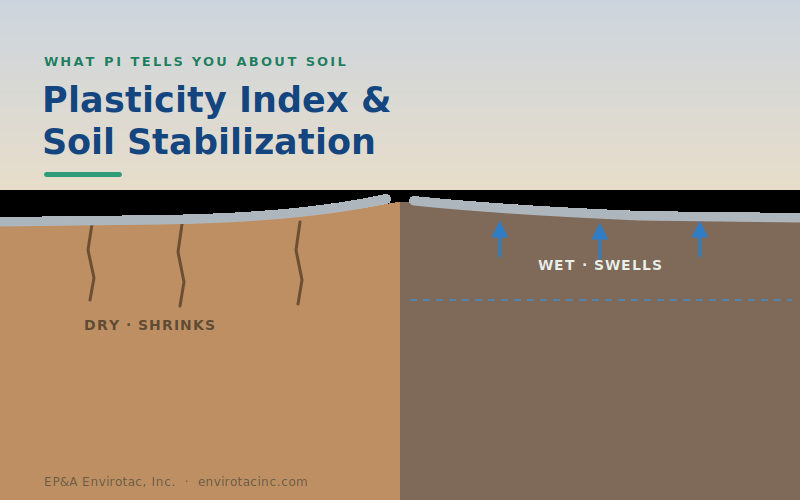
A high PI on its own isn’t a verdict. What it points to is moisture sensitivity: soil that shifts, softens, and behaves differently than expected once conditions change. Sometimes the PI value matters less than whether the soil keeps generating costs nobody budgeted for. Figuring that out starts with understanding what the number is actually telling you.
What Does Plasticity Index Tell You About Soil Behavior?
Plasticity Index is, technically, the range of moisture content over which soil holds together: moldable, deformable, without crumbling or turning to liquid. Put more simply, it’s a measure of how much a soil’s behavior changes as water content shifts.
Higher PI usually means more clay in the mix. Clay-rich soils are generally more reactive to moisture changes than sandy soils. Reports don’t always spell this out plainly, and the number matters less for what it says today than for what it predicts months out, under weather nobody tested for in a lab.
Low PI tends to mean fewer surprises down the road. Moderate PI sits in a gray zone where conditions end up mattering more than the number itself. High PI is the one that tends to demand a second look.
How Different Plasticity Index Ranges Affect Construction Performance
Low Plasticity Soils
These soils are generally easier to work with because they remain relatively stable as moisture conditions change. They don’t swing much with the weather. A season from now, they’ll probably behave about the same as they do today, which, on a busy site, counts for a lot more than it sounds like it should.
Moderate Plasticity Soils
This is the gray zone. A lot of project teams get caught off guard here because moderate PI soils can perform well under the right conditions. And “the right conditions” ends up doing most of the work in that sentence. Drainage. Compaction timing. Whatever happens to be specific to that site that week.
High Plasticity Soils
A high PI rarely causes trouble on the day the report shows up. The trouble comes later: a road starts rutting, a platform won’t stay firm, and maintenance crews are making their third trip to the same stretch of ground. Greater shrink-swell potential and increased sensitivity to seasonal moisture swings. None of it is exotic. It’s just clay doing what clay does when nobody planned around it.
What Is Considered a High Plasticity Index?
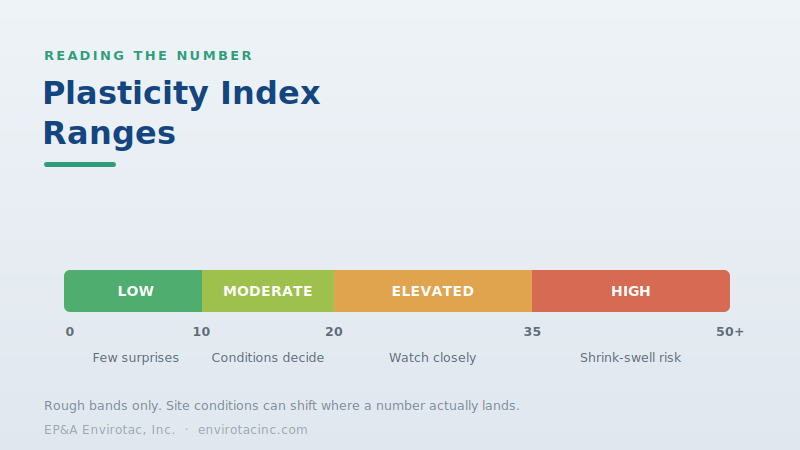
Rough bands, for context: below 10 is generally low plasticity; 10 to 20 is moderate; 20 to 35 indicates increasing moisture sensitivity, and above 35 is often considered highly plastic.
Treating these like pass/fail lines is one of the easier mistakes to make. Soil doesn’t usually cooperate with that kind of cleanliness. A PI of 28 on one site might sit fine for a decade. A PI of 18 somewhere else turns into a recurring headache because of traffic loads, drainage, or moisture exposure the site just wasn’t built to handle. Two sites can post nearly identical numbers and tell completely different stories. The PI gets you started. It doesn’t finish the job.
Plasticity Index remains one of the most widely used screening tools in geotechnical engineering because it provides a practical way to identify soils that may be susceptible to shrink-swell behavior during the early stages of site evaluation.
Common Challenges Associated with High-Plasticity Soils
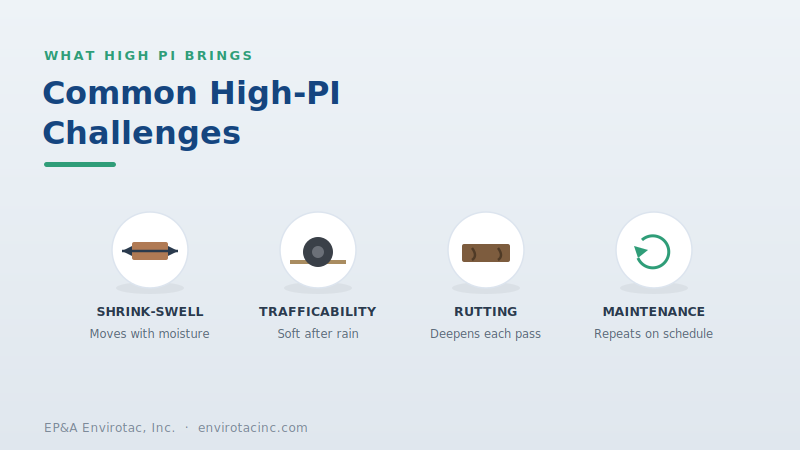
Moisture-Driven Expansion and Contraction
Anyone who’s worked around expansive clay has watched this happen. A surface looks fine in one season and looks like a different surface entirely a few months later, after a stretch of rain or drought. Shrink-swell isn’t a lab concept once you’ve seen it move across an actual parking lot.
Reduced Trafficability
Rain changes things fast on a high-PI site. Ground that held equipment fine Tuesday can be impassable by Thursday. Crews on these projects end up watching the forecast almost as closely as the soil report, and the two turn out to be more connected than the report alone lets on.
Rutting and Surface Deformation
Haul roads take the worst of it. Repeated traffic on soft ground doesn’t just compress it; it displaces it, and the grooves get deeper with every pass. A few inches of rutting is an annoyance. Past a certain depth, it starts deciding which equipment can even use the road at all.
Increased Maintenance Requirements
Teams rarely go looking into stabilization because a lab printed a number. They go looking because they’re tired of fixing the same stretch of ground over and over. Regrading and aggregate replacement stop being occasional and start showing up on the weekly schedule, and that’s usually the point someone asks, out loud, why they’re doing this again.
Long-Term Performance Concerns
The damage tends to be quiet at first. It shows up later as shortened service life and lifecycle costs that run past what the budget assumed. By the time it’s obvious, the soil’s usually been working against the project for a while already.
The consequences can extend beyond maintenance costs. Soil scientists and geotechnical researchers have documented how high shrink-swell soils contribute to pavement distress, foundation damage, slope instability, and failures in buried infrastructure when their movement isn’t adequately accounted for during design and construction.
When Does a High Plasticity Index Signal a Need for Soil Stabilization?
A high PI is worth paying attention to. It isn’t a verdict on its own. A high Plasticity Index doesn’t automatically mean stabilization is required. The better question is what the soil is actually costing the project and whether that cost keeps climbing. A few signs tend to push the conversation forward:
The existing soil can’t reliably carry the loads it needs to. Sometimes this shows up as visible deflection under equipment. Sometimes it’s a surface that never quite firms up, no matter how much compaction effort goes into it.
Maintenance costs keep recurring. One repair is normal. A pattern is information: if the maintenance log reads more like a subscription than a one-off event, that’s the soil talking, not bad luck.
Importing aggregate gets expensive. Sounds simple enough on paper: order material, haul it, place it. The economics shift fast once material has to travel a long distance, or once a project burns through more aggregate than anyone planned for, which high-plasticity soils have a habit of demanding.
Moisture keeps affecting performance, over and over. Wet weather that repeatedly disrupts schedules or access has stopped being an occasional inconvenience. It’s become a project variable.
What it usually comes down to: intended use, expected loads, the specifics of the site, and how much performance the project can’t afford to lose. PI tells you what kind of soil you’re working with. These conditions tell you whether it’s worth doing something about.
How High-Plasticity Soils Increase Maintenance and Construction Costs
Before pricing out stabilization, it’s worth pricing out the alternative.
Take a haul road that holds up fine in dry weather but needs aggregate replacement and regrading after nearly every storm. The geotechnical report might flag a high PI, but that’s rarely what pushes someone to evaluate stabilization. It’s the maintenance, the downtime, and the material costs that keep showing up. PI functions less like a diagnosis here and more like an early warning.
Doing nothing isn’t free. It just spreads the cost out thin enough to pass as routine.
Recurring maintenance is the most obvious cost, though obvious and large aren’t the same thing. Regrading a haul road every few weeks adds up fast once it’s tallied across a full timeline instead of being treated as one-off incidents.
Aggregate replacement compounds it. Every load carries a price (sourcing, hauling, placing), and high-plasticity soils tend to chew through aggregate faster than expected, simply because it keeps sinking or washing out.
Weather downtime is harder to quantify, but it can be just as costly. A day equipment can’t move because the ground’s too soft is a day that’s gone for good. Once that productivity is lost, recovering it isn’t always straightforward.
Equipment takes the wear too: more cycle time, more fuel, more strain, all from machines fighting soft ground instead of standing on something solid.
What’s strange is how rarely these costs show up all at once. They arrive in pieces. A truckload here, an extra grading pass there, a few lost days after a storm. Easy to miss individually. Add them up over a project’s life, and “doing nothing” tends to be the most expensive choice on the table. It just never looks that way in the moment.
What Project Teams Often Find
By the time stabilization comes up, the soil usually isn’t a mystery anymore. The site’s already handed over the clues. Equipment access starts depending on weather. Aggregate gets used up faster than projected. Maintenance stops feeling occasional and starts feeling routine. What actually changes isn’t the soil. It’s the moment someone realizes the problem isn’t going away on its own and that managing around it has gotten more expensive than just fixing it.
Why Plasticity Index Is Only One Part of the Evaluation
No single number tells the whole story in a geotechnical report. PI might be the one that catches the eye first, but engineers who’ve read enough of these reports tend to weigh it against everything else on the page before drawing conclusions.
Moisture content at the time of testing and during construction can shift how soil behaves on-site, separate from PI entirely.
Soil classification gives a broader category to work from, a sense of general tendencies beyond plasticity alone.
Strength metrics like CBR get closer to the question that actually matters in the field: can this soil carry the load it’s about to carry?
Traffic loads, weather exposure, how heavy and how often, all of it decides whether a given PI ends up mattering or just sits there as a number nobody revisits.
PI is an indicator. Not a design parameter on its own. The experienced read on a report is rarely “what’s the PI.” It’s closer to what story all these numbers tell once they’re read together.
Research into expansive soils has found that shrink-swell behavior is influenced by multiple factors, including clay mineralogy, liquid limit, clay content, and moisture conditions, not just Plasticity Index alone.
Why Polymer Stabilization Is Often Evaluated for High-Plasticity Soils
The conversation around stabilization often starts before anyone compares products. It starts the moment a team realizes they’re spending more time managing the soil than actually building anything on it.
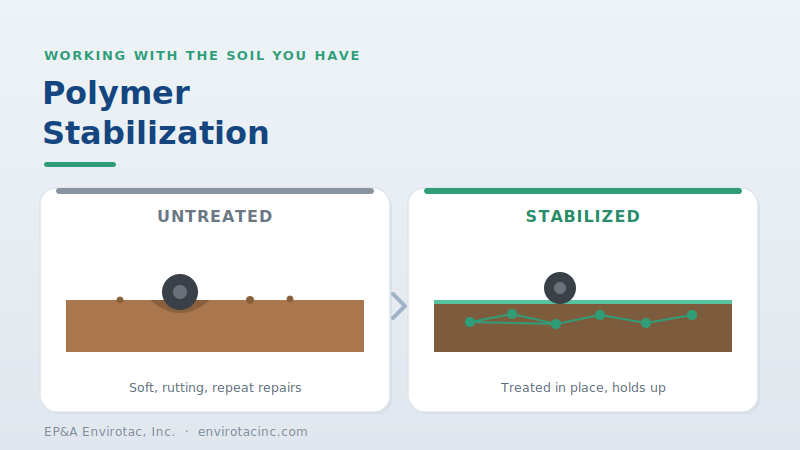
Polymer stabilization doesn’t solely rely on importing material. It works with the soil that’s already there, improving its engineering performance directly. On projects where hauling costs, site access, or material availability are real concerns, that distinction alone is often enough to earn it a second look.
Working with Existing On-Site Material
No excavation, no hauling away the problem soil. The material that’s already underfoot gets treated where it sits, which on sites with limited access or a lot of ground to cover often ends up being the deciding factor.
Improving Trafficability
The first thing teams check is whether equipment can actually cross the site reliably, including the day after rain. If a treatment can’t pass that test, nothing else about it gets much attention.
Reducing Aggregate Import Requirements
Treating existing soil instead of covering it tends to cut down on how much aggregate needs hauling in over time. On sites where importing material is costly or just logistically painful, this is frequently the line item that makes the whole conversation worth having.
Supporting Long-Term Surface Performance
Polymer stabilization gets evaluated for more than its immediate effect: how it holds up across seasons and across repeated load cycles, weighed against the alternative of patching the same spot every few months.
Minimizing Maintenance Interventions
Maybe the most consistent reason it comes up at all: it’s meant to break the maintenance cycle. Instead of regrading and patching on repeat, treated surfaces get assessed on whether they can hold performance with real gaps between interventions.
Worth being precise here: polymer stabilization may improve performance characteristics tied to problematic, high-plasticity soils. Claiming it lowers PI outright is a different statement, one that needs project-specific testing behind it, not just a general assumption.
Questions to Ask Before Choosing a Stabilization Strategy
A handful of questions tend to come up before any approach gets chosen.
- What performance problems does this site actually have?
- How moisture-sensitive is the soil, really? What loads does the surface need to support?
- How much maintenance is the project willing to live with?
- Is importing material even practical here?
- And which approach, polymer-based or something else, actually fits what this project needs?
Working through these honestly tends to settle two things at once: whether stabilization is worth pursuing, and if so, which approach fits.
Conclusion
Plasticity Index is a small number carrying more weight than its size suggests. It flags risk early, and high-plasticity soils in particular tend to bring real challenges: shrink-swell movement, reduced trafficability, and maintenance that won’t quit. But the real cost was never the PI number itself. It’s what happens when those challenges go unaddressed: repairs that keep repeating, aggregate that keeps getting imported, productive days lost, and a surface that never quite holds. Setting that cost against the alternatives, including polymer stabilization, is what turns a number on a report into an actual decision.
If a geotechnical report flags high-plasticity or moisture-sensitive soil, looking into stabilization early tends to pay off: better constructability, less maintenance, and a surface that holds up longer than it otherwise would.
Applications - Dust Control & Soil Stabilization Products
Leave a Reply