

February 6, 2026
Some of the most stable-looking surfaces still produce the highest particulate readings. Calmer surfaces, fewer visible plumes, and reduced complaints have traditionally signaled that suppression measures were working, particularly across engineered surfaces where disturbance was episodic and evaluation remained local.
At the same time, particulate matter has become a more familiar signal in recent years. PM2.5 and PM10 readings now accompany routine weather and air-quality reporting, widening the frame through which dust is understood beyond the surface alone. In large-scale surface systems where disturbance is sustained, the difference between surface calm and airborne particulate behavior becomes operationally significant. Fine particles behave differently once released, and their movement is shaped by forces that are not always apparent at ground level.
As monitoring has expanded, a pattern has become harder to ignore. Surfaces can appear stable even as particulate levels stay elevated, and PM readings sometimes shift in ways that do not align with what is visible at ground level. This pattern shows up frequently in environments shaped by repeated traffic and extended exposure.
What appears at first to be inconsistency is usually something else. It reflects the point where surface performance and airborne behavior stop responding to the same controls.
Interpreting Surface Behavior and Airborne Particles
Dust suppressants act at the surface, where particle detachment begins. They operate as surface-level controls, shaping how particles interact at the point of contact. Particulate matter measurements, by contrast, describe what happens once particles move beyond that surface and into the surrounding air.
This distinction is central. Surface calm and airborne behavior are influenced by different forces, even though they originate from the same material system. A treated surface can remain stable and cohesive while finer particles respond to mechanical and atmospheric effects such as turbulence, shear, and airflow that lie outside the surface-control domain.
Seen this way, divergence between visual indicators and PM readings does not suggest that surface treatments are underperforming. It indicates that different parts of the system are being observed at different stages. Holding both signals together allows surface-level performance to be evaluated on its own terms, while particulate behavior is interpreted as a separate but related outcome shaped by re-entrainment and environmental forces.
How Dust Suppression Influences Particle Behavior
Dust suppressants work by altering how particles interact at the surface. Most formulations rely on adhesion, cohesion, or moisture retention. Polymers form flexible films that bind particles at contact points within treated surfaces. Hygroscopic agents attract and retain water, increasing capillary forces between grains. Both mechanisms raise the energy required to dislodge material, which is why visible dust often decreases shortly after treatment across polymer-bound surface systems.
Particle size is where behavior begins to diverge. Coarser particles have more mass relative to surface area, making gravity and polymer binding forces dominant within the surface-control domain. Finer particles, particularly PM10 and PM2.5, behave differently. Their small aerodynamic diameter allows them to remain suspended with relatively little energy input. Once released from the bound surface matrix, their motion is influenced less by surface conditions and more by turbulence and airflow near the ground.
Traffic introduces mechanical energy unevenly across particle sizes. Repeated shear, vibration, and abrasion progressively disturb surface cohesion, increasing the likelihood of particle release under sustained traffic. Larger particles tend to remain embedded as long as surface integrity holds, while finer material experiences progressive detachment. This process is cumulative. Individual vehicle passes may not produce noticeable change, but repeated disturbance increases the likelihood of fine particle release over time within engineered surface systems.
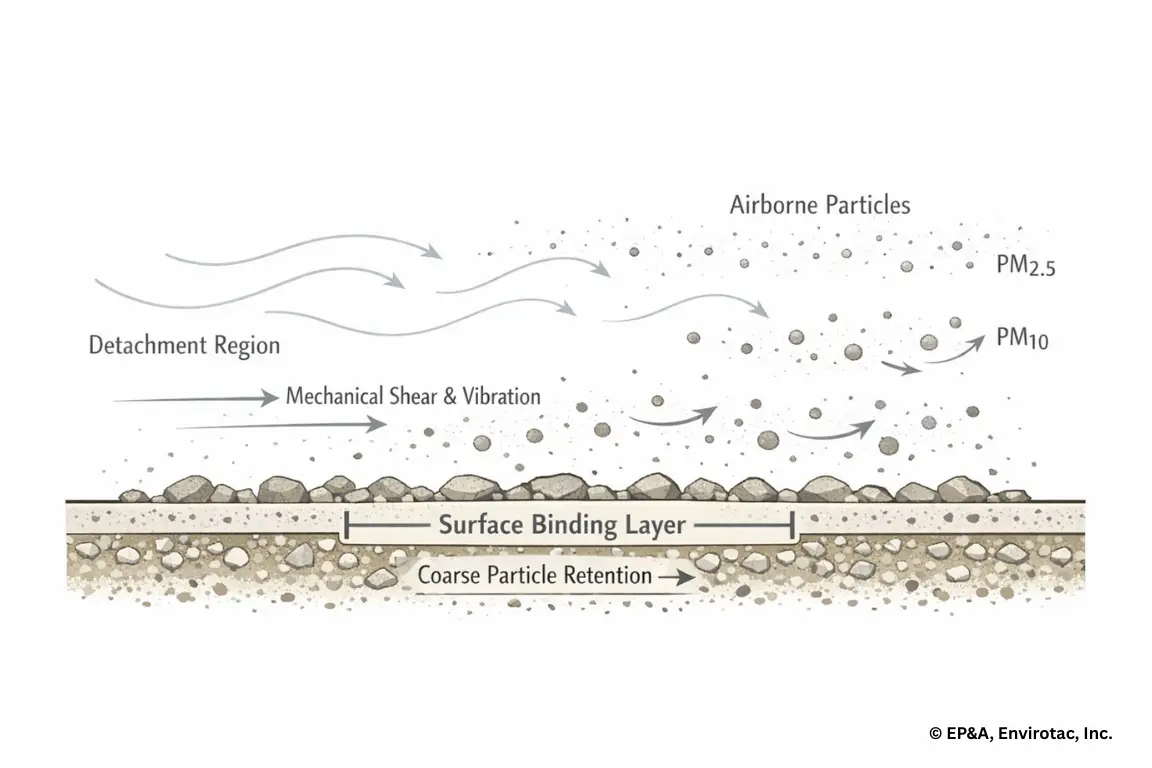
Moisture conditions shape how long polymer binding forces remain effective. Water enhances capillary attraction and polymer flexibility, increasing resistance to detachment within the treated surface matrix. As treated surfaces dry, those forces give way to broader mechanical and atmospheric influences, lowering the energy threshold required for fine particles to separate. This drying cycle explains why the particulate response can shift even when the application remains unchanged.
Temperature also shapes how moisture behaves within treated surfaces. As conditions move through cycles of heating and cooling, subtle shifts in wetting and cohesion can change how easily particles separate over time. These effects develop gradually and interact with traffic-driven disturbance rather than replacing it.
Once particles become airborne, atmospheric forces dominate their movement. Wind speed, turbulence, and pressure gradients determine whether particles disperse, resettle, or remain suspended. PM measurements capture this post-surface phase of behavior, reflecting conditions governed by re-entrainment forces rather than surface cohesion alone.
Reading Performance in Operating Conditions
At scale, dust suppressant performance is rarely interpreted through a single signal. Surface condition, visible dust, and particulate behavior are typically read together across treated surface systems, with attention focused on how they evolve under similar operating conditions. The question is not whether one confirms the other, but whether they respond consistently to the same forces over time within the surface-control domain.
Over time, it is the pattern that tends to matter, not any single reading. PM levels often rise and fall with traffic surges, weather shifts, or localized activity across engineered surface environments. Those moments are taken into account, but their significance becomes clear only when they are read alongside repeated conditions.
Where divergence persists, interpretation tends to shift toward understanding system boundaries within treated surface systems. Sustained traffic, repeated drying cycles, and extended exposure windows often explain why finer particles remain mobile even as surface integrity holds. Seen this way, divergence reflects the point at which re-entrainment and environmental forces begin to dominate particle behavior, indicating a shift beyond surface-level control rather than a need for immediate reaction.
Over time, decision boundaries emerge for organizations managing treated surfaces at scale. When particulate behavior continues to diverge under comparable disturbance and re-entrainment conditions, attention often expands to adjacent controls or structural measures. This transition is guided by scope and persistence rather than urgency. Dust suppression remains effective within its surface-control role, even as additional system-level measures may become relevant under broader environmental conditions.
Particulate Monitoring in Dust Suppression Evaluation
This playbook reflects how experienced teams structure particulate observation when evaluating dust suppression outcomes. It supports attribution and interpretation rather than compliance or enforcement.
What is measured
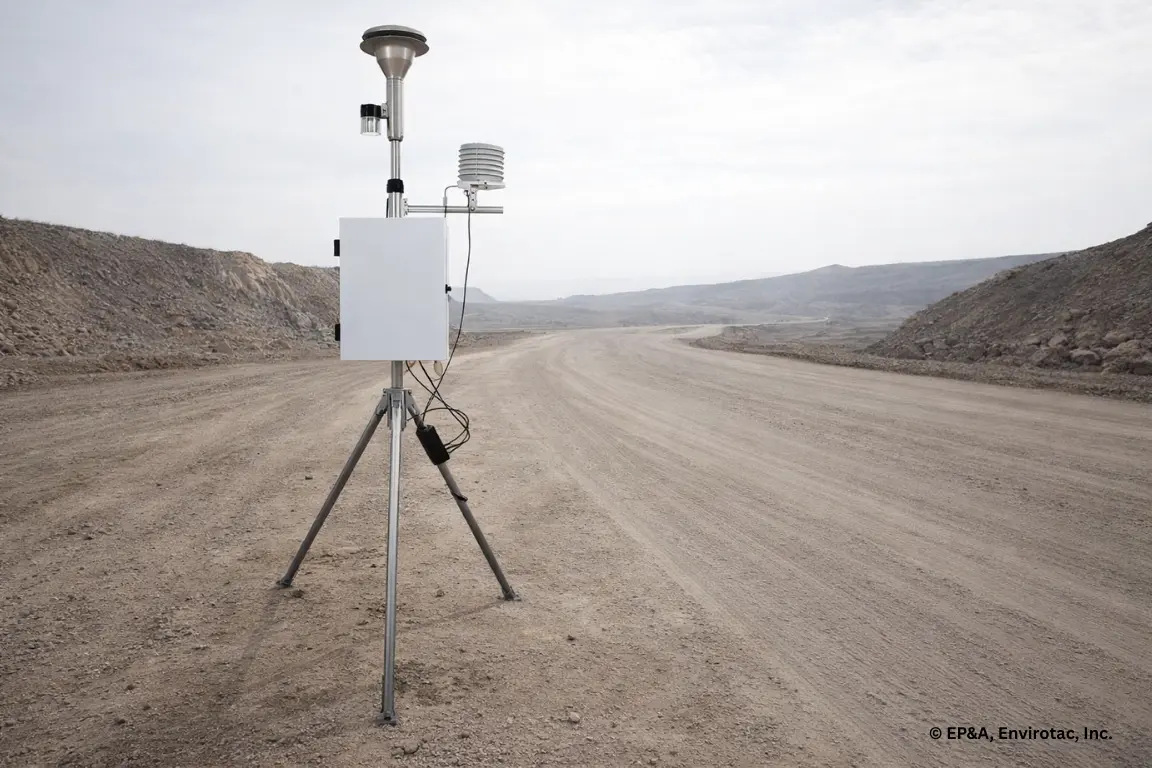
PM10 captures larger inhalable particles that respond strongly to surface disturbance. PM2.5 captures finer particles whose movement is dominated by airflow and re-entrainment once airborne. Both are standard concentration measures expressed in micrograms per cubic meter.
Instrumentation classes
Reference-grade monitors are used where long-term comparability is required. Indicative or low-cost sensors are often used for trend detection and spatial coverage, typically paired with verification against a reference device.
Sampling windows
Baseline measurements are collected under representative conditions prior to treatment. Post-treatment observations are taken during comparable disturbance windows. Repeated observations carry more interpretive value than isolated samples.
Contextual variables
Wind, temperature, moisture, precipitation, and traffic activity are logged alongside PM data to distinguish environmental variability from treatment effects.
How results are read
Interpretation focuses on whether PM trends settle or persist after disturbance, and whether divergence from surface cues repeats under similar conditions. Patterns matter more than single exceedances.
Interpreting Particulate Metrics in Context
When dust suppressant performance is discussed through a particulate matter lens, outcomes are typically described using standard concentration measures rather than custom metrics.
Baseline PM average
The average PM concentration measured over a defined baseline period under representative conditions.
Post-treatment PM average
The average PM concentration measured during comparable operating windows after treatment.
Observed change in PM concentration
The relative difference between baseline and post-treatment averages, used descriptively rather than as a performance guarantee.
PM exceedance frequency
The number of sampling periods exceeding a referenced guideline during baseline versus post-treatment conditions, used for context rather than compliance claims.
Traffic-normalized PM observations
PM trends interpreted within comparable traffic or disturbance bands to support attribution.
Together, these indicators describe different parts of the same system, each contributing insight that gains clarity when considered in combination.
Dust Suppressant Mechanisms and Particulate Interaction
| Suppressant category | Primary mechanism | Typical effect on coarse dust | Typical interaction with PM10 | Typical interaction with PM2.5 | Operational characterization |
| Hygroscopic agents | Moisture attraction and capillary force enhancement | Reduces immediate surface dust release | Response varies with humidity and drying cycles | Fine-particle behavior reflects airflow and environmental conditions after release | Most effective where moisture presence is sustained or periodically renewed |
| Organic binders | Particle coating and increased cohesion | Improves surface stability and visible dust control | Reduction levels depend on formulation and disturbance intensity | Primary influence occurs before particles become airborne | Performance reflects surface wear conditions and disturbance intensity over time |
| Synthetic polymers, including acrylic polymers | Film formation and structural surface binding | Strong reduction in surface disturbance | Maintains suppression performance across repeated disturbance conditions | Supports reduced fine-particle release at the point of detachment, with outcomes shaped by airflow and environmental conditions | Provides surface stabilization that works alongside broader particulate management strategies |
Particulate Behavior Under Varying Traffic Conditions
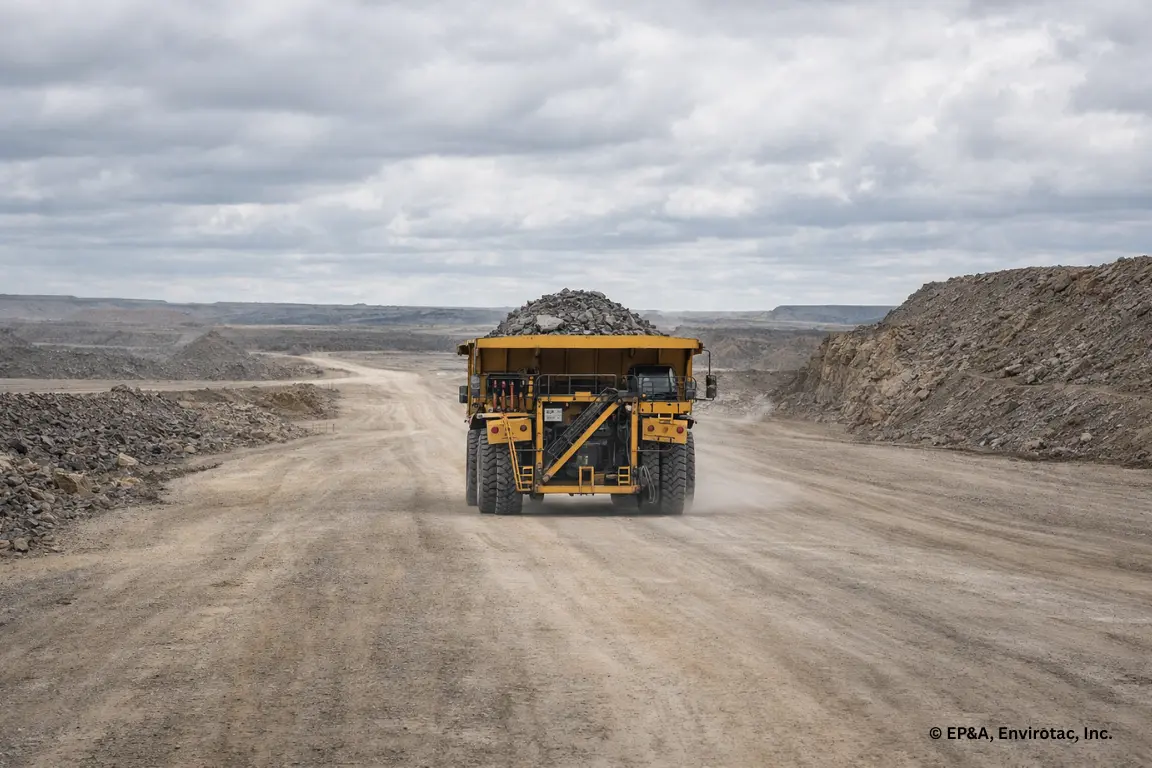
Traffic is one of the strongest drivers of particulate re-entrainment, and it rarely remains constant across observation periods. PM outcomes are therefore read in relation to disturbance intensity rather than as isolated concentration values.
Experienced teams tend to interpret PM trends within comparable activity windows, aligning baseline and post-treatment observations with similar traffic profiles. Where activity varies, parallel observations from untreated or reference areas are often used to provide directional context.
The aim is not to mathematically correct PM values but to prevent misattribution. Changes that persist under similar disturbance conditions and re-entrainment conditions carry more interpretive weight than those observed during shifting activity levels.
Observed Boundaries in Surface-Level Dust Control
As disturbance becomes sustained through repeated traffic loading, finer particles may re-enter the air even when surface integrity remains intact. Within treated surface systems under continued loading, re-entrainment reflects the increasing influence of mechanical and atmospheric forces rather than a loss of surface-level control.
Field and wind-tunnel research shows that while polymer-based surface treatments reliably reduce visible dust, PM2.5 behavior under persistent disturbance responds to forces that extend beyond the treated surface matrix. This divergence is expected once particle movement is governed less by binding and more by airflow and shear near the ground.
Environmental cycles further shape this handoff. As treated surfaces dry or move through temperature swings, surface cohesion can decline, allowing broader mechanical and atmospheric influences to govern fine-particle mobility. These shifts occur gradually and are not directly tied to traffic intensity alone.
Changes in particulate readings also tend to track variation in traffic patterns or weather conditions. Interpreted within that operating context, PM data clarifies where surface treatments remain the appropriate control and where additional system-level measures begin to matter.
Why This Way of Reading Matters
When dust control is evaluated through a single signal, misalignment is often treated as an error. When multiple signals are held together, misalignment becomes information. Over time, this distinction reduces reactive decisions and replaces them with proportionate responses grounded in how systems actually behave.
Interpreting dust suppression through a particulate matter lens does not demand more complexity for its own sake. It encourages consistency. It aligns surface-level action with airborne outcomes and helps organizations distinguish between what can be controlled directly and what requires broader coordination.
Placing Dust Suppression in System Context
Viewed through a particulate matter lens, dust suppression becomes easier to place in context. Surface condition, visible dust, and PM readings describe different phases of the same system, shaped by disturbance, re-entrainment dynamics, and environmental cycles over time.
This approach does not call for more aggressive intervention or constant adjustment. It supports clearer judgment about what surface-level controls influence directly and what reflects downstream behavior within surface systems shaped by traffic, environment, and material response.
If you’re exploring how particulate matter fits into dust control decisions at scale, this lens is most useful when applied across repeated conditions rather than isolated events. It is intended to support judgment, not replace it.
Clarity at the Boundary of Surface Influence
At scale, the challenge is rarely knowing which tools exist.
It is knowing what each tool can reasonably influence and where its influence naturally ends.
Dust suppression has always been part of that equation.
Particulate matter simply makes the boundaries clearer.
Applications - Dust Control & Soil Stabilization Products

Leave a Reply