
December 4, 2025
Introduction
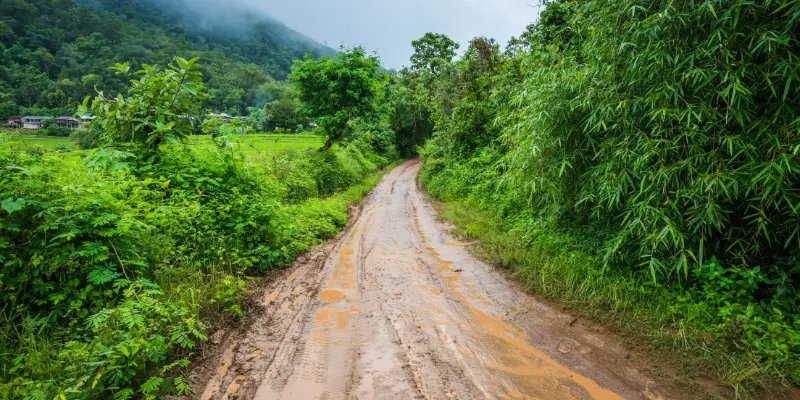
Every rainy season, the graders go out again. A stretch that ran fine in May turns into ruts and standing water by late summer. When the dust dries in the fall, corrugations ripple across the surface. Patrol routes slow down. The vehicles endure significant damage. Crews return to the very same locations they worked only months earlier.
These failures are not random. They follow a repeatable pattern shaped by soil behavior, moisture cycles, traffic stress, and drainage, not by the work ethic of maintenance crews. Surface repair plays an essential operational role in maintaining safe travel and controlling dust, but deeper soil behavior continues to govern long-term performance beneath the surface.
By the end of this article, you will understand why seasonal road breakdown happens so reliably, how stabilization differs from routine patch-and-grade work, and how organizations can decide where structural treatment has practical value and where it does not.
The Real Causes of Seasonal Road Failure
Unpaved border roads often sit on clay or silt subgrades. These soils behave very differently when wet compared to when dry.

When rainfall raises moisture levels, shear strength drops sharply. Under tire loads, softened soil deforms and begins to push upward into the aggregate layer, a process engineers describe as pumping. Over time, the surface settles unevenly into ruts. In low points or wash crossings, standing water keeps the soil in this weakened state long after storms pass.
Dry seasons create a different problem. As moisture leaves the surface, fines loosen. Vehicle vibration reorganizes loose grains into repeating ridges—the familiar washboard pattern. Corrugations grow fastest in braking and acceleration zones, at curve approaches, and on moderate inclines, where shear forces peak.
Drainage often decides where problems appear first. Cross-drain failures, unarmored washes, crowned sections that capture water instead of shedding it, and shoulder depressions that trap runoff can lock moisture directly into the subgrade.
Traffic intensity multiplies these effects. Patrol trucks applying heavy throttle or braking concentrate stress at predictable points. Corrugations reorganize material faster after each grader pass because the aggregate has already been disturbed and loosened.
All of these mechanisms operate whether grading schedules are aggressive or minimal. That is why the same locations usually fail each year, not because surface work is poor, but because the base that carries the load never permanently gains strength.

Why Grading and Surface-Only Maintenance Can’t Address Structural Failure
Grading addresses shape, not strength. It smooths driving surfaces by redistributing loose aggregate, improving immediate ride quality and drainage appearance. However, it does not increase the bearing capacity of moisture-sensitive subgrades. When soils soften after rainfall, deformation continues beneath the surface regardless of how well the top layer has been reshaped. Under certain traffic conditions, repeated grading can also loosen surface material, allowing corrugations to reorganize more quickly once vehicles return.
Dust control products serve a different purpose. They play a critical role in operational safety, surface durability, visibility improvement, and environmental compliance. Surface-applied polymer palliatives are designed to bind fines, control airborne particulates, and improve visibility and air quality along unpaved roads. In these roles, they remain essential operational tools, especially in areas near communities, work zones, and environmentally sensitive corridors. Structural reinforcement, by contrast, typically requires deeper stabilization practices.
Many seasonal rutting and pumping mechanisms originate deeper in the soil profile, meaning that surface treatments perform best when paired with appropriate structural reinforcement rather than used as stand-alone solutions. Addressing these structural failure mechanisms requires stabilization methods that modify and strengthen the soil body itself, expanding beyond surface dust management into blended and compacted treatment zones.
Surface re-graveling follows a parallel pattern. Additional aggregate temporarily improves ride conditions but settles into weak subgrade layers during wet periods if underlying strength remains unchanged. Increased surface weight can further intensify pumping where saturation persists, producing renewed surface breakdown within months.
The issue is not the performance of dust control or grading practices; both play legitimate and valuable roles in unpaved road maintenance. The limitation arises only when surface improvement tools are applied outside their intended performance range. Lasting seasonal performance requires pairing surface management with stabilization approaches that address the load-bearing soils beneath the wheels.
What Soil Stabilization Actually Means
Soil stabilization modifies existing soils to create stronger, more moisture-resistant layers capable of carrying repeated traffic loads. Rather than replacing native material, most approaches work by improving what is already present through bonding, structural reinforcement, or changes in plasticity.
Common stabilization methods include:
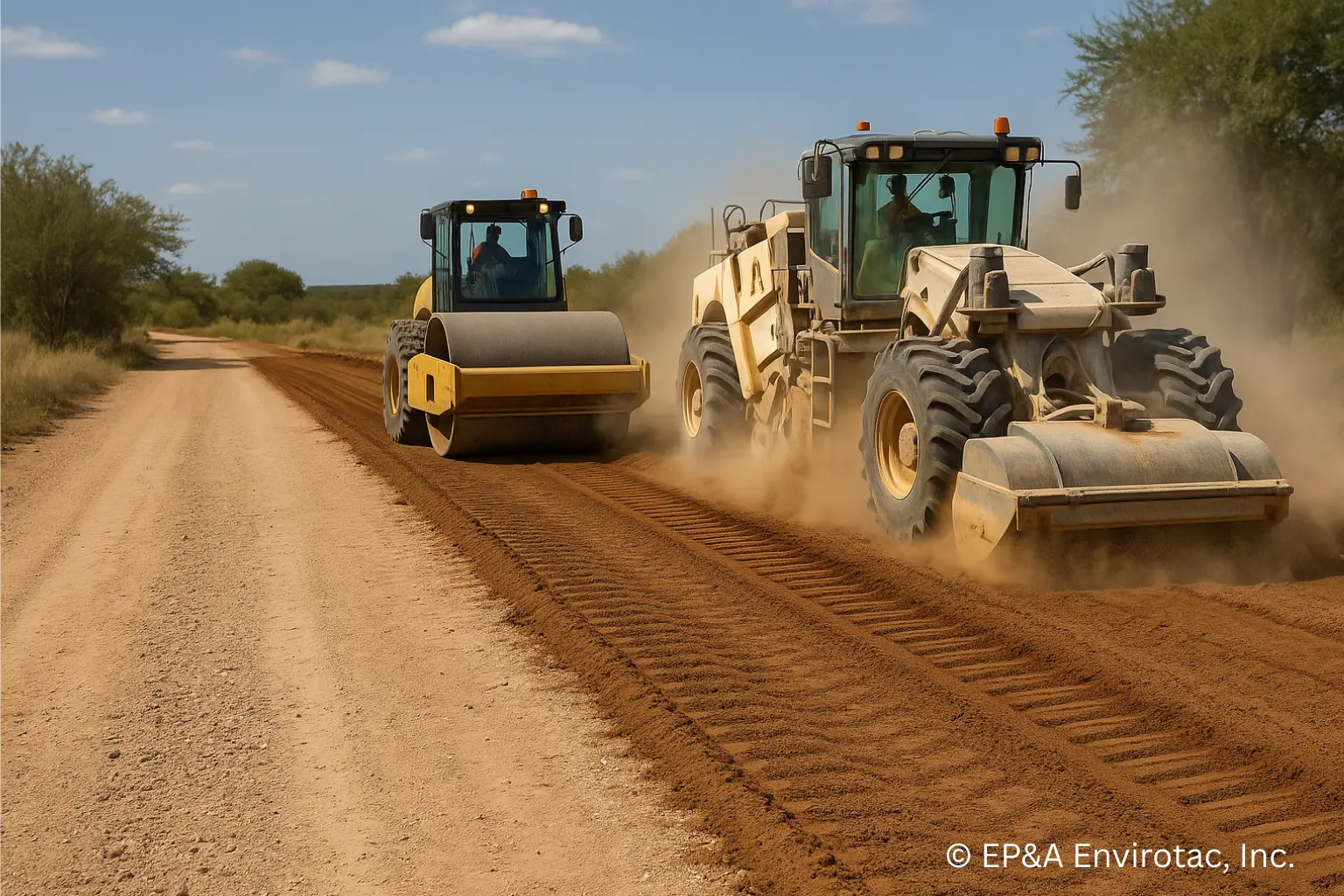
Mechanical soil treatment: blending soils to improve gradation and compactability while managing moisture content during rolling.
Cement or lime binders: increasing stiffness and compressive capacity in clay-rich soils where industrial or weighty loads dominate.
Soil stabilization polymers: forming bonds between soil particles that can reduce water sensitivity and improve cohesion in suitable profiles.
Geosynthetics: distributing axle loads over weak formations through geocells or fabrics without directly altering chemistry.
Combined systems: pairing structural reinforcement with binders where soil properties vary sharply within short distances.
Academic research on synthetic polymers, including acrylic formulations, reports measurable increases in soil stiffness and reductions in moisture susceptibility under repeated loading when treatments are matched to appropriate soil types. Studies examining polymer–cement blends also demonstrate strengthened performance using lower cement content than traditional mixes alone, though outcomes remain sensitive to preparation practices, compaction control, and drainage conditions.
The consistent finding across the literature is simple: stabilization works only when method selection fits soil behavior and site constraints. Each stabilization method offers valuable benefits when properly matched to site-specific soil conditions—underscoring the importance of professional evaluation and tailored design.
How Stabilization Changes Long-Term Maintenance Behavior
Routine maintenance focuses mainly on surface renewal:
Frequent grader mobilizations.
Emergency reopening after storms.
Dust palliation cycles tied to dry season complaints.
Continued fleet wear from rough surfaces and ruts.
An accumulating backlog of the same failures each year.
Structural stabilization approaches maintenance differently:
Select segments receive deeper treatment based on soil performance and drainage exposure.
Grading cycles lengthen where the treated base resists deformation.
Fewer emergency responses are triggered by storms.
Vehicle wear declines as corrugations and rut depth stabilize.
Dust treatment demand drops where bonded surfaces persist.
In field experience, maintenance tracking often reveals that a limited number of recurring locations generate most work orders. Targeting those zones rather than treating each mile equally offers the greatest operational effect without unnecessary construction.
Stabilization does not remove the need for maintenance. Drainage cleanup, surface shape adjustment, and edge repair remain necessary. The difference lies in lowering how often full reshaping becomes urgent.
Where Stabilization Delivers the Greatest Value
Structural treatment justifies review when certain site conditions repeat:
Segments become seasonally impassable despite regular grading.
Washboard returns within weeks under normal patrol traffic.
Clay or silt soils dominate beneath thin aggregate layers.
Drainage crossings repeatedly degrade after rain.
Heavy braking or slow-speed grades correlate with surface collapse.
Identical locations consume budget year after year.
Not every road segment needs structural intervention. Some sections perform acceptably under conventional maintenance and do not currently show the soil-related failure mechanisms that stabilization is designed to address. In practice, agencies often find that structural treatment is deferred for segments where:
Routes are expected to be temporary or short-term, and maintenance demands remain low relative to service life.
Natural soils drain freely and do not show moisture-related rutting or soft-spot formation.
Traffic levels remain light and do not create persistent corrugation or surface deformation.
Dry-season wear is limited to minor cosmetic roughness that does not affect reliability or vehicle performance.
On these segments, routine grading, drainage upkeep, and dust control can continue to meet operational needs, while stabilization resources are focused on areas experiencing true structural degradation.

Environmental and Community Considerations
Unpaved road dust carries more consequences than inconvenience. Field studies measuring particulate emissions along gravel and dirt roads regularly document particulate concentrations that exceed air-quality standards during dry or windy periods. Medical literature links inhalation of fine particulates to respiratory and cardiovascular risks.
Environmental monitoring has also shown vegetation stress adjacent to heavily traveled unpaved routes, where repeated dust deposition coats leaf surfaces and alters plant health near road margins.
Stabilization reduces how often road surfaces must be aggressively reworked, which limits sediment transport into nearby drainage channels. Bonded or reinforced surfaces release fewer fines than repeatedly scarified roads. Avoiding chloride-based dust control can also reduce salt runoff and fleet corrosion concerns.
None of these factors means stabilization carries no environmental tradeoffs. Binder choice matters. Choosing products with minimal environmental impact is key. Drainage modification may disturb habitats. These aspects require site review, not blanket assumptions.
What Makes Stabilization Projects Successful
When stabilization does not deliver its full potential, it nearly always traces back to process control gaps:
Soil behavior misunderstood or not assessed.
Treatment methods mismatched to field conditions.
Moisture management during blending handled poorly.
Compaction standards missed.
Drainage left unresolved.
Relying solely on surface dust treatments when a structural stabilization design is actually needed.
Successful stabilization works best when material selection is integrated into a broader engineering and site-design process.
How Organizations Test Methods Before Wide Use
Cautious adoption remains the simplest safeguard:
Short demonstration stretches are built at known problem points.
Soil testing confirms material compatibility.
Drainage adjustments precede any treatment.
Performance is observed across both wet and dry seasons.
Grading frequency and surface deformation are tracked relative to untreated segments.
Field observation offers a reality check before budgets scale beyond pilot work.
Comparing Stabilization Options
| Method | Typical Applications |
| Mechanical blending | Sandy or variable soils where moisture issues remain moderate |
| Cement/lime binders | High-plasticity clays with heavy axle loads |
| Soil stabilization polymers | Moisture-sensitive soils where flexibility and water resistance help reduce deformation |
| Geosynthetics | Weak formations where distributing load without chemical change is preferred |
| Combined systems | Complex profiles where drainage, strength, and cohesion challenges coexist |
Conclusion
Seasonal failure on border patrol roads rarely reflects poor maintenance habits. It results from predictable soil behavior interacting with weather, traffic stress, and drainage gaps. Grading and palliation are highly effective at managing the visible effects of seasonal deterioration, but by themselves, they typically do not change the underlying soil and drainage conditions that drive long-term performance.
Stabilization alters this pattern by strengthening the base itself, not by smoothing symptoms. Where conditions support its use, it extends service intervals and reduces emergency maintenance. Where soils or traffic do not warrant deep intervention, routine approaches remain appropriate.
Organizations evaluating stabilization should approach the work as applied engineering guided by soil properties, drainage behavior, and long-term maintenance planning, not as a product choice or a one-size decision. The greatest value emerges when stabilization targets genuine failure drivers rather than treating every mile the same.
Applications - Dust Control & Soil Stabilization Products
Leave a Reply