

March 3, 2026
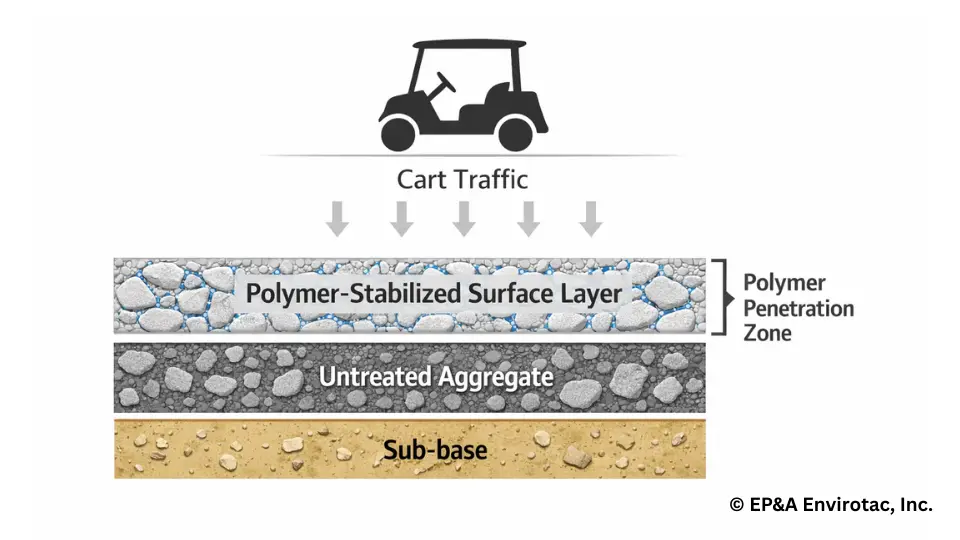
Polymer dust control treatments function by penetrating the upper layer of gravel or decomposed granite and binding fine particles so they resist displacement under traffic. That bond, however, is only as reliable as the surface receiving it. If the aggregate layer is loosely compacted, unevenly graded, or structurally unstable, the binder simply conforms to those weaknesses.
On golf cart paths, long-term performance is shaped by several interdependent variables: surface stability, aggregate gradation, compaction quality, moisture condition at application, and drainage geometry. None of these operate independently. A deficiency in one area can shorten service life even if the others are properly addressed.
Cart paths introduce a specific pattern of stress. Traffic concentrates at tee exits, green approaches, staging areas, and turns, where braking and acceleration increase shear forces. Mid-path segments behave differently from those transition zones. Preparation standards should reflect that variation rather than assume uniform conditions along the entire route.
Visible dust, fines migration, or premature surface wear often appear to be treatment issues. In practice, they frequently originate in earlier preparation decisions. Stabilization begins before application, not after.
Golf-course guidance supports this broader view. Sprayable stabilizers are commonly used to limit dust on natural stone and decomposed granite paths while preserving surface aesthetics, and periodic maintenance is expected as part of ongoing care. The durability of those results depends heavily on the condition of the base and surface layer at the time of application.
Preparation influences outcome at every stage. When the receiving surface is stable, well-graded, and correctly conditioned, polymer dust control treatments perform with greater consistency and predictability.
Defining Service Life in Golf Cart Path Dust Suppression
In this context, service life refers to the period during which a polymer dust control treatment continues to bind surface fines effectively without requiring reapplication. It is not a fixed duration. It reflects how well the treated surface maintains cohesion under traffic and environmental exposure. Traffic intensity, aggregate composition, seasonal moisture fluctuation, and climate all shape how long a treatment holds. Of those variables, preparation quality is the one most within reach before application begins. A stable, correctly conditioned substrate allows the treatment to distribute with greater consistency and carry shear stress more predictably across repeated loading cycles.
Performance conclusions drawn without accounting for substrate condition are often incomplete. Early deterioration on a loosely compacted or poorly graded surface does not necessarily reflect binder failure — the treatment may have functioned exactly as intended. What failed, in those cases, was the structure beneath it.
Environmental conditions add further variability. Paths exposed to irrigation: overspray behave differently from those in well-drained corridors. Freeze-thaw cycles introduce expansion forces beneath the treated layer. High-play resort facilities experience concentrated loading patterns that differ from lower-traffic municipal courses. Each of these factors interacts with preparation quality.
Service life is therefore best understood as an outcome shaped by engineering decisions made prior to treatment. When those decisions are deliberate and consistent, durability becomes more predictable, and reapplication cycles can be planned rather than reactive. Context matters. Evaluation is site-specific.
Measurable Surface Preparation Benchmarks for Polymer Performance
Preparation cannot rely on visual judgment alone. Without practical field indicators, the decision that a path is “ready for treatment” becomes subjective and inconsistent across crews or contractors. Operational benchmarks provide structure before application begins. These are not laboratory specifications. They are field-based conditions that help confirm whether the aggregate layer is capable of receiving and supporting a polymer dust control treatment under anticipated traffic.
Several indicators are especially relevant on golf cart paths:
- Surface firmness The path should resist deformation under foot traffic and light cart movement. Any visible rutting, pumping, or lateral displacement suggests that the sub-base requires correction before surface stabilization proceeds.
- Moisture condition The aggregate should be damp but not saturated. Standing water, surface sheen, or excessive dryness can interfere with even binder distribution.
- Aggregate gradation A balanced distribution of coarse particles and fines should be present across the full width of the path. Segregated zones, stripped areas, or depleted fines reduce cohesion. Angular aggregate improves particle interlock and provides a more stable bonding matrix.
- Compaction lift depth Effective compaction is achieved in controlled lifts rather than single-pass attempts. For most decomposed granite and crushed gravel surfaces, lifts in the range of 3–4 inches allow more uniform density through the treated layer.
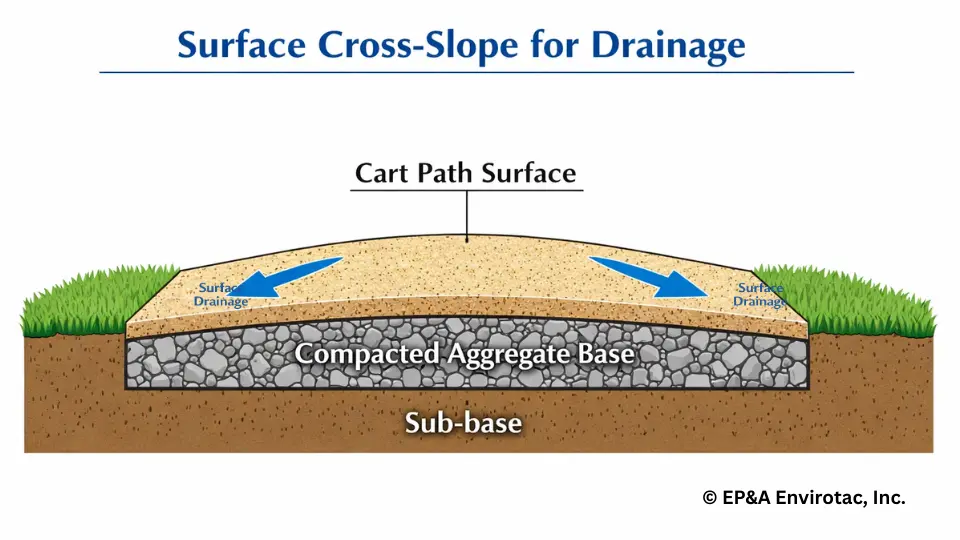
- Cross-slope A cross-slope near 2% supports lateral drainage under typical field conditions and reduces the likelihood of standing water.
- High-traffic reinforcement Tee exits, staging areas, green approaches, and tight turns should receive additional compaction effort relative to mid-path segments, reflecting their higher shear exposure.
These benchmarks establish consistency prior to treatment. Adjustments may be warranted based on aggregate characteristics, climate, and expected cart volume, but the underlying objective remains the same: confirm that the surface is structurally stable, properly graded, and conditioned for uniform binder penetration. Preparation is measurable. When standards are defined in advance, performance becomes easier to evaluate after application.
Surface Stability and Polymer Bond Integrity
Polymer bond integrity begins with the condition of the base beneath the treated layer. A surface treatment can bind particles together, but it cannot compensate for a structure that shifts under load. When the underlying aggregate lacks density or the sub-base is soft, traffic forces are transferred unevenly through the treated layer. Over time, that movement introduces stress into the binder matrix. The surface may appear cohesive immediately after application, yet subtle deflection under repeated cart loading gradually weakens that cohesion.
EPA’s AP-42 documentation explains the mechanical driver behind dust generation on unpaved surfaces: wheel forces pulverize material and create airborne particulate through turbulent shear. A stabilizer reduces particle mobility, but the aggregate mass must still resist deformation. If it fails, the treatment absorbs stresses it was never intended to carry.
In practice, inadequate base preparation often reveals itself incrementally. Minor lateral movement becomes visible as a migration of fines. Shallow bonding gives way first in high-load zones. What is perceived as premature pavement wear frequently traces back to insufficient compaction or unresolved sub-base instability. Depth matters. Stability below the treated layer supports stability at the surface.
Where softness, rutting, or pumping are present, correction should occur before polymer application. A sound foundation allows the binder to function as a cohesive element rather than as a structural substitute.
Aggregate Gradation and Effective Polymer Penetration
Surface appearance, as many superintendents have observed, does not always reflect gradation quality. A path may look uniform while still lacking the particle distribution necessary for long-term cohesion. Particle size distribution determines how voids are structured within the aggregate layer. That structure influences how deeply and evenly a polymer emulsion can penetrate. Penetration depth, in turn, affects the continuity of the bonded matrix across the treated surface.
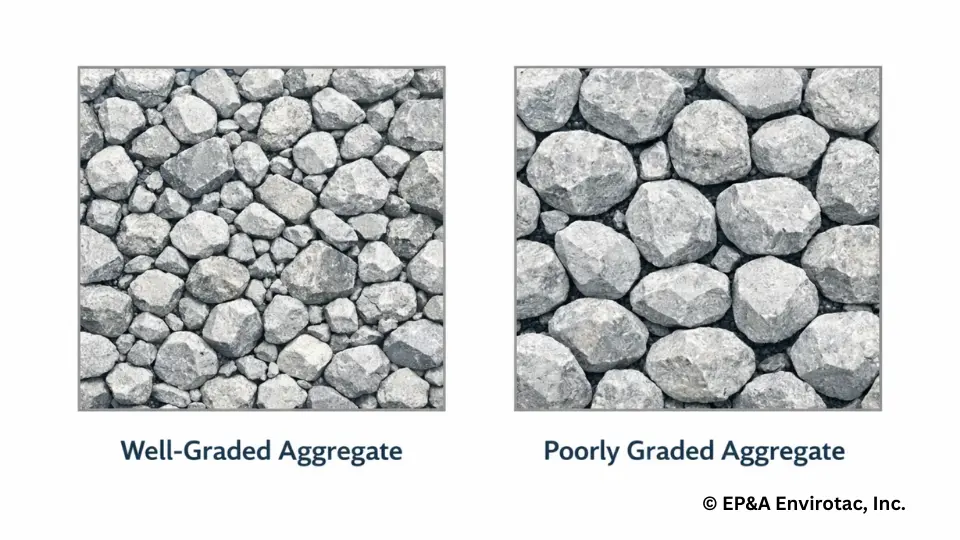
Well-graded, angular aggregate typically provides a more stable framework than segregated or rounded material. Engineering guidance for unpaved surfaces consistently notes that controlled fines content improves interparticle interlock while allowing adequate binder distribution. Recent peer-reviewed research on polymer–mineral interaction further supports that polymer formulations can be tuned to mineralogy and fines content to enhance binding efficiency while managing environmental considerations.
Imbalances in gradation produce predictable limitations. Excess fines can restrict penetration and concentrate binder near the surface, leaving deeper layers less integrated. Insufficient fines reduce cohesion and limit the contact area available for bonding. In both cases, durability is affected. Shape also plays a role. Angular particles create more contact points and resist displacement under load more effectively than rounded aggregates, which tend to shift more readily under repeated traffic.
Fine particle migration compounds the issue over time. Each loading cycle on a depleted surface reduces the structural matrix available for bonding. Restoring particle size distribution before treatment strengthens the foundation for stabilization rather than relying on surface film alone. Gradation influences penetration, which ultimately influences durability over time. Addressing distribution before application improves the likelihood of consistent performance across the treated path.
Compaction Standards That Support Cohesion
Surface density remains fundamental to polymer performance. The binder connects particles that are already in contact; it does not replace structural interlock. Compaction reduces void space and increases the number of particle contact points within the aggregate layer. When density is insufficient, particles shift under load. That movement places stress on the bonded matrix and gradually weakens cohesion.
The progression is usually incremental. Early signs may be limited to minor lateral displacement in high-traffic areas. Over repeated cart cycles, those localized shifts expand, allowing fines to migrate and reducing the continuity of the treated layer. Compaction practices should reflect aggregate type, moisture condition, and expected traffic intensity. Controlled lifts — typically in the range of 3–4 inches for decomposed granite or crushed gravel — promote more uniform density through the treated depth. Serious, single-pass attempts often leave inconsistent compaction within the layer.
Field evaluation provides practical confirmation. A properly compacted surface resists deformation under anticipated cart loading and maintains firmness across the full path width. Areas near tee exits, green approaches, and staging zones warrant additional attention, as braking and acceleration increase shear stress in those segments. Compaction, however, is not a uniform exercise across the entire path network. Matching density to anticipated load improves long-term stability and reduces the likelihood of localized failure after treatment.
Moisture Conditioning Before Polymer Application
Moisture at the time of application plays a direct role in how evenly a polymer emulsion distributes through the aggregate matrix. The surface does not need to be saturated, but it should not be excessively dry either. Balance supports uniform penetration. When the aggregate is overly dry, the binder may draw inward rapidly, limiting even distribution across the treated depth. Conversely, excess surface water can dilute the concentration before the emulsion integrates with the particle structure. In both cases, consistency is reduced.
Pre-wetting, when used deliberately, helps moderate absorption and supports more controlled penetration. The objective is to create a receptive surface condition that allows the binder to integrate evenly rather than pool or dissipate. Golf course environments introduce additional variability. Irrigation overspray can leave one side of a path damp while the other remains relatively dry. Recent rainfall may affect certain segments differently depending on slope and drainage. These differences are not always visible at a glance, yet they influence treatment behavior.
Moisture assessment should extend across the full width and length of the intended treatment area. Allowing the surface to stabilize after rainfall or irrigation cycles improves consistency and reduces variability in curing. Application timing is part of preparation. Attention to surface moisture supports predictable bonding and contributes to longer service intervals.
Drainage and Surface Geometry Considerations
Drainage influences surface performance long after application is complete. A stabilized layer may resist dust effectively, yet persistent moisture alters how that layer responds under traffic. Surface geometry determines how water moves across and away from the path. When the cross-slope flattens or reverses, water tends to collect rather than shed. Repeated saturation in those areas gradually reduces shear resistance within the treated aggregate.
Grading, therefore, precedes stabilization. Restoring a consistent crown profile and maintaining a cross-slope near 2% under typical field conditions supports lateral drainage and limits prolonged moisture exposure. The polymer stabilizes the surface; it does not correct underlying hydrology. Localized failures after storm events often correspond to areas where drainage geometry was compromised before treatment. Saturated zones are more susceptible to rutting, particularly in high-load segments such as tee exits and turning radii. These stress points experience compounded forces under wet conditions.
Drainage infrastructure should also be part of preparation. Catch basins, culverts, and adjacent swales require inspection and clearing to ensure they function as intended. Stabilization performs more consistently when water is directed and managed rather than allowed to accumulate unpredictably. Water movement is not incidental. It interacts continuously with compaction, gradation, and traffic patterns. Addressing geometry before treatment strengthens the overall system and supports more stable long-term performance.
Environmental and Safety Considerations for Golf Course Applications
Environmental alignment is part of responsible program design. Polymer dust control treatments are typically applied adjacent to turf, irrigation systems, and drainage corridors, which makes application discipline and documentation important components of the overall process.
Turf Compatibility
Acrylic polymer products used for dust suppression are generally formulated for use in vegetated environments. Even so, transitions between aggregate paths and actively growing turf warrant attention. Overspray onto turf areas should be minimized, and buffer zones can help reduce localized exposure. Application parameters near greens and tees should reflect the sensitivity of those areas. The objective is consistency. Controlled application limits unintended migration and preserves surrounding play surfaces.
Runoff and Water Management
Binder stability during the curing window is influenced by surface moisture and rainfall timing. Application scheduled immediately before significant precipitation increases the potential for dilution or surface disturbance. Proper cross-slope, functional drainage, and adequate compaction reduce this risk by encouraging lateral water movement rather than pooling. A well-prepared aggregate matrix anchors the binder within the treated layer. When water is managed effectively, off-path transport becomes less likely.
Regulatory and Municipal Alignment
Courses operating under municipal or public oversight may require Safety Data Sheets and alignment with established Best Management Practices. EPA fugitive dust guidance recommends the use of approved chemical suppressants in conjunction with speed management and routine inspection. These practices translate directly to golf cart path programs. Selection should reflect site-specific priorities and compliance requirements.
Documentation supports clarity. Maintaining product information, application records, and inspection logs simplifies communication with stakeholders and regulatory bodies.
Reinforcing High-Traffic Golf Cart Zones
In most courses, cart paths do not experience uniform stress. Load patterns change depending on location and movement. Tee exits, green approaches, staging areas, and tight turns are subjected to braking forces, acceleration, and directional shear that mid-path segments rarely encounter. These areas accumulate stress more quickly, and preparation standards should reflect that difference.
Aggregate quality plays a significant role in these zones. Well-graded, angular material provides stronger inter-particle contact and better resistance to lateral displacement. A segregated or rounded aggregate is more prone to movement under repeated turning or stopping forces. Compaction effort in high-traffic segments should exceed that of straight, lower-stress sections. Additional passes increase density and improve internal stability where shear forces are highest. Reinforcement at these transition points reduces the likelihood of localized disruption after treatment.
Material continuity is equally important. Displaced aggregate should be returned to the travel surface before compaction. Where depletion has occurred, compatible material should be reintroduced and integrated rather than layered superficially. Edge containment contributes to long-term performance. Unconfined margins allow gradual lateral migration of fine and coarse particles, particularly near curves and exits. Maintaining defined edges helps preserve the structural integrity of the treated surface.
Preparation that reflects actual use patterns improves durability and reduces reactive maintenance in the most visible areas of play.
Surface Preparation in Different Course Contexts
Preparation principles remain consistent, but emphasis shifts depending on site conditions and operational demands.
Dry, Wind-Prone Courses
In arid environments, wind can accelerate fines migration independently of traffic. Even well-compacted paths may lose surface material over time if particle distribution has shifted. Gradation assessment before treatment becomes especially important in these settings. Reintroducing and integrating depleted fines helps restore cohesion and improve binder effectiveness.
Higher temperatures and lower humidity may also influence curing behavior. Monitoring surface moisture at application remains critical, particularly in exposed segments where evaporation rates vary.
High-Traffic Resort Courses
Resort layouts with concentrated play often experience repeated loading at staging zones, practice areas, and high-visibility transitions. These areas benefit from elevated compaction standards and closer inspection intervals. Reinforcing edge containment and monitoring for early signs of displacement can prevent localized deterioration that affects appearance and performance.
Post-season evaluation provides useful feedback. Identifying stress points before visible failure allows for corrective preparation rather than reactive repair.
Municipal Courses with Budget Constraints
Facilities operating under tighter budgets often evaluate dust control through measurable outcomes. In these contexts, thorough preparation supports longer service intervals and reduces recurring labor associated with watering, grading, and spot repairs.
Pilot treatments applied to high-traffic segments can provide data on maintenance hours, complaint frequency, and aggregate retention. Those metrics support planning decisions without requiring broad implementation at the outset.
Context influences priority, but preparation remains the foundation of durable performance across all course types.
Surface Preparation Factors That Influence Long-Term Performance
Surface performance reflects the interaction of several preparation variables rather than any single factor in isolation. Gradation affects penetration. Compaction establishes density. Moisture at application influences distribution. Drainage geometry shapes how the surface responds after curing. These elements work together, and weakness in one area can limit the benefit of the others.
The relationship becomes clearer under load. A well-graded and properly compacted surface distributes stress more evenly across the treated layer. When drainage is effective, moisture does not linger long enough to undermine cohesion. When moisture at application is controlled, binder integration remains consistent through the treated depth.
By contrast, small deficiencies tend to compound. Under-compacted areas allow incremental particle movement. Poor cross-slope permits localized saturation. Gradation imbalance reduces internal contact points. None of these conditions may appear significant alone, yet over time, they influence durability.
Freeze–thaw cycles illustrate this interaction. In climates where seasonal expansion occurs, capillary moisture movement within loosely compacted layers increases vulnerability to disruption. A dense, well-drained matrix responds more predictably.
Long-term performance is not just determined at the moment of application. It is shaped by the structural condition established beforehand and reinforced through consistent preparation practices.
Operational Benefits Beyond Dust Reduction
Reducing airborne dust is the primary objective of polymer stabilization, but its operational effects often extend further when preparation standards are consistent.
Maintenance Efficiency
Stabilized and properly prepared surfaces generally require fewer grading cycles and less reactive correction after storms. When aggregate remains in place and surface density is maintained, routine watering for dust suppression can decline. Maintenance planning becomes more predictable, particularly during high-play periods.
Equipment and Asset Protection
Loose aggregate contributes to abrasive wear on carts and maintenance equipment. A cohesive surface reduces particle displacement under traffic, which in turn can limit accumulation in cart components and surrounding turf edges. Over time, this may influence cleaning frequency and minor repair demands.
Player and Member Experience
Surface appearance affects perception. Cleaner carts, reduced visible dust, and more consistent path conditions contribute to the overall presentation of the course. These effects are especially noticeable near greens, tees, and staging areas where traffic is concentrated.
Surface Longevity
Preparation that supports stable bonding can extend intervals between reapplications and reduce aggregate replacement frequency. When fines remain integrated within the matrix, surface texture and structure change more gradually.
These operational outcomes are secondary to dust suppression but remain closely tied to preparation quality. When surface conditions are addressed deliberately, stabilization programs tend to require less reactive adjustment over time.
Extending Reapplication Cycles Through Proper Preparation
Reapplication intervals are influenced by traffic volume, environmental exposure, and aggregate characteristics, but preparation quality remains central. A surface that has been properly graded, compacted, and conditioned allows the initial treatment to integrate more uniformly and resist shear stress more effectively over time.
Where preparation is inconsistent, performance variability tends to appear earlier. Areas with insufficient density or unresolved drainage issues may require localized retreatment even if adjacent segments remain stable. In contrast, a uniformly prepared surface typically supports more even wear patterns, making maintenance planning more predictable.
Subsequent applications also benefit from structural consistency. When the base layer remains stable, additional treatments can be applied with fewer corrective adjustments. This reduces the need for repeated grading or aggregate replacement prior to each cycle.
USDA NRCS guidance (Conservation Practice Standard 373) emphasizes the importance of site-specific application and maintenance planning for dust suppression systems, with periodic reapplication expected based on traffic and conditions. Aligning preparation standards with that planning approach supports clearer lifecycle evaluation.
Total cost assessment extends beyond product volume. Labor hours, watering frequency, equipment wear, and complaint response all influence program economics. Preparation that improves durability can reduce variability in those categories and provide more consistent performance data over time.
Preparation affects timing, and timing influences cost stability.
Operational Metrics That Justify Surface Stabilization
Measurement provides clarity when evaluating stabilization performance. Without baseline data, improvement is difficult to quantify, and planning becomes reactive rather than strategic.
Several operational metrics are commonly tracked in conjunction with dust control programs:
Maintenance Labor
Documenting labor hours per 1,000 linear feet for watering, sweeping, regrading, and spot repair establishes a reference point before treatment. Comparing those figures after stabilization provides insight into workload distribution and seasonal variability.
Water Usage
Tracking dust-suppression watering frequency and path-specific irrigation volume helps determine whether surface cohesion has improved. In environments where water availability is constrained, even moderate reductions can be meaningful from an operational standpoint. However, for long-term maintenance, frequent water use is not recommended.
Complaint and Fleet Impact
Monitoring complaint volume related to dust or cart cleanliness provides indirect performance feedback. Cart cleaning frequency and minor wear-related repairs may also reflect surface conditions over time.
Programmatic guidance from agencies such as FHWA and NRCS emphasizes the value of inspection schedules, speed management, and documented maintenance plans for unpaved surface management. These principles translate effectively to golf cart path systems, where traffic patterns are repetitive and concentrated.
Metrics do not replace field observation. They supplement it. When tracked consistently, they support more informed decisions about maintenance cycles and reapplication timing.
The Integrated System View
Dust control performance rarely hinges on a single preparation decision. Gradation, compaction, drainage, moisture conditioning, and traffic exposure interact continuously. The treated surface reflects that interaction.
When these elements are aligned, results tend to be consistent. The aggregate layer remains cohesive under load. Water sheds rather than accumulates. Fines stay integrated within the matrix. Maintenance becomes more predictable.
Where misalignment exists, variability follows. A well-compacted segment may perform reliably while an adjacent area with subtle drainage deficiencies deteriorates more quickly. Small inconsistencies often explain uneven performance across the same path network.
Viewing stabilization as a system rather than a standalone application clarifies expectations. Preparation establishes the framework. The polymer reinforces it. Ongoing inspection preserves it.
Predictability improves when the system is treated as interconnected rather than sequential.
Practical Considerations That Influence Treatment Performance
Polymer dust control treatments perform reliably when preparation standards are met and site conditions are evaluated realistically. Several external variables influence consistency over time.
Surface preparation quality remains decisive. Application timing relative to rainfall affects curing. Extended freeze–thaw cycles introduce seasonal stress beneath the treated layer. Excess fines or depleted gradation may require correction before stabilization. Traffic loads beyond typical golf cart parameters accelerate wear.
These variables do not undermine the effectiveness of stabilization; they define its operating environment. Recognizing them allows preparation standards to be adjusted proactively rather than reactively.
Responsible program design includes periodic inspection and refinement. Conditions change. Preparation practices should respond accordingly.
Pre-Application Field Audit Checklist
Before applying a polymer dust control treatment, confirm the following field conditions:
- Subgrade firmness with no visible pumping, rutting, or lateral displacement
- No standing water and adequate drainage time after rainfall
- Balanced aggregate distribution across the full path width
- Controlled fines fraction appropriate to the aggregate type
- Compaction completed in consistent lifts with uniform density
- Cross-slope near 2% to support lateral drainage
- Crown profile intact where applicable
- Reinforced compaction in high-traffic zones
- Defined and maintained edge containment
- Functional drainage infrastructure free of obstruction
A surface meeting these conditions is structurally prepared to receive treatment. Where deficiencies are identified, corrective preparation should precede application.
Courses evaluating existing path systems may benefit from site-specific technical review to align preparation standards with long-term dust suppression objectives.
Applications - Dust Control & Soil Stabilization Products

Leave a Reply