
January 25, 2026
Reapplication frequency tells the story that compliance reports don’t.
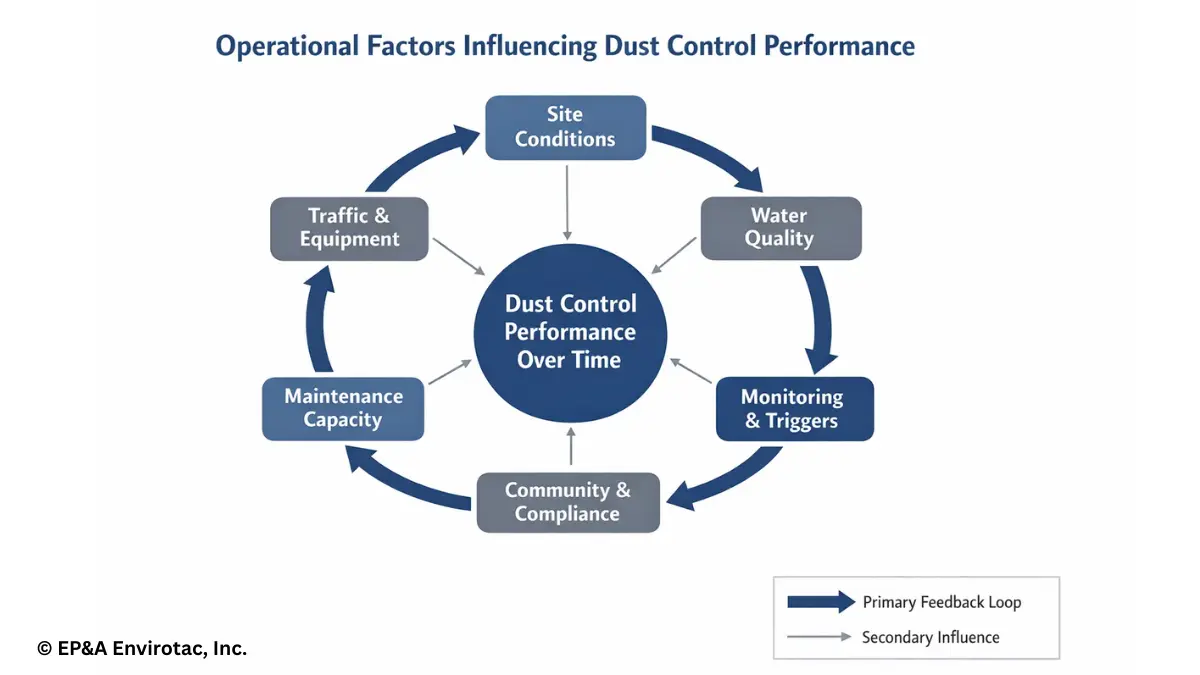
A method specified for weekly maintenance starts requiring twice-weekly service, then every other day, then daily intervention. The escalation happens gradually enough that no single moment feels like failure. Labor hours accumulate quietly. Access windows tighten. What was supposed to be manageable becomes the operational constraint no one anticipated.
Fugitive dust is not just a visibility issue. It contributes directly to PM10 and PM2.5, particle sizes that the World Health Organization links to increased cardiovascular and respiratory risk because they penetrate deep into the lungs. Dust control is a health issue as much as an operational one.
That connection becomes more visible in urban settings. UK air-quality assessments attribute roughly 22% of PM10 emissions to construction activity, which places site-level dust control firmly within public-health and regulatory expectations, not merely neighborhood tolerance.
The contradiction is now familiar: the industry has more dust control methods than ever, yet durable performance remains rare. The issue is not awareness or intent. It is that dust is still approached as something to suppress temporarily, rather than as a system behavior that must be managed across time, access constraints, and operating conditions.
How Site Conditions Shape the Performance of Dust Control Approaches
Regulatory frameworks reflect part of this mismatch. Under programs such as NPDES construction stormwater permitting, compliance is typically demonstrated through documented Best Management Practices, not through verification of long-term control effectiveness. This structure rewards early compliance signals more than sustained system performance.
Operationally, dust is treated as something to suppress rather than as a signal of unstable ground systems. Decisions are made without explicitly accounting for project phase, site accessibility, water quality, or maintenance capacity. Monitoring, when present, is frequently used for reporting rather than control.
Field measurements point to where controls matter most. A 2024 Aerosol and Air Quality Research study using UAV-based emission inventories found that vehicle travel, topsoil excavation, and loading activities accounted for as much as 90% of particulate emissions during earthworks, representing a substantial contribution relative to other sources in comparable settings.
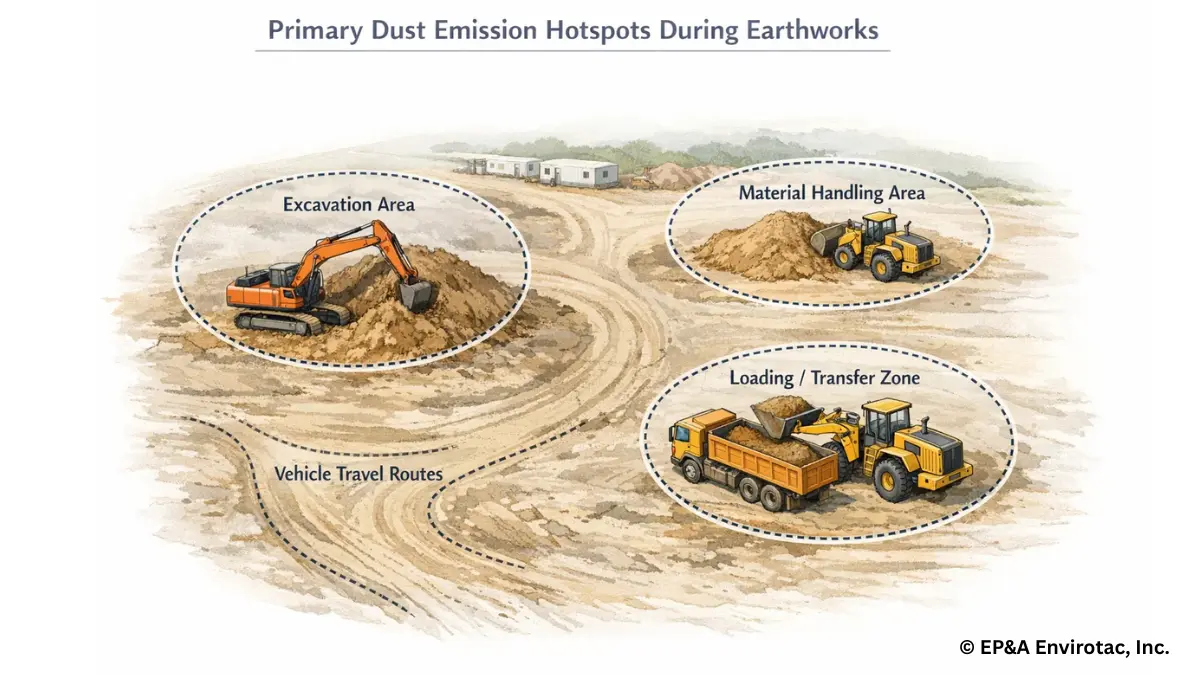
Uniform watering programs that ignore these hotspots predictably underperform.
The paradox follows: the methods chosen to “solve” dust often degrade the conditions that generate dust in the first place.
How to Select and Operate Dust Control Methods That Hold Up in Practice
Canonical dust control methods (baseline)
Consistent with EPA guidance, most projects rely on a familiar set of methods:
- Water-based suppression
- Chemical suppressants and stabilizers
- Biopolymers
- Vegetative cover or mulching
- Windbreaks and enclosures
- Fogging or misting systems
- Engineered controls (armoring, paving, grading)
Each can be effective in the right context. Sustained performance depends on how well the method aligns with site and operating conditions.
Many controls also influence erosion and runoff behavior, reinforcing that dust management is part of a broader land-disturbance system, not a standalone task.
Bench table—how methods compare in practice
| Method | Initial Suppression | Durability Over Time | Water Footprint | Maintenance Burden | Community Risk |
| Water-only suppression | High (hours) | Low | High | High | Moderate–High |
| Chemical stabilizers* | High | Moderate–High | Moderate | Moderate | Moderate |
| Biopolymers | Moderate | Low–Moderate (≤8 days) | Low–Moderate | Moderate | Low |
| Vegetative cover / mulch | Low (initial) | High | Low | Low | Very Low |
| Windbreaks & enclosures | Low | High | None | Low | Low |
| Fogging / misting systems | Moderate | Low–Moderate | High | High (mechanical) | Moderate |
| Engineered controls (armoring, paving, grading) | Low | Very High | None | Very Low | Very Low |
(Note: The asterisk indicates that “chemical stabilizers” represent a broad category with wide variation in formulation and performance. Environmental and operational effects depend on application rate, site conditions, and regulatory classification and should be evaluated on a product-specific basis.)
In this context, durability reflects how long control remains effective, while maintenance burden reflects labor and mechanical exposure rather than material cost alone.
Decision framework—explicit and defensible
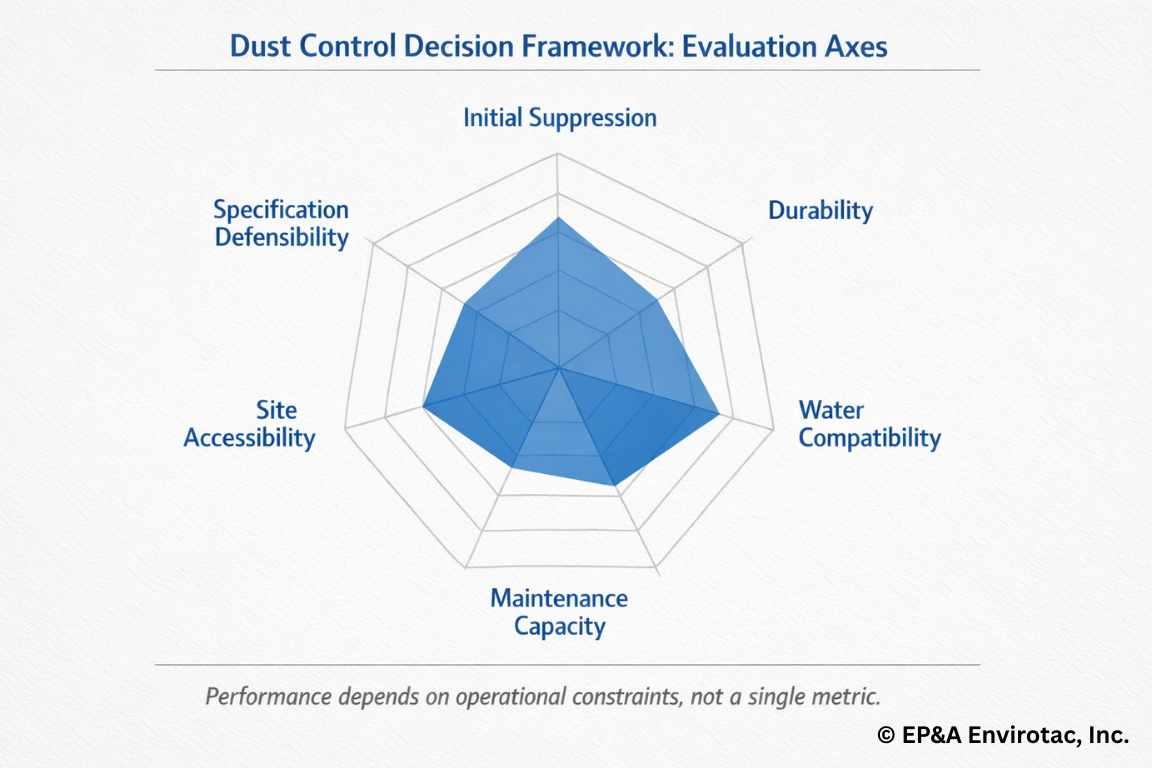
Durable selection evaluates methods across six axes:
- Project phase
- Water availability and quality
- Maintenance capacity
- Site accessibility
- Community exposure risk
- Specification defensibility
In linear projects such as pipelines, utilities, and transport corridors, limited site access constrains how often dust control measures can realistically be maintained.
If a method requires reapplication at intervals shorter than physical access allows, it is operationally incompatible regardless of laboratory performance. Reapplication frequency becomes the dominant failure mode.
Planning assumptions often underestimate how quickly constraints surface. Access that appears adequate on plans can become limited once distance, weather exposure, and mobilization time are factored into routine maintenance.
At the same time, maintenance capacity is frequently absorbed by secondary equipment issues first, leaving fewer resources available to correct declining dust performance before it becomes visible off-site.
Specification defensibility becomes critical not when methods are selected, but when substitutions are proposed after conditions change.
For consultants, documenting these axes transforms dust control from preference into defensible engineering judgment.
Monitoring → Action Decision Table
| Signal | Threshold | Action | Responsible Role |
| PM10 at haul-road exit | Exceeds limit (15-min avg) | Stabilize surface; restrict traffic | Site Operations |
| Wind speed | Above site threshold | Suspend earthmoving | Superintendent |
| Track-out | Beyond the site boundary | Deploy sweeping / wheel wash | Logistics |
| Community complaint | Logged | Inspect and adjust within 24 hrs | Compliance |
Monitoring deployment logic
Monitoring only creates value when it produces an actionable signal, not just records. Durable programs distinguish between hotspot, perimeter, and worker-exposure monitors, deployed using a concentric logic that prioritizes source diagnosis before boundary compliance. Programs that rely solely on perimeter monitoring often discover failure only after dust has already migrated off-site.
Field postmortems—how failure actually shows up
Construction site: water-only suppression
At the outset, water-only suppression appears reasonable. Water is available, inspectors recognize it, and early site conditions are forgiving. For the first one to two weeks, dust levels appear manageable, reinforcing confidence in the approach.
At this stage, the approach remains defensible: water is available, inspectors recognize it as an accepted control, and early documentation shows visible suppression during inspections.
By the second week, conditions shift. Rising temperatures and wind reduce the effective window of suppression. Crews respond by increasing watering frequency, which introduces a second-order effect: repeated wet–dry cycling destabilizes surface fines. Vehicle traffic begins to mobilize material rather than suppress it.
The response is incremental rather than strategic—watering is increased again, not because it is effective, but because it is familiar, documented, and already mobilized.
By Week 3, the system tips. Track-out increases, sweeping frequency doubles, and slurry accumulation reduces workable hours. Complaints begin to surface, and inspections become more frequent. At this point, the method has not “failed” in isolation—the surrounding system has.
Hidden costs emerge gradually: labor hours escalate, productivity drops, and complaint response begins to consume management time.
By the time stabilization is considered, the costs have already accrued quietly through labor, lost time, and scrutiny, making the eventual correction feel reactive rather than planned.
Mining operation: chemical suppression with process water
In mining environments, early performance can be misleading. During Month 0, chemical suppression using available process water meets dust targets. KPIs look stable, and maintenance schedules remain unchanged.
Early performance creates a false sense of stability, as dust KPIs remain within limits while mechanical stress accumulates invisibly in delivery systems.
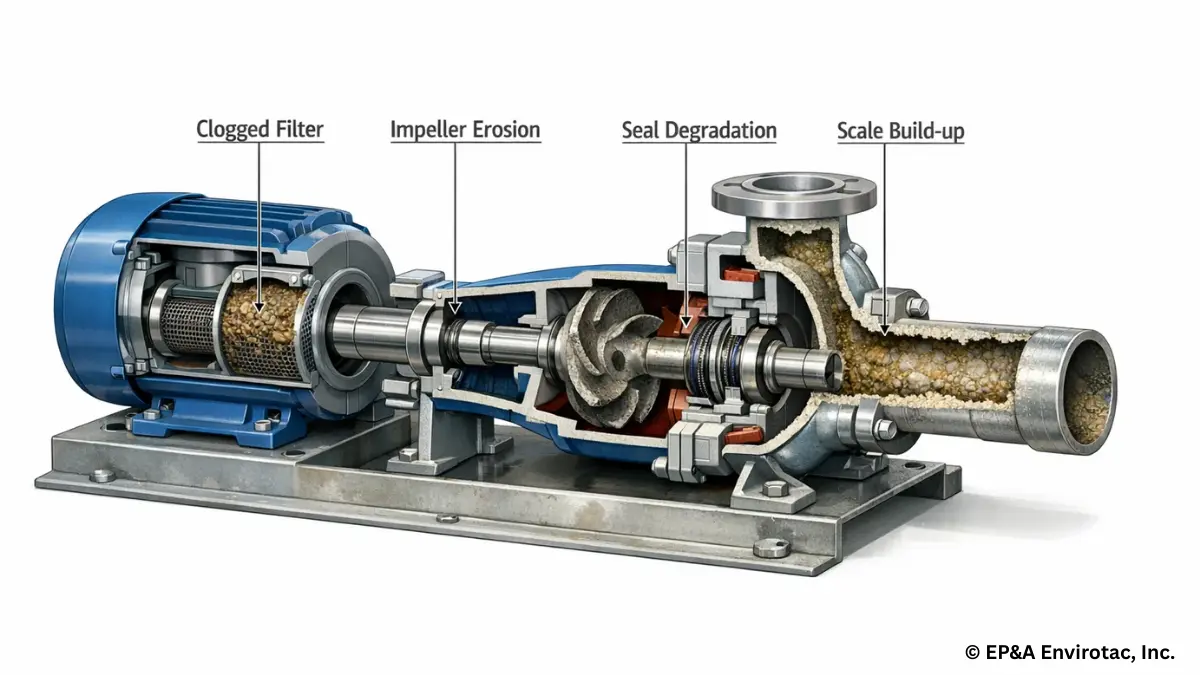
By Month 1, subtle mechanical signals appear. Nozzle fouling requires weekly cleaning, but production continues. By Month 2, pump pressure drops and seal wear accelerates. Filter replacement frequency doubles, pulling maintenance crews away from higher-priority systems.
These signals are often tolerated longer than they should be, because production continues and no single failure appears severe enough to justify a system change.
By Month 3, maintenance—not just dust—becomes the bottleneck. Downtime per intervention ranges from 2 to 6 hours, and dust resurges despite continued application.
The failure becomes unmistakable only when maintenance capacity, not dust suppression, becomes the limiting factor on operations.
NIOSH guidance notes that foam-based suppression can reduce dust 20–60% more effectively than water alone in high-energy material handling environments.
Linear infrastructure failure—utilities and pipelines
In linear projects, early assumptions center on manageability. Water-based suppression is selected with the expectation that reapplication, while frequent, will be feasible. During the first two weeks, this prediction appears correct—especially near access points.
The underlying assumption is not that reapplication will be easy, but that it will be manageable within expected access windows.
As work progresses along the corridor, exposure increases. Dry conditions and crosswinds amplify dust between access nodes. Reapplication now requires full remobilization of crews, extending response times.
Each delay compounds the problem, as untreated sections lengthen and suppression shifts from preventative to reactive.
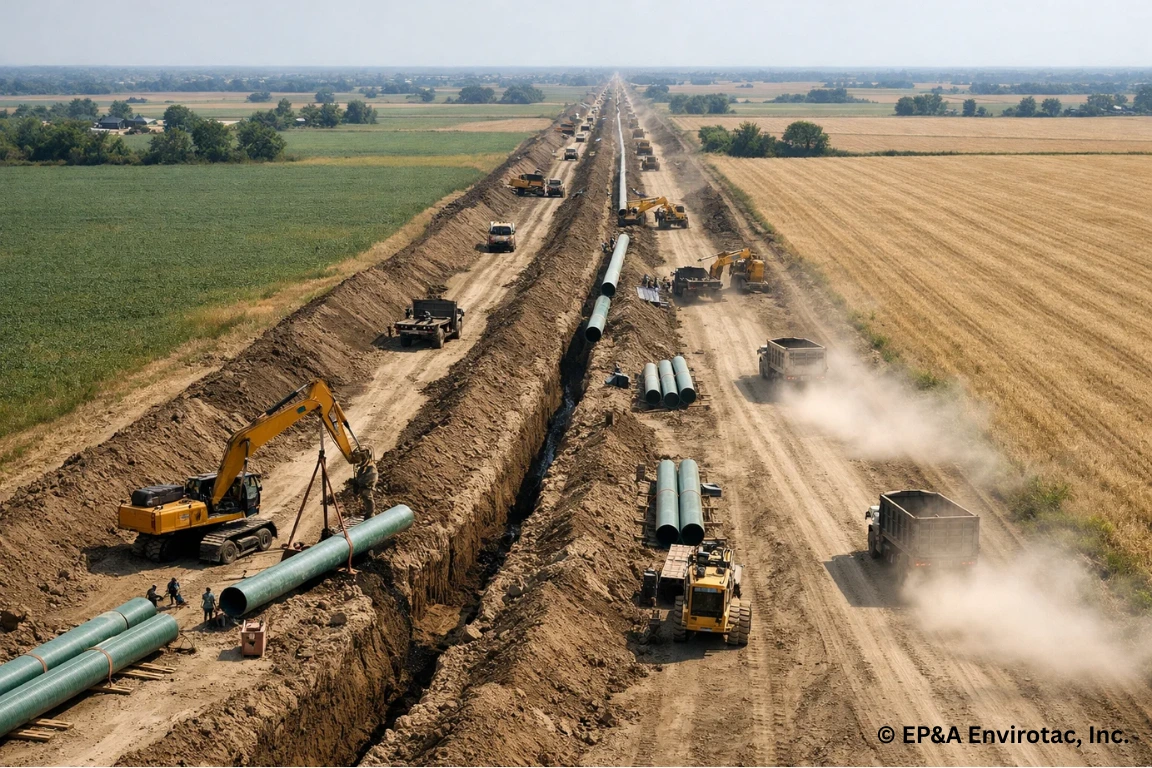
By Weeks 5–6, weather windows narrow. Dust suppression lags behind active work in exposed segments, and downwind complaints begin to surface.
Hidden costs include repeated mobilization, lost work windows, and inspection escalation.
The defining constraint is not material performance, but the simple reality that methods requiring frequent intervention fail when intervention itself is the scarce resource.
Water compatibility and mechanical reality matrix
This matrix summarizes how different water-quality conditions typically translate into mechanical stress and maintenance burden for dust-control delivery systems. It is not a performance guarantee, but a planning aid: higher suspended solids and abrasive fines generally increase nozzle fouling, pump wear, abrasion risk, service time, and spare-parts consumption, while chemically reactive water introduces corrosion and scaling risks that can drive maintenance even when solids are low. The intent is to support method and equipment selection by highlighting where water compatibility, not just dust suppression efficiency, becomes a limiting factor for long-term performance.
| Water Quality Condition | Nozzle Fouling | Pump Wear | Abrasion Risk | Service Hours / Month | Spare Parts Dependency |
| Low TSS / low hardness | Low | Low | Low | <5 hrs (indicative, site-dependent) | Low |
| Moderate TSS | Moderate (filter recommended) | Moderate | Moderate | 10–15 hrs (typical range, site-dependent) | Medium (product-specific) |
| High TSS / abrasive fines | High | High | High | 25+ hrs (indicative for unfiltered, high-abrasion water) | High |
| Reactive chemistry | Variable — scaling or precipitation risk (context specific) | Variable — corrosion or accelerated wear possible (chemistry & materials dependent) | Chemical degradation risk (scaling/corrosion) rather than physical abrasion | 10–20 hrs (highly chemistry-dependent; monitoring recommended) | Variable — may be Medium–High for corrosive waters |
(Note: This matrix summarizes typical patterns observed in field operations. Actual nozzle fouling, pump wear, abrasion risk, maintenance hours, and parts consumption depend on particle size, hardness, concentration (TSS), water chemistry (pH, chlorides, alkalinity), equipment design, pre-filtration, and operating procedures. Treat numeric ranges as indicative; site-specific testing and material matching are required for accurate maintenance planning.)
Community and compliance integration
Industry guidance indicates that vehicle track-out can extend up to 500 m from large sites, 200 m from medium sites, and 50 m from small sites, making boundary-only controls insufficient.
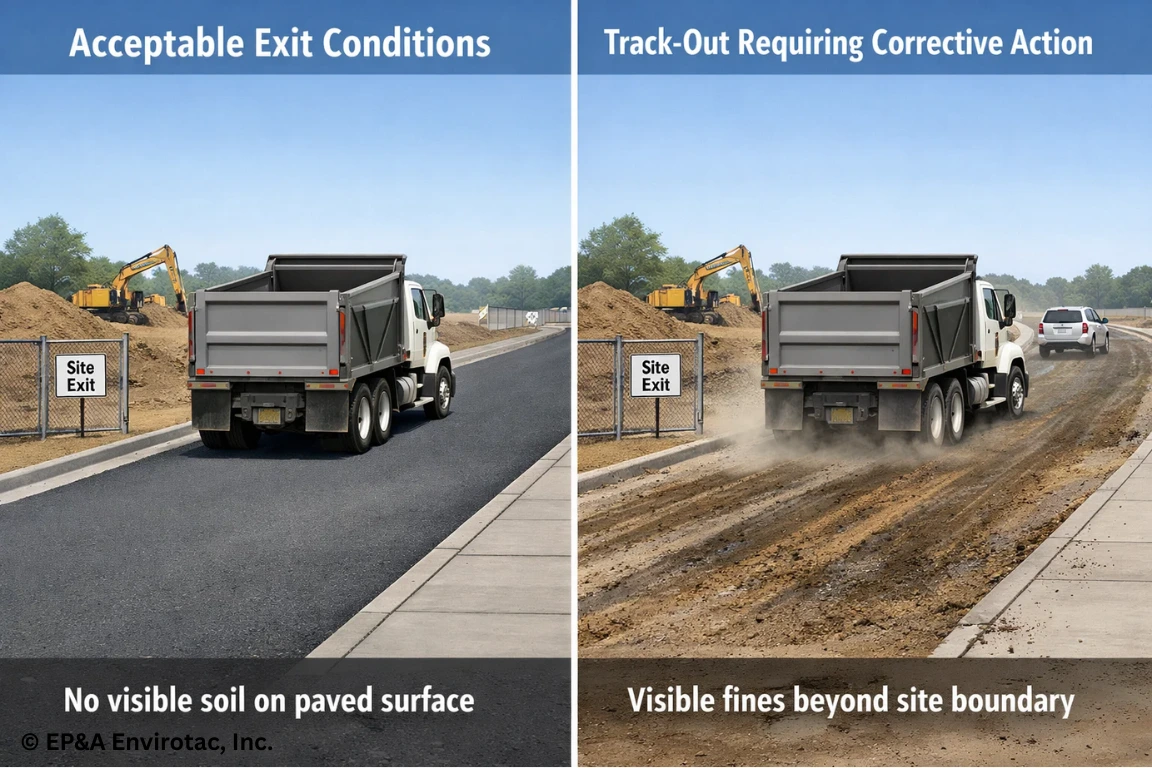
Visual track-out benchmarks for field inspection
Distance thresholds alone are insufficient for consistent enforcement. Effective programs pair them with visual condition benchmarks so inspectors can distinguish acceptable conditions from early failure.
Indicators of effective screening- No visible soil plume behind exiting vehicles
- Pavement appears dampened or uniformly clean within the first 10–20 m
- No accumulation of loose fines in wheel paths or gutter lines
- Track-out limited to faint discoloration that dissipates naturally with traffic
- Visible dust plume generated by exiting vehicles
- Dry, loose soil deposits accumulating beyond the site exits
- Material tracked into gutters, drainage inlets, or pedestrian paths
- Repeated wheel marks or ridging indicating fines are being transported, not contained
These visual cues enable inspectors to take action before track-out reaches distance-based thresholds, thereby reducing reliance on complaint-driven enforcement.
Programmatic Compliance in Practice
Across large, regulated infrastructure programs, durable dust control performance is rarely achieved through suppression methods alone. Instead, it emerges where dust control is formalized as an operational system that links monitoring, response thresholds, and documentation into a single, repeatable workflow.
In multi-year programs operating across mixed urban and peri-urban corridors, dust control is often managed through predefined integration of real-time monitoring, surface treatment selection, and escalation protocols. Suppression methods are adjusted not only in response to visible conditions but also to trend indicators such as rising reapplication frequency or declining surface durability.
Compliance in these programs is evaluated against response behavior, not the absence of exceedances alone. When monitoring indicates deteriorating performance, predefined actions are triggered—ranging from method adjustment to access planning changes—before complaints or enforcement follow. Inspection records capture both observed conditions and the decisions made, creating a defensible compliance narrative under variable weather and access constraints.
The outcome is not a dust-free operation but operational stability: fewer reactive interventions, clearer decision pathways, and reduced reliance on complaint-driven enforcement. This reflects how durable compliance is achieved when dust control is treated as a continuous management process rather than a static requirement.
Operational Reference Materials
The following reference materials are included to support evaluation, documentation, and decision-making during active projects.
Example specification clause
Dust control methods shall be selected based on demonstrated durability under site-specific conditions, including project phase, accessibility, water quality, and maintenance capacity. Substitutions must demonstrate equivalent or superior performance across these dimensions and shall not increase reapplication frequency or community exposure risk.
Audit-Ready Inspection Checklist
The following checklist supports routine inspection and documentation of dust control performance at active sites. It is intended to guide consistent field observation and early corrective action, particularly where track-out and surface disturbance present elevated risk.
Surface Condition
- Active travel routes show no accumulation of loose, dry fines
- Treated surfaces remain intact and visibly effective under current traffic
- No evidence of surface breakdown due to repeated wet–dry cycling
Track-Out Control
- Pavement within the first 20 m of the site exits appears clean or damp
- No visible dust plume generated by exiting vehicles
- No accumulation of tracked material in wheel paths, gutters, or drainage inlets
- Wheel wash, rumble grids, or exit controls are present and functioning where required
If two or more conditions above are not met, corrective action is required regardless of the measured track-out distance.
Weather and Site Conditions
- Wind speed and direction consistent with the control method assumptions
- Recent weather events (drying periods, rainfall) accounted for in inspection notes
- Untreated or newly disturbed areas identified and documented
Monitoring and Response
- Monitoring locations unobstructed and representative of site conditions
- Observations aligned with predefined response thresholds
- Any exceedance or deterioration triggers inspection escalation and adjustment
Documentation
- Date, time, and location of inspection recorded
- Observed conditions documented with notes or photographs where appropriate
- Corrective actions logged, including time to response
Why Durable Dust Control Reduces Risk, Cost, and Regret Over Time
Systems-based dust control is not about virtue. It is about risk discipline. Programs that align methods with access, mechanical reality, and maintenance capacity experience fewer surprises. Specifications that anticipate failure modes are easier to defend. Communities that see consistent behavior escalate less often.
Durability reduces regret.
Frequently Asked Questions
- How is dust typically managed on active sites?
Dust is reduced through a combination of surface treatment, traffic management, and operational controls appropriate to site conditions.
- Are dust-free conditions achievable during earthworks?
Dust is unavoidable during land disturbance. Some dust generation is unavoidable, particularly during dry or windy conditions.
- What surrounding communities may observe during normal operations?
Intermittent dust may be visible during certain activities or weather conditions, followed by corrective response measures.
- How are changing conditions addressed?
Predefined triggers require inspection and adjustment when conditions change or thresholds are exceeded.
Turning Dust Control Strategy Into Day-to-Day Practice
Dust control methods do not fail because they are ineffective. They fail because they are selected without regard for the systems they operate within. When decisions are grounded in durability, compatibility, and defensibility, performance follows.
The tools referenced in this article—including a dust-control total-cost framework, specification language considerations, and inspection checklists—are presented here to support practical evaluation and decision-making in active projects.
Dust is what systems produce when balance is lost.
The patterns described here are familiar to many projects, but they are rarely identical. If your experience has followed a different path—or broken down for various reasons—those experiences are welcome in the comments.
Applications - Dust Control & Soil Stabilization Products

Leave a Reply