
October 23, 2026
Compaction changes the arrangement of soil particles by reducing air voids. When performed at a suitable moisture content and with an appropriate compaction method, it can improve soil strength and stiffness and reduce compressibility. The result depends on soil type, moisture, compaction effort, and the requirements of the finished structure.
A reliable testing program connects laboratory results with field measurements. Laboratory testing establishes a reference relationship between moisture content and dry density. Field testing then evaluates whether the placed soil has achieved the specified level of compaction.
This guide explains the principal soil compaction tests, how to interpret their results, what can cause a test to fail, and when soil stabilization may be worth considering.
What Is Soil Compaction Testing?
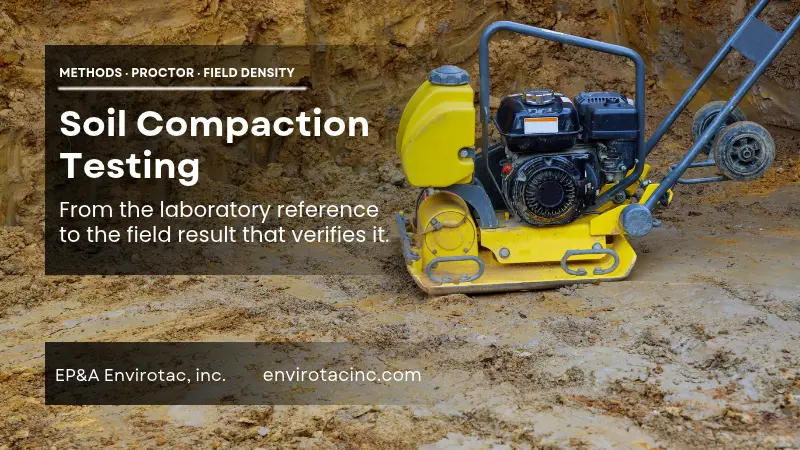
Soil compaction testing is the process of measuring how densely soil has been compacted and comparing the result with an established laboratory reference or project requirement.
Compaction generally involves placing soil in controlled layers, adjusting moisture as needed, and applying mechanical effort through equipment such as rollers, rammers, or vibratory compactors.
The purpose of testing is to verify that the prepared soil is suitable for its intended use under the project’s specified acceptance criteria. A density result is one part of construction quality control; it does not independently establish bearing capacity, settlement performance, or overall foundation adequacy.
Why Is Soil Compaction Important in Construction?
Compaction is important because the condition of the soil beneath a structure or pavement affects how it responds to loads and environmental conditions. Properly controlled compaction can help:
- Improve strength and stiffness: A denser soil structure can provide better support under applied loads, depending on soil type and moisture.
- Limit excessive settlement: Reducing air voids can reduce subsequent volume change under loading.
- Support pavement performance: Compacted subgrades and base materials help provide a stable platform for pavement layers.
- Improve construction consistency: Testing identifies areas that may need additional moisture conditioning or compaction.
- Meet project specifications: Density and moisture requirements are often included in earthwork and pavement construction documents.
The required compaction level is project-specific. Soil classification, loading, material characteristics, design assumptions, and applicable specifications all influence the acceptance criteria.
How Soil Compaction Testing Works
A typical compaction testing program includes laboratory evaluation, field placement, in-place testing, and comparison with the project requirement.
1. Identify and Evaluate the Soil
Soil type influences how material responds to moisture and compaction effort. The material should be characterized using the testing and classification procedures appropriate to the project.
2. Establish a Laboratory Reference
A laboratory compaction test determines the relationship between moisture content and dry density under a defined compactive effort. The results provide the maximum dry density and optimum moisture content for that test.
3. Place and Compact the Soil
Soil is typically spread in controlled lifts. Moisture may be adjusted before mechanical compaction. Lift thickness and equipment selection should suit the material and project specifications.
4. Measure Field Density and Moisture
An appropriate field method is used to determine in-place density and, where required, moisture content.
5. Compare the Result With the Specification
The measured field dry density is compared with the applicable laboratory maximum dry density or other specified acceptance criterion. The reference method must match the one required by the project.
What Is the Proctor Compaction Test?
The Proctor test is a laboratory method used to establish the relationship between soil moisture content and dry density under a specified compaction effort.
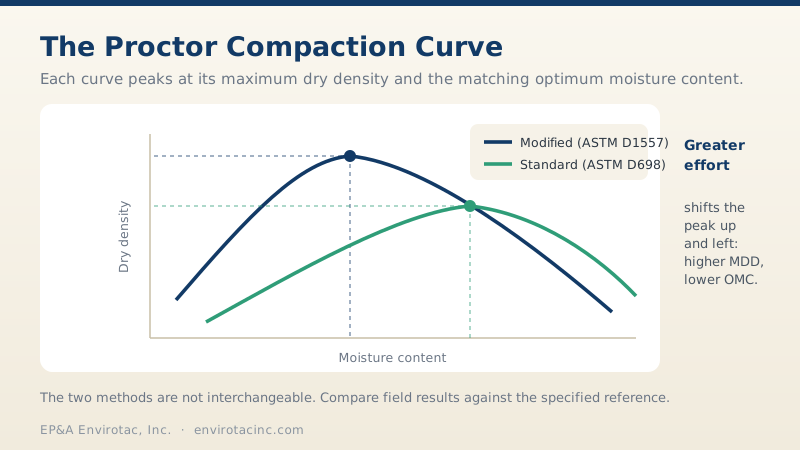
A soil sample is compacted at a series of moisture contents. The resulting dry densities are plotted against moisture content to produce a compaction curve. The curve is used to identify:
- Maximum Dry Density (MDD): The highest dry density achieved in the test under the specified compactive effort.
- Optimum Moisture Content (OMC): The moisture content associated with that maximum dry density.
Two common laboratory methods are the Standard Proctor and Modified Proctor tests.
Standard Proctor Test
The Standard Proctor test, commonly associated with ASTM D698, uses a lower compactive effort than the Modified Proctor test. It is used where the project specification calls for the Standard Proctor reference.
Modified Proctor Test
The Modified Proctor test, commonly associated with ASTM D1557, applies greater compactive effort. It generally produces a higher maximum dry density and a lower optimum moisture content than the Standard Proctor test for the same soil, although the actual relationship depends on the material.
The two methods are not interchangeable. A field density result must be compared against the laboratory reference specified for the project.
Some free-draining or coarse-grained soils may not produce a well-defined Proctor maximum. In those cases, the applicable specification and alternative laboratory procedures should guide the reference value.
What Is a Field Density Test?
A field density test measures the density of soil after it has been placed and compacted at the construction site. The result is used to determine whether the compacted layer meets the project’s specified density requirement.
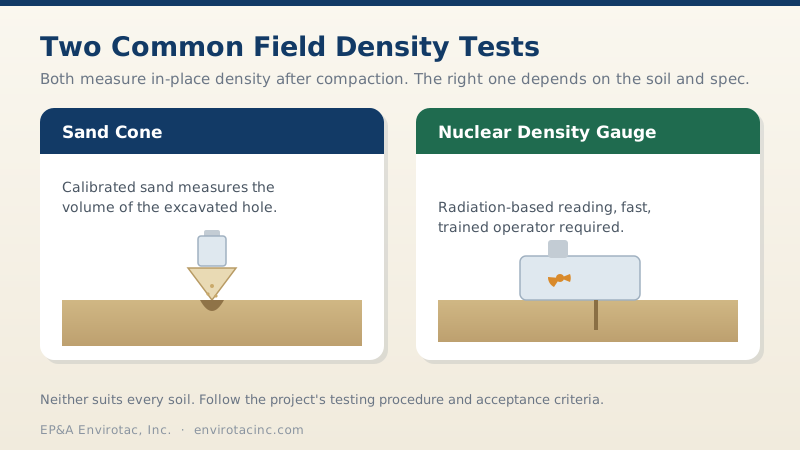
Common field methods include the sand cone test and nuclear density gauge testing. The suitable method depends on soil characteristics, project specifications, equipment availability, and testing requirements.
Sand Cone Test
The sand cone method determines the volume of a small excavated hole using calibrated sand. The general procedure is:
- Prepare and level the test surface.
- Excavate a hole and collect the removed soil.
- Determine the mass and moisture content of the excavated material.
- Use calibrated sand and the apparatus to determine the hole volume, accounting for the equipment’s calibration and applicable corrections.
- Calculate the in-place wet and dry density.
The method can provide a direct field measurement, but its suitability depends on material gradation, test-hole stability, and the applicable test procedure. Oversized particles or unsuitable soil conditions may affect the validity of the result.
Nuclear Density Gauge Test
A nuclear density gauge uses radiation-based measurement to estimate in-place density and moisture content. It is commonly used for construction quality control because measurements can be obtained relatively quickly.
The gauge must be operated by trained personnel in accordance with applicable radiation safety requirements. Calibration, standardization checks, surface preparation, material characteristics, and measurement geometry can affect readings.
The method is not suitable for every soil or site condition. Project procedures should address equipment checks, measurement limitations, and any required verification.
Understanding Soil Density
Soil density describes the mass of soil within a given volume. In compaction testing, the distinction between wet density and dry density is important.
- Wet density: Includes the mass of soil solids and water in the measured volume.
- Dry density: Represents the mass of soil solids per unit of total volume, excluding water mass.
Dry density is commonly used for comparison with Proctor maximum dry density because moisture content can change during construction.
What Is Maximum Dry Density (MDD)?
Maximum dry density is the highest dry density measured on a laboratory compaction curve for a defined soil and compaction effort.
MDD is not a universal value for a soil category. It depends on the tested material, the laboratory method, and the compactive effort.
If the soil material changes significantly during construction, the established reference may no longer represent the material being placed. The project testing plan should address when a new laboratory reference is needed.
What Is Optimum Moisture Content (OMC)?
Optimum moisture content is the water content at which the soil reaches its maximum dry density under the specified laboratory compaction effort.
At moisture contents below OMC, adding water can help soil particles rearrange under compaction. Beyond the optimum, additional water generally reduces the dry density achievable under the same effort.
In the field, moisture conditioning may involve adding water and mixing, or allowing soil to dry before compaction. The acceptable moisture range should come from the project specification rather than assuming that OMC is a universal field target.
How to Calculate Percent Compaction
Percent compaction compares the field dry density with the laboratory maximum dry density specified for the material.
Percent Compaction = (Field Dry Density ÷ Laboratory MDD) × 100
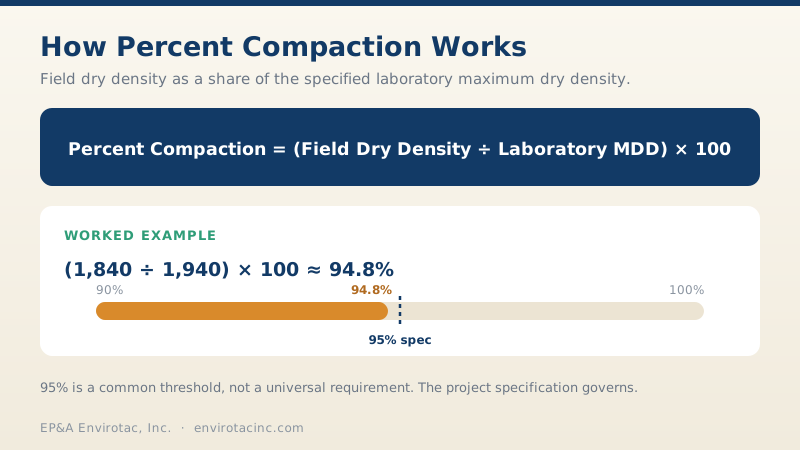
For example, if the field dry density is 1,840 kg/m³ and the applicable laboratory MDD is 1,940 kg/m³:
Percent Compaction = (1,840 ÷ 1,940) × 100
The result is approximately 94.8% compaction.
Whether this meets the project requirement depends on the specified percentage, the correct laboratory reference method, and any additional acceptance criteria. A commonly encountered threshold such as 95% should not be treated as a universal requirement for every construction project.
Laboratory Compaction Testing vs. Field Density Testing
Laboratory and field tests serve different purposes and work together.
| Laboratory compaction test | Field density test |
|---|---|
| Establishes a reference moisture-density relationship | Measures soil condition after field compaction |
| Determines MDD and OMC for the test method | Determines in-place density and, where applicable, moisture |
| Uses controlled laboratory conditions | Reflects actual site placement and compaction |
| Supports selection of a compaction target | Verifies compliance with project requirements |
A laboratory result alone cannot confirm that a construction lift has been compacted adequately. Field measurements provide the verification needed during earthwork.
What Happens If Soil Fails a Compaction Test?
A failed compaction result indicates that the tested location or layer did not meet the applicable acceptance criterion. The next step is to identify the likely cause and determine the corrective action. Potential factors include:
- Moisture content outside the specified range
- Insufficient compaction effort
- Lift thickness beyond what the equipment can effectively compact
- Soil variability or a change in material
- Unsuitable equipment for the soil type
- Poor mixing or uneven moisture distribution
- Test-method limitations or an unrepresentative measurement
Corrective action may include moisture adjustment, remixing, additional compaction, reducing lift thickness, changing equipment, or reassessing the material. Retesting should follow the project’s quality-control and acceptance procedures.
Repeated failures may indicate that the issue is not limited to compaction effort. Soil suitability, drainage, material consistency, and the need for a revised construction approach may also warrant review.
Where Is Soil Compaction Testing Used?
Soil compaction testing is used across many construction applications.
Road and Pavement Construction
Compaction testing helps verify the condition of subgrade and other earthwork layers supporting pavement systems. Requirements depend on pavement design, material type, and project specifications.
Building Pads and Foundations
Prepared building pads and foundation-related earthwork may require density testing to verify compliance with design and construction requirements. Density testing is only one part of evaluating foundation support.
Parking Areas and Site Development
Compaction testing supports quality control for parking areas, access roads, utility corridors, and general site grading where compacted soil forms part of the constructed section.
Soil Compaction vs. Soil Stabilization
Soil compaction and soil stabilization address related but different aspects of soil performance.
Compaction mechanically densifies soil by reducing air voids. Its effectiveness depends on moisture, soil characteristics, equipment, and compaction effort.
Soil stabilization modifies or improves soil properties through an appropriate treatment or construction method. The treatment may be considered when the existing material presents challenges that cannot be addressed adequately through moisture conditioning and compaction alone.
Stabilization does not automatically replace compaction testing, geotechnical evaluation, or project-specific acceptance requirements. The appropriate approach depends on the soil, intended use, design, and construction conditions.
When Should Soil Stabilization Be Considered?
Soil stabilization may be worth evaluating when:
- Soil conditions make it difficult to achieve specified construction performance.
- Material variability complicates consistent earthwork.
- The project requires an improvement in soil behavior beyond mechanical densification.
- Site conditions call for a treatment approach selected through engineering evaluation.
The choice of stabilization method should be based on material characteristics, project objectives, constructability, and applicable design requirements.
Need a Soil Stabilization Solution for Your Construction Project?
When soil conditions make it difficult to achieve the required performance, stabilization may be worth considering alongside the project’s compaction and testing requirements.
EP&A Envirotac, Inc. offers soil stabilization solutions for construction and other soil-related applications. If your project involves challenging soil conditions, explore how Envirotac’s services may support your site requirements.
Explore EP&A Envirotac, Inc. Services
Frequently Asked Questions About Soil Compaction Testing
What Is the Purpose of Soil Compaction Testing?
Soil compaction testing verifies whether placed soil meets the density requirements established for a construction project. It supports quality control for earthwork, pavement layers, building pads, and other applications.
What Is the Difference Between Standard Proctor and Modified Proctor?
The Modified Proctor test uses greater compactive effort than the Standard Proctor test. For the same soil, it generally produces a higher maximum dry density and lower optimum moisture content. The applicable test method is determined by the project specification.
What Does 95% Compaction Mean?
A result of 95% compaction means the measured field dry density is 95% of the applicable laboratory maximum dry density. It is an acceptance threshold only when the project specification requires it.
How Is Field Soil Density Measured?
Common methods include the sand cone test and nuclear density gauge testing. The appropriate method depends on the material, site conditions, specification, and applicable testing procedure.
Why Does Moisture Content Matter During Compaction?
Moisture affects how soil particles rearrange under compactive effort. Dry density typically increases with added water up to the optimum moisture content and then decreases beyond it under a defined laboratory compaction effort.
Does Passing a Compaction Test Guarantee Soil Stability?
No. A passing density result confirms compliance with the specified density criterion at the tested location. Overall soil performance also depends on factors such as soil type, drainage, loading, settlement behavior, and geotechnical design.
What Should Be Done When a Soil Compaction Test Fails?
The cause should be evaluated before corrective work is selected. Depending on the conditions, the response may involve moisture adjustment, additional compaction, thinner lifts, different equipment, material reassessment, or an engineering review.
Applications - Dust Control & Soil Stabilization Products

Leave a Reply