
October 16, 2026
Strength is a given. The brief inherited it, the treatment confirmed it, and the tests blessed it. The failure, when it came, had excellent documentation.
When the visible symptom and the governing failure are not the same thing, selecting the right intervention becomes difficult. A road that deteriorates after rain might point toward drainage, material plasticity, fines loss, or bearing capacity, and each implies a different response. Applying the same treatment across those four problems produces four different outcomes. One of them solves the project.
Here, ground improvement refers to near-surface soil and aggregate performance in roads, access routes, industrial sites, and mining applications: situations where the question is how to improve existing material, not redesign the ground profile beneath it.
This article follows the decision in the order it should happen: what is failing, what needs to change, where that change has to occur, what mechanism can produce it, how it holds up in service, and whether the original problem was resolved.
Start With the Failure, Not the Treatment
The symptom a project team reports is a clue. It is not a treatment specification.
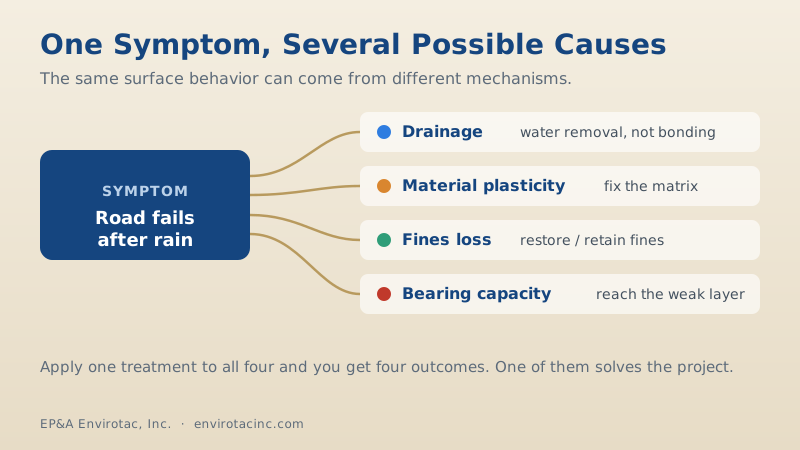
“The road is dusty” describes an outcome. It does not establish which material characteristic or operating condition is driving the dust, whether fines are present in excess or being lost, whether the problem lives in surface cohesion, surface texture, traffic speed, or something upstream of the road surface entirely. Dust is measurable and consequential. The treatment has to address what produces it, not suppress the visible result.
Instability, erosion, raveling, and wet-weather failure follow the same logic. Each symptom can have more than one cause. Wet-weather impassability might point toward drainage, subgrade shear strength, plasticity in the base material, or some combination. FHWA research on unpaved road management identifies grading, fines content, clay content, and shear strength as distinct material variables, each capable of producing similar-looking surface behavior through different mechanisms.
By the time a symptom reaches a project decision-maker, it may already have been shaped by an interpretation. A site manager reports instability. The interpretation traveling up the chain may already have an embedded treatment assumption attached to it. The engineering question is whether that interpretation is correct, or whether the visible failure is standing in for a different governing problem.
The reported symptom is where diagnosis starts. Not where it ends.
Before Stabilizing, Decide What Actually Needs to Change
Stabilization is one possible response to a diagnosed problem. It is not the diagnosis.
Once a project is framed as a stabilization job, the remaining decisions can narrow prematurely toward product selection. Whether stabilization is the right first intervention, or whether something else belongs before it, instead of it, or alongside it, is the question that belongs earlier in the process.
Where poor grading is the governing deficiency, correcting the material may be more rational than increasing chemical dosage to compensate for it. A road with insufficient fines may perform poorly not because its matrix lacks bonding agents but because its gradation cannot support the required surface behavior. More stabilizer applied to a poorly graded material does not fix the grading. It treats the symptom while the cause stays in place.
The same pressure test applies to drainage. Water’s involvement in a failure does not make drainage the automatic prerequisite. The question is what water is doing in the failure, whether it is part of the governing mechanism or a contributing condition that a well-specified treatment can account for. That answer determines whether drainage belongs in the solution at all, and in what capacity.
Other interventions belong in this evaluation: material correction, grading adjustment, replacement, mechanical modification, and combinations of these. Not as a taxonomy of methods, but as competing responses to the same diagnosed problem. The selection question is not which of these is generally best. It is which one addresses the governing failure.
A poorly constructed road cannot always be stabilized into a well-performing one. Geometry, drainage, material quality, and preparation are not obstacles around a treatment decision. They are part of the engineering problem.
Make Sure the Treatment Zone Matches the Problem
Even when stabilization is the right intervention, a technically sound treatment can fail the project if the treated zone does not reach the material responsible for the failure.
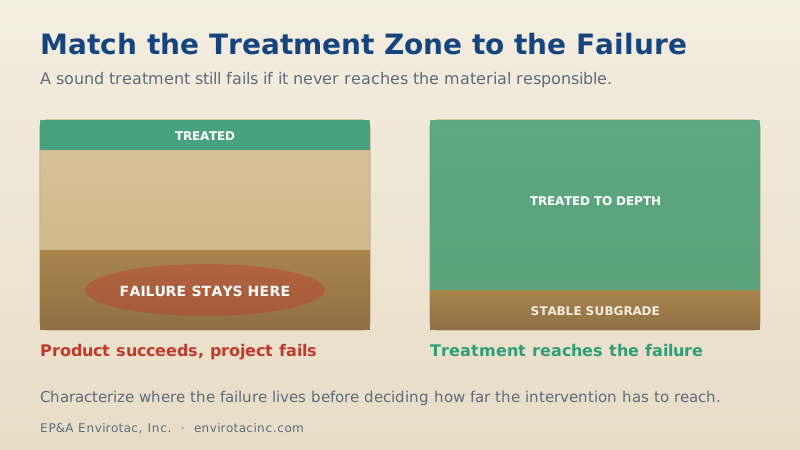
This is not an argument for always treating deeper, but an argument for characterizing where the failure lives before deciding how far the intervention needs to reach.
A surface application can perform well within the surface layer while leaving a deeper failure untouched. The treated zone bonds, stabilizes, and behaves as intended. The project still fails because the governing problem was below the treatment. The product succeeded. The selection process did not.
FHWA distinguishes spray-on and mix-in approaches in part by how deeply and uniformly the additive is incorporated. Each has typical treatment depths and different incorporation mechanisms. Each can be appropriate or inappropriate depending on where the failure is and what the material requires. The guidance also notes that actual mixing depth affects effective application rate; the theoretical treatment zone and the delivered treatment zone are not automatically the same.
Treatment depth is an engineering decision with project consequences, not an application parameter to be settled on site. It belongs in the same diagnostic evaluation as material compatibility, fines content, plasticity, moisture, traffic loading, and climate. These variables together determine how the treatment zone should be matched to the failure zone, and whether the intervention can modify the material responsible for the problem at the depth and under the conditions where that modification is needed.
When Polymer Stabilization Earns a Place in the Decision
Apply polymer stabilization without evaluating the specific formulation against the specific material and service conditions, and the selection process has stopped one step short of where the decision lives. Formulation, soil interaction, performance objective, treatment zone, and service environment are not equivalent considerations. Performance varies across all of them, and those differences determine whether the intervention solves the project or merely changes the material.
The question is not whether polymer stabilization works. It is whether this formulation, on this material, for this performance objective, at this treatment zone, under this service environment, is the right technical answer. That requires checking specific characteristics: how the polymer interacts with the soil fraction present, what property it is changing, and whether that change addresses the governing failure.
Performance varies with polymer type, molecular characteristics, and soil properties, and cationic, neutral, and anionic polymers can interact differently with clay fractions. A polymer that produces improvement on one material may produce little measurable effect on another with different plasticity or gradation. Formulation-specific evidence is what makes that useful in practice, which is why documented performance data carries the weight it does in a technically sound selection.
Dust control and stabilization can share mechanisms without being interchangeable performance specifications. A polymer that retains surface fines and improves cohesion may reduce dust and contribute to surface integrity at the same time, but the performance objective governing the treatment decision differs in each case. Collapsing both into strength improvement misrepresents what the treatment is doing and makes verification harder.
This is where EP&A Envirotac, Inc.’s technical documentation becomes relevant. Its published materials identify the formulation and present application information and test-based performance claims, including CBR results. The numbers carry more weight when the context behind them is clear, and EP&A Envirotac, Inc.’s technical and test documentation helps connect published performance data to the soil, treatment, and application variables that matter on the project.
Judge the Choice by What Happens After Application
Technical fit is the entry requirement. It does not determine whether the treatment remains a sound project choice over time.
FHWA draws a distinction between spray-on and mix-in approaches that goes beyond upfront cost. Spray-on treatments can be less expensive to install but may require more frequent rejuvenation as surface exposure degrades the treated layer. Mix-in approaches carry higher initial construction costs but can provide deeper incorporation, longer treatment performance, and different maintenance requirements. Neither is preferable in the abstract. The question is what it costs to maintain required performance over the intended service period, not what the product costs to apply.
A surface that holds up in dry conditions but needs rejuvenation after every wet season carries a different lifecycle cost than one that performs through both. The gap between those two profiles is where the treatment decision should be made, not at the product price.
The application method belongs inside this evaluation. The treatment rate applied during design and the treatment delivered in the field are not automatically the same. Road preparation, uniformity of application, mixing depth, field moisture conditions, and construction sequencing all affect what the ground receives. A treatment that looks sound on paper but ignores constructability under actual site conditions may underperform, not because the product failed, but because the delivered treatment differed from the designed one.
A product’s nominal price communicates almost nothing about the cost of keeping the project performing.
Verify the Performance You Actually Needed
A changed material property is not a resolved project problem.
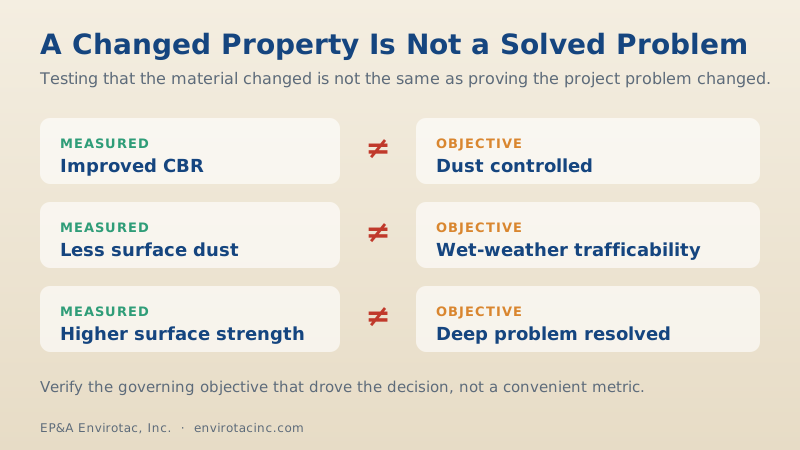
Testing that a treatment modified the material, like increased CBR, changed plasticity characteristics, or increased compressive strength, demonstrates a change in the measured property. It does not confirm that the thing that mattered changed.
Improved CBR does not prove dust control. Reduced surface dust does not prove wet-weather trafficability. Increased surface strength does not prove a deeper structural problem was resolved. Each of those verification approaches tests something. None of them necessarily tests the governing performance objective that drove the original treatment decision.
Material and performance testing follows the governing problem, not a universal metric. For polymer stabilization, laboratory testing, field results, and credible third-party research each answer different parts of the performance question. Taken together, they provide a broader basis for evaluating how a treatment performs across soils, application conditions, traffic, and environmental exposure, giving project teams stronger ground for a fit evaluation than any single evidence source provides on its own.
The verification approach should be defined before the treatment is committed. The original failure diagnostic should produce the performance specification. The performance specification should produce the verification method. That sequence proves something useful. Working backward from available metrics proves the treatment was applied, which is not the same thing.
Conclusion
A sound ground improvement choice is not necessarily the most sophisticated, the most aggressively marketed, or the least expensive to install. It is the one whose mechanism, treatment zone, construction requirements, service behavior, and lifecycle economics match the actual failure.
The project risk is not simply selecting the wrong product. It is paying to improve the wrong property, in the wrong place, by the wrong mechanism, and finding that out only after the project returns to service.
Knowing when stabilization is the right call, when something else belongs first, and what evidence will show the choice worked is the judgment this decision requires. When polymer stabilization fits those conditions, the case for it rests on specific formulation characteristics, documented performance evidence, and a verification approach tied to the failure that drove the decision in the first place.
That is the standard for any treatment selection. It is also the standard for evaluating one.
EP&A Envirotac, Inc. specializes in soil stabilization and dust control solutions across roads, access routes, industrial sites, mining applications, and a range of other industries. Talk to our team about what your project requires.
Applications - Dust Control & Soil Stabilization Products
Leave a Reply