
October 13, 2026
Sandy and silty soils don’t present one engineering problem. The classification describes the material, not what the soil needs to do, what conditions it will face, or what is preventing it from performing. Two sites with nearly identical gradations can demand completely different interventions because the controlling problem differs. Getting the diagnosis wrong early is expensive.
The stabilization decision starts with the performance requirement and the failure mechanism, not just the soil type.
Common soil stabilization methods include mechanical improvement, cement, lime, bituminous treatment, grouting, geosynthetics, and polymer stabilization, but the appropriate method depends on the failure mechanism and the required performance.
The Failure Mechanism Comes First
What Does the Soil Need to Do?
“Stability” isn’t a performance specification. Before treatment is selected, the required outcome has to be defined: bearing capacity under anticipated loading, trafficability through wet-season construction, erosion resistance under sustained flow, controlled settlement, and maintained integrity between subgrade and aggregate layers. For foundation and structural applications, the relevant question is whether the supporting stratum can meet the required bearing, settlement, drainage, and long-term performance criteria under the proposed loading, not simply whether the soil is sandy or silty. The treatment follows from that requirement. Without it, the selection process is working backwards.
A soil can be perfectly adequate under one set of conditions and insufficient under another, not because anything changed in the soil, but because the loading, moisture exposure, or performance requirement changed. Stabilization is justified by a performance gap, not by the classification.
Identifying the Controlling Mechanism
Soil type is an input to diagnosis, not the diagnosis itself. The same sandy or silty classification can be driven by fundamentally different controlling mechanisms, and those mechanisms point toward different interventions.
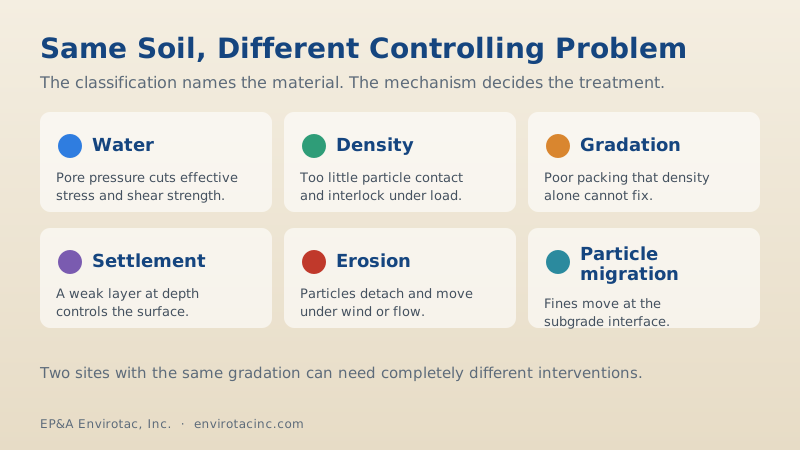
- Water: Increased pore-water pressure reduces effective stress and can reduce available shear strength. In fine-grained silts, capillary rise and groundwater can contribute to elevated moisture above the water table, so surface drainage alone may not reveal the controlling condition. Clean sands generally have little intrinsic cohesion; apparent cohesion from suction under unsaturated conditions can contribute to strength, but saturation removes that contribution.
- Density: Insufficient particle contact and interlock under load represent a physical deficiency. Whether compaction resolves it depends on achieving and maintaining the target density under actual site conditions. Field soil compaction testing establishes whether the specified density was actually achieved, not just assumed.
- Gradation: Poor or gap-graded particle-size distributions can limit packing and support characteristics even when density is improved. Blending can address a gradation deficiency that compaction alone cannot.
- Settlement: A weak or compressible layer at depth controls what happens at the surface. The vertical profile matters as much as the surface condition; treating only the surface doesn’t change the controlling layer.
- Erosion: The mechanism is particle detachment and transport. Treatments designed to improve bearing strength may not address erosion resistance, and treatments designed for erosion control may not provide the structural improvement load-bearing applications require. Where erosion is the controlling problem and site conditions like climate, establishment time, and maintenance allow, vegetation can be an effective surface protection approach, either on its own or alongside other treatments.
- Particle migration: In layered systems, fines migrating from the subgrade into the aggregate under repeated loading can degrade system performance over time. The controlling problem can be at the interface rather than within the soil mass itself.
Different failure mechanisms point toward different interventions. A silty subgrade losing support under wet-season traffic is a different engineering problem than a sandy embankment losing surface material under storm flow, even if both get described as soil stability issues.
When Soil Stabilization Is the Right Approach
Soil stabilization deliberately changes the engineering properties of the soil to meet a performance requirement. That means strength, stiffness, cohesion, erosion resistance, surface stability, resistance to particle movement, or hydraulic behavior, depending on what the project needs and what the selected treatment actually changes.
A soil doesn’t have to be visibly failing before stabilization has value. Anticipated loading, construction traffic, moisture exposure, changed site use, or durability requirements can all create a legitimate performance gap in soil that currently appears adequate. The justification is the performance objective, not the visible condition of the soil at the moment of assessment.
When Drainage Needs to Be Addressed Alongside Stabilization
Persistent water conditions can control soil performance regardless of what a treatment achieves. Where water is a significant factor, dewatering and stabilization often work together. Addressing the hydraulic condition improves the construction environment and reduces factors that would otherwise undermine treatment performance over time.
When Mechanical Improvement May Be Sufficient
Where the controlling deficiency is density or gradation, and the conditions for achieving and maintaining improvement are realistic, mechanical stabilization can meet the performance requirement without chemical treatment. It changes the soil’s physical state, its density, void ratio, and particle arrangement, rather than its chemistry. How the soil subsequently responds to moisture and loading still depends on its material characteristics and the service conditions it faces.
When Separation or Reinforcement Serves a Different Function
These are distinct mechanisms, not alternative stabilizers.
A geotextile at the subgrade-aggregate interface helps prevent fines migration and preserves the separation and integrity of the base layer over time. Its primary function is managing the interface rather than modifying the intrinsic properties of the subgrade soil. The resulting system can perform better because separation and filtration preserve the integrity of the aggregate structure and help maintain the intended drainage characteristics.
A geogrid interacts with aggregate particles and provides lateral restraint, improving load distribution within the aggregate structure and reducing stress concentration on the subgrade. It improves system behavior without modifying the subgrade soil’s properties. The mechanisms, and the problems they address, are different from those of chemical stabilization.
Using any treatment for a problem it wasn’t designed to solve produces poor outcomes regardless of installation quality.
When to Consider Excavation and Replacement
For shallow unsuitable zones, highly variable material that makes consistent treatment difficult, or situations where the controlling layer is beyond practical treatment depth, excavation and replacement can be the more reliable engineering choice. The comparison is always site-specific; depth, variability, constructability, material availability, and schedule all factor in.
Soil Stabilization Methods for Sandy and Silty Soils
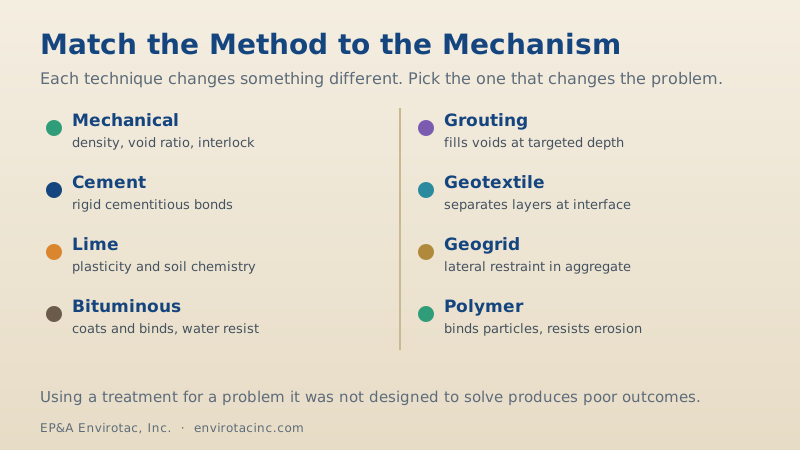
The following soil stabilization techniques are best compared by the mechanism they change, the conditions they require, and the performance they demonstrate.
Mechanical Stabilization
Mechanical stabilization changes the physical arrangement of particles: density, void ratio, and interlock. It is effective where the deficiency is primarily physical and where moisture can be controlled sufficiently to achieve and hold target density. Unlike chemical treatment, it modifies the soil’s physical state rather than its chemistry, so subsequent performance still depends on the soil’s characteristics and the service conditions it faces.
Cement Stabilization
Portland cement forms cementitious bonds within the treated soil, producing strength and stiffness gains in appropriate sandy, granular, and low-plasticity soils. Suitability depends on gradation, plasticity, chemistry, moisture, mix design, and project requirements, not on a fixed fines threshold. Cement stabilization has a long field record and is well-supported by established highway and geotechnical guidance.
Uniform mixing, moisture control, compaction to target density, and adequate curing before loading are construction control requirements, not design assumptions. High-sulfate soils and highly organic soils present compatibility concerns worth addressing early. The resulting layer is relatively stiff, and shrinkage-related cracking can become a long-term consideration in pavement applications, including the potential for cracks to reflect through an overlying asphalt layer.
Lime Stabilization
Lime treatment produces immediate changes in soil-water chemistry, plasticity, and workability through cation exchange and particle flocculation. Where soil chemistry and reactive silica and alumina support the pozzolanic reaction, lime produces longer-term strength gain. Testing helps establish whether a given soil is suitable for lime treatment and what treatment level may be appropriate. Soil characteristics such as Plasticity Index and other soil-specific properties inform that assessment, not gradation alone. Performance testing then verifies what the treatment actually achieves.
Lime and cement are not interchangeable for sandy and silty soils. Suitability for either depends on soil-specific testing, not on general category assumptions.
Bituminous Stabilization
Bituminous treatment can coat particles and bind the granular matrix, improving cohesion and water resistance while producing a relatively flexible bound layer. Suitability depends on soil gradation, binder compatibility, temperature susceptibility, and the performance requirement. It is not a universal approach for granular soils; the same evaluation logic applies as with any other method: the failure mechanism and required performance determine whether it belongs on the candidate list.
Grouting
Grouting modifies soil behavior by injecting cementitious or other grout into targeted zones, with the objective of improving strength, reducing permeability, or filling voids. It is more specialized than surface or shallow mixing treatment; effectiveness depends on soil permeability, injection pressure, treatment geometry, grout viscosity, and the specific conditions at depth. Where the controlling problem lies at a depth or in a configuration that surface treatment cannot effectively address, grouting may provide a more targeted solution. That level of targeting also means it requires careful site characterization before it can be designed or evaluated.
Geotextiles
The primary functions of geotextiles are separation, filtration, and drainage. The mechanism is at the interface, preserving layer integrity over time by preventing mixing and migration between dissimilar materials. System-level performance can improve as a result, but the geotextile is managing the boundary, not modifying the soil on either side of it.
Geogrids
Geogrids provide reinforcement through aggregate interlock and lateral load distribution. They improve system behavior without modifying subgrade soil properties. Sufficient aggregate depth above the grid is required to develop the composite action the design assumes.
Evaluating Whether a Treatment Actually Fits
How Deep Does the Problem Extend?
Treatment has to reach the controlling layer. A surface or shallow treatment that doesn’t engage the layer driving the performance problem improves something that wasn’t the issue. Site investigation needs to establish the vertical profile, not just the surface condition, and a failed proof roll can reveal weak subgrade conditions that warrant further investigation before treatment is selected.
What Construction Constraints Matter?
Mixing uniformity, moisture management, equipment access, curing time, weather exposure, return-to-service requirements, and quality-control repeatability all affect constructability. A treatment that works in principle still has to be implemented consistently at project scale. A treatment specification that doesn’t address these requirements isn’t complete.
What Will the Treatment Have to Withstand?
The service environment, meaning traffic loading, wet-dry cycling, erosion exposure, abrasion, and sustained saturation, is what determines the durability a treatment needs to demonstrate, not just the improvement it achieves at the time of construction. Selection has to account for the exposure, not just the performance target on day one.
What Trade-Off Are You Willing to Accept?
Every treatment changes something and introduces its own requirements. Cement stabilization produces strong, stiff improvement and requires construction time, moisture control, and curing before trafficking. Some polymer treatments can support shorter return-to-service windows with performance that is formulation- and application-specific. Geogrid with additional aggregate requires aggregate availability and sufficient section depth.
Cost belongs in this evaluation as a whole-project consideration: material, equipment, labor, treatment depth, quality control, and the consequences of underperformance, not simply the unit price of the stabilizing agent.
The treatment with the strongest performance on paper isn’t automatically the right project solution. Project selection should optimize for what the project needs, strength, schedule, constructability, durability, cost, and confidence level, not for what performs best under ideal conditions.
What Evidence Exists for This Approach?
Engineering guidance and published research establish that an approach is plausible for a class of soils and conditions. They don’t establish performance for a specific soil, site, construction environment, or project requirement. Laboratory evidence demonstrates what happened under tested conditions. Field verification provides evidence of how the treatment performs under actual project conditions. Product-specific evidence, such as formulation, application rate, soil compatibility, and performance data, is a separate question from category-level research.
Polymer Soil Stabilization: Where It Fits
Polymer stabilization is a serious and technically capable soil improvement approach. It is also a broad category: acrylic copolymers, polyvinyl acetate, styrene-acrylic, lignosulfonate, and other formulation classes operate through different mechanisms and produce different outcomes. Performance demonstrated for one formulation on one soil under one set of conditions doesn’t transfer automatically to a different configuration of those variables. That’s not a limitation unique to polymer treatment; it’s how soil improvement works. It’s also why formulation selection and soil-specific evaluation matter.
How Polymer Treatment Changes Soil Performance
Depending on formulation, concentration, soil, and application conditions, polymer treatment can improve particle binding and cohesion, increase resistance to detachment and surface erosion, modify strength characteristics, and affect hydraulic behavior. The mechanism that matters depends on what the soil needs to do; a polymer formulation selected for surface binding may have limited value as a structural stabilizer, and one selected for strength improvement may perform differently under erosion exposure.
Polymer stabilization has been studied across a range of erosion-control and surface-stabilization applications. For structural stabilization, the evidence is more formulation- and condition-specific, which makes testing against the actual project requirement more important, not less.
The Variables That Govern Polymer Performance
Polymer chemistry determines the fundamental interaction mechanism with soil particles. Molecular weight and concentration affect penetration depth, viscosity, and the degree of particle coating or void filling. Soil surface area, gradation, clay content, mineralogy, and pH all influence how the polymer distributes and bonds. Moisture at application, curing temperature and time, and mixing uniformity determine what the treated state actually is when the project loads it.
A polymer treatment is a soil-formulation-application-curing system. Changing one variable without accounting for the others can produce materially different results. Selecting the right polymer for a project means understanding which variables the project can control and which the formulation needs to accommodate.
Field Performance and Durability
Laboratory results are produced under controlled conditions: defined moisture levels, mixing, specimen preparation, and curing. Field conditions differ in ways that matter. Wet-dry cycling can affect bonding integrity in some formulations, sustained saturation can produce different performance than dry-state strength measurements indicate, and traffic imposes abrasion and mechanical stress that laboratory specimens don’t face. Long-term field performance data for polymer stabilization is less extensive than for cement or lime. That gap is reduced through project-specific testing and monitored field application, not through extrapolation from laboratory data.
Applying Polymer Stabilization Effectively
Polymer stabilization makes strong engineering sense when the failure mechanism aligns with what the treatment actually changes.
For erosion control and surface stability in slopes, embankments, unpaved surfaces, and areas subject to wind or water erosion, polymer treatment’s ability to bind surface particles and resist detachment addresses the controlling mechanism directly.
Where chemical stabilization is appropriate but a stiff treated layer creates problems, such as shrinkage cracking, differential movement, or applications where the rigidity of a cement-treated layer is undesirable for the specific loading or design conditions, an appropriately formulated polymer treatment can provide a different performance profile.
For sandy soils with low fines content, where the soil lacks the reactive constituents lime depends on, polymer bonding through particle coating, adhesion, and interparticle bonding can provide a different stabilization mechanism. Cement can also be effective in many sandy and granular soils, so where both are candidates, the comparison belongs at the level of required performance, treatment mechanism, construction conditions, and testing, not soil texture alone.
For projects where construction schedule is a genuine constraint, curing and return-to-service requirements can influence treatment selection. Some polymer formulations are designed for rapid curing, but the achievable return-to-service time depends on the formulation, application conditions, curing requirements, and required performance.
Across each of these situations, the failure mechanism has to match the treatment mechanism, the formulation has to be appropriate for the soil, and the performance has to be verified against the actual project requirement.
Verify the Treatment Before Scaling It
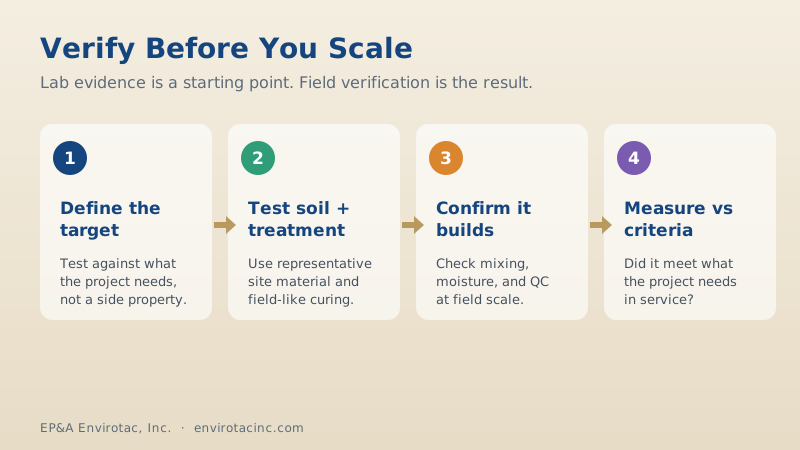
Define the Performance Target
Test against what the project requires: strength under wet conditions if wet-season performance is the requirement, erosion resistance under design flow if surface protection is the objective, and trafficability after the required curing window if construction access is the constraint. A laboratory improvement in an unrelated property doesn’t answer the project’s question.
Test the Soil and Treatment Together
Evidence from a different soil is a starting point, not a result. Testing on representative site material at the proposed formulation, concentration, and application conditions, with curing that approximates field conditions rather than optimized laboratory conditions, produces data that is more directly relevant to the project decision.
Confirm Field Constructability
Application uniformity, mixing consistency, moisture management, curing protection, and quality-control repeatability all need to be confirmed at field scale before committing to full treatment. A laboratory recipe isn’t a construction specification.
Measure Against the Agreed Criteria
The question isn’t whether the treatment improved the soil. It’s whether the treatment achieved what the project requires, under conditions that reflect actual service exposure. That’s the basis for scaling with confidence.
Practical Questions
How do you stabilize sandy soil?
There is no single treatment for sandy soil. Start by identifying the controlling problem, such as inadequate density, erosion, particle migration, water-related loss of support, or settlement, and define the required performance. The appropriate solution may involve compaction, drainage, geosynthetics, cement, bituminous treatment, polymer stabilization, or removal and replacement. Site-specific testing determines which approach is suitable.
Can sandy soil be stable without stabilization?
Yes. Many sandy soils perform well at appropriate density under the loading and exposure conditions they face. The classification doesn’t determine the requirement.
Should wet sandy soil be stabilized or drained?
It depends on what’s controlling the performance problem. If water is causing temporary loss of support that resolves as conditions dry, drainage addresses the cause. If the performance requirement has to be met through wet conditions, stabilization becomes relevant, and drainage may be what makes the treatment durable. Often both are part of the solution.
Is lime suitable for sandy soil?
Generally not as the primary structural stabilizer in low-clay sandy soils. Lime’s longer-term strength gain depends on suitable reactive soil constituents. Silty soils with appropriate mineral content may respond, but suitability and dosage should be established through soil classification and laboratory testing, including pH-based testing to estimate lime proportion where appropriate, followed by performance testing to verify the treatment rather than assume it from gradation alone.
Is cement better than polymer stabilization?
They are different treatments for potentially different problems. Cement has a longer track record and more extensive published guidance for a wide range of sandy and granular soils. Polymer stabilization offers different performance characteristics that can be more appropriate for specific failure mechanisms, soil types, or construction constraints. The comparison belongs at the project level.
Is geogrid the same as soil stabilization?
No. Geogrid reinforces the soil-aggregate system through load distribution and aggregate interlock. It improves system behavior without modifying the subgrade soil’s intrinsic properties. The mechanisms, and the problems they address, are different.
Does reducing permeability always help?
No. Reduced permeability is useful where infiltration or internal water movement is contributing to the failure mechanism. Where the application requires drainage or rapid pore-pressure dissipation, reducing permeability may work against the project requirement.
Can polymer stabilization replace excavation?
For shallow, relatively uniform unsuitable zones, the excavate-or-treat decision depends on whether field-scale evaluation demonstrates the treatment can reach and adequately modify the controlling material. For deep, highly variable, or severely unsuitable material where treatment consistency is difficult to achieve, excavation is often the more reliable option.
Do laboratory polymer results predict field performance?
They demonstrate performance under the tested conditions. Field performance depends on soil variability, application consistency, curing environment, and service exposure conditions that laboratory testing approximates rather than replicates. Project-specific field verification is what closes that gap.
Diagnose Before You Stabilize
The controlling problem, the required performance, and the treatment mechanism have to align. Sandy or silty is where the investigation starts, not where it ends. Failure mechanisms, performance requirements, and site conditions produce different answers, sometimes for soils that look identical on a gradation curve.
Where polymer stabilization fits that alignment is where the failure mechanism, soil characteristics, performance requirement, and construction conditions point toward it; the next step is evaluation against the actual soil and the actual project requirement. That’s where the treatment either earns its place or doesn’t.
If that’s where your project is, our team works through that evaluation with you, starting with the soil, the problem, and the performance the project needs to achieve.
Applications - Dust Control & Soil Stabilization Products

Leave a Reply