
September 21, 2026
Along a graded hill, a crew builds a silt fence. Twice a shift, a water truck runs the haul route. Work proceeds, photos are filed, and inspection boxes are checked.
None of that answers the most important question: is the control actually working under the conditions on site right now?
Stopping sediment is not the same as installing a barrier. Controlling dust is not the same as spraying a surface. A control can be physically intact and still be less effective once site conditions have changed.
Rainfall reroutes runoff, wind picks up, exposed soil expands, grading alters drainage, and traffic increases. A control that was effective last week may not be enough today.
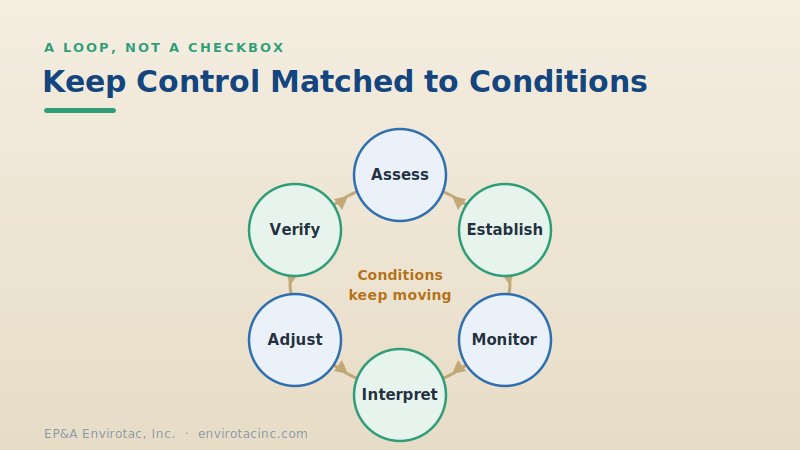
A continuous loop is a useful way to handle that uncertainty:
Assess → Establish → Monitor → Interpret → Adjust → Verify
This is not a legal requirement. It is a practical framework for turning field observations into defensible judgments, while your permits, SWPPP, and local requirements remain the governing authority.
What Does “Working” Actually Mean?
Under the current traffic, wind, and moisture conditions, a functional dust control keeps particulate matter from leaving the work area. A functional erosion control holds soil in place, controls runoff paths, and reduces sediment movement under the relevant site conditions.
Neither result is permanent. It helps to think in three practical states:
- Working: the intended outcome is being achieved under current conditions.
- Changing: site or control conditions have shifted enough to require closer attention.
- Failing: the intended outcome is no longer being achieved, or the control is inadequate for current conditions.
These are practical working categories, not official EPA or FHWA classifications.
Start With a Baseline
You cannot tell whether performance improved or declined without knowing where it started. A useful baseline can capture:
- Exposed soil and surface condition
- Traffic levels
- Existing dust or erosion
- Drainage and runoff pathways
- Controls already installed
- Weather or recent rainfall conditions
The baseline does not need to become another complicated inspection system. Its purpose is to make change visible rather than relying on memory or isolated observations.
Monitor the Site, Not Just the Control
This is where routine inspections can fall short.
A control may be intact and still be inadequate because the site around it has changed. Traffic may have increased. A new grading phase may expose additional soil. A slope may have been reconfigured. Wind or rainfall may have become more severe.
When performance declines, separate control-side causes from site-side causes. Control-side issues may include damage, displacement, depletion, or poor maintenance. Site-side causes may include increased exposure, altered runoff, higher traffic, or changing weather.
The distinction matters because the control may not have failed in isolation. The conditions it was designed for may simply no longer match the conditions on site.
What to Watch for Dust and Erosion
Dust and erosion leave different signals.
For dust, watch for recurring visible plumes, changing haul-road conditions, increased traffic, dry surfaces, wind, and how quickly dust returns after treatment. Where project requirements or risk justify it, PM10 or PM2.5 monitoring can provide quantitative information.
For erosion, look for exposed soil, new runoff pathways, rills, gullies, sediment accumulation, damaged BMPs, and changes following rainfall.
EPA construction stormwater resources provide requirements and guidance for inspection and maintenance. The useful question here is what to do after an inspection identifies a change: determine why it happened and whether the current control remains appropriate.
Watch Early Signals and Actual Outcomes
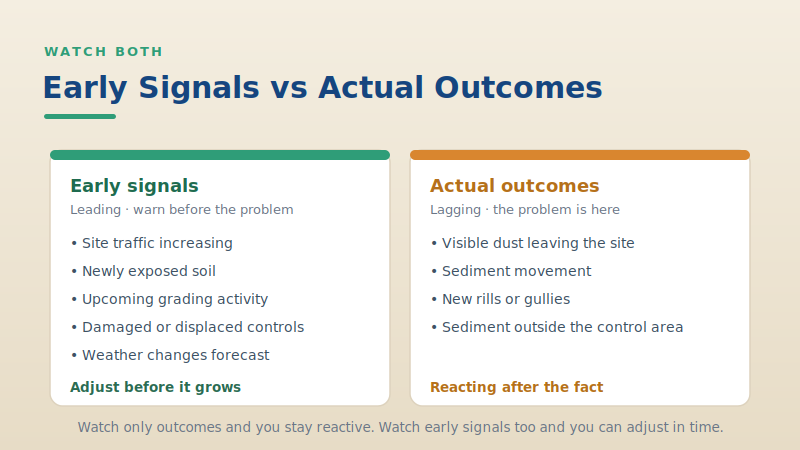
Some indicators warn that performance may change before a visible problem appears. Examples include:
- Increasing site traffic
- Newly exposed soil
- Upcoming grading activity
- Damaged or displaced controls
- Forecast or observed weather changes
Other indicators confirm that a problem has already occurred:
- Visible dust leaving the work area
- Sediment movement
- New rills or gullies
- Sediment accumulation outside the intended control area
Watching only for outcomes means the response is usually reactive. Watching both early signals and outcomes creates an opportunity to adjust before the problem grows.
Diagnose Before You Adjust
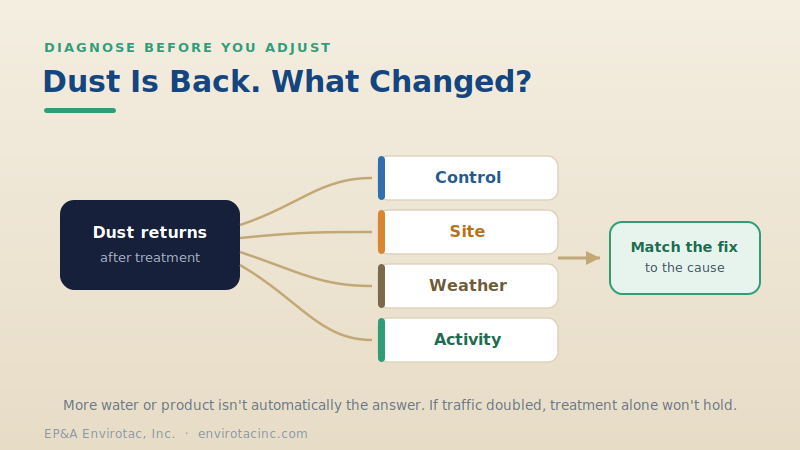
When performance changes, first ask what actually changed: the control, the site, the weather, the construction activity, or a combination of them?
For example, imagine a haul road that was adequately controlled earlier in the week but begins producing visible dust again. If traffic volume has doubled, simply applying more treatment may not address the underlying change. The appropriate response could involve treatment adjustment, traffic management, surface modification, or another control measure, depending on the cause and project requirements.
More water, more product, or more frequent application should not automatically be treated as the answer. Diagnose first. Then match the response to the cause.
Verify the Fix
A corrective action is not complete when it is applied. It is complete when its effect has been checked.
Go back to the affected location, examine the same indicator that set off the response, and compare the outcome with the baseline or the prior state.
If the problem remains, that is useful information. It may indicate that the original diagnosis was incomplete or that site conditions changed again. The cycle continues:
Observe → Diagnose → Adjust → Verify
How Often Should You Monitor?
There is no universal inspection schedule that fits every construction site. A practical approach combines:
- Routine monitoring aligned with project requirements
- Event-based reassessment after significant rainfall, wind, grading, or traffic changes
- Risk-based attention where failure could have greater consequences, such as areas near sensitive receiving waters
Applicable permits, SWPPPs, and local requirements remain controlling. This framework should support those obligations, not replace them.
Documentation That Helps
Good records connect an observation to a decision. A useful performance record can include the date, location, construction activity, weather, control condition, observation, likely cause, action taken, and whether the action improved the outcome.
That creates a record of what changed, what was done, and what happened afterward, rather than simply documenting that an inspection occurred.
Dust Control Is Not the Same as Worker Exposure
Visible dust and occupational exposure are different questions.
OSHA’s construction silica standard requires covered employers to use specified exposure-control measures, including engineering and work-practice controls, and to maintain a written exposure control plan where applicable. The absence of visible dust does not establish that workers have no respirable crystalline silica exposure.
Site dust-control observations should therefore not be treated as a substitute for an occupational exposure assessment.
A Quick Performance Check
Before closing an inspection, ask:
- What changed since the last check?
- Is dust recurring, and under what conditions?
- Are there new runoff paths, rills, gullies, or sediment movement?
- Is the control intact and maintained?
- Did traffic, wind, rainfall, or grading change?
- Did the last corrective action actually improve performance?
These questions turn an inspection from a simple condition check into a performance review.
Frequently Asked Questions
How do you know if dust control is working?
Dust stays manageable under current traffic, wind, and surface conditions, and it does not quickly return after treatment. If dust reappears soon after treatment, that is a signal to reassess what changed.
How do you know if erosion control is working?
Soil remains in place, runoff follows its intended pathways, and new rills, gullies, or sediment movement are not appearing under the relevant conditions.
Does visible dust automatically mean the control has failed?
Not necessarily. It can indicate changing conditions that require reassessment. The appropriate response depends on the cause, the site requirements, and the performance objective.
Do construction sites need dust sensors?
Not every site requires sensors. Quantitative monitoring may be appropriate when project requirements, risk, or specific monitoring objectives call for it. Visual and operational observations can also provide useful performance information.
What should you do if dust returns after treatment?
Identify what changed first. Traffic, wind, surface condition, treatment coverage, and construction activity can all affect performance. The corrective action should address the identified cause.
Final Takeaway
Installing or applying a control tells you what was done. It does not tell you what is happening now.
Real performance becomes visible through what happens afterward and whether controls continue to match changing site conditions.
Assess, establish, monitor, interpret, adjust, and verify. Repeating that loop helps construction teams catch changing conditions earlier, make more targeted adjustments, and maintain control as the work progresses.
Need to evaluate whether your current dust or erosion controls are keeping pace with changing site conditions? EP&A Envirotac, Inc. can help assess site requirements and identify practical control strategies based on your project conditions.
About the Author
Amit Kumar is a Digital Marketing Specialist at Sage Titans, where he works on SEO, AI search visibility, paid media, social media advertising, and reputation management. His work centers on practical marketing strategies designed to improve visibility and support measurable business objectives.
Applications - Dust Control & Soil Stabilization Products

Leave a Reply