
September 14, 2026
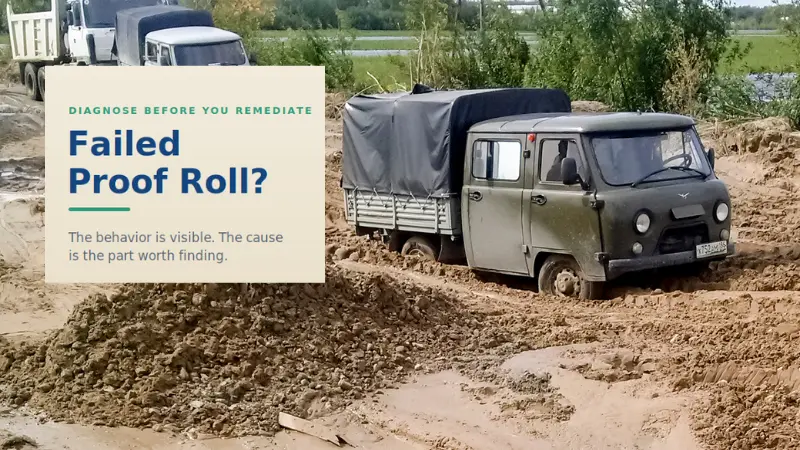
The subgrade said something. Remediation is the response. The conversation goes sideways when the response comes before the sentence is finished.
A poor proof-roll result can come from a temporarily bad condition, material that isn’t suitable for the intended use, a weak zone running deeper than the surface being tested, or a situation where the soil isn’t what needs to change, the structural system is. Those aren’t the same situation and don’t have the same fix. Someone who treats every rut as a removal order and someone who treats every rut as a stabilization job can make the same mistake from opposite directions: skipping the part where you figure out what you’re dealing with.
This article works through that gap, from the failed proof roll to interpretation, to cause, to how you choose a fix, to how you know whether it worked.
A Failed Proof Roll Shows You the Behavior. It Doesn’t Tell You Why.
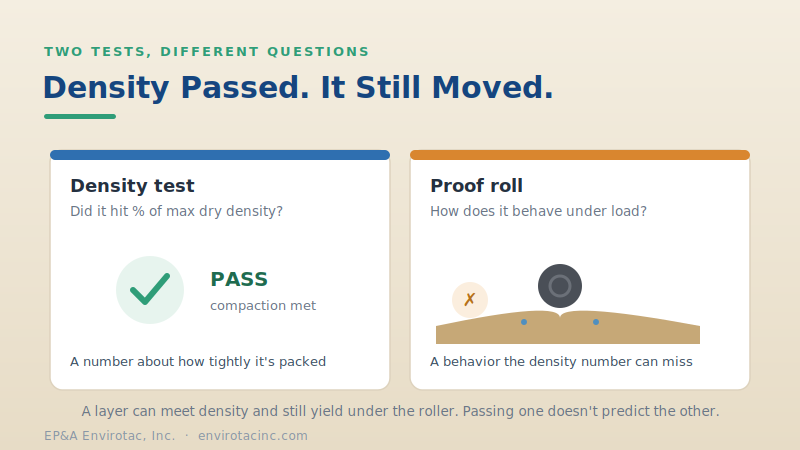
Proof rolling puts the prepared surface under load and shows you how it responds. You can pass density on a section and still watch it move under a loaded roller. Density testing and proof rolling are asking different questions, and the answer to one doesn’t always predict the answer to the other.
What you see is conditional. The equipment, the loading, the soil type, and the moisture at the time of rolling all shape the response. Acceptance criteria vary by agency and specification. What constitutes failure under one standard may not under another. The call involves judgment: what counts as yielding and where the line sits.
FHWA is clear on this point: proof rolling identifies soft and yielding material and gross deficiencies. Conventional proof rolling is not a direct measurement of a soil property, and it doesn’t tell you what to do about what it finds.
What you have after a failed roll is evidence that the surface isn’t holding up under the tested conditions. What you don’t have is a cause, and committing to a fix before you’ve established one is where jobs get expensive.
Is It the Condition, the Material, or Both?
Getting this wrong means fixing the wrong thing.
Moisture is a major source of confusion
Seeing wet soil and moving straight to stabilization or excavation is a reflex that can cost people. There are at least three different situations that can look the same from the surface.
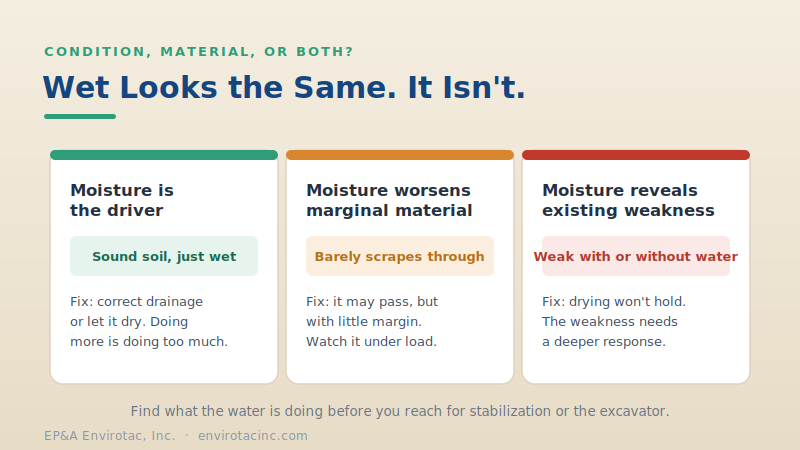
Sometimes moisture is the driver. The soil may be sound, but elevated moisture has pushed it past the point where it can carry load properly, and correcting drainage or letting it dry out may bring it back. If that’s the problem, doing more than that is doing more than the situation calls for.
Sometimes moisture is making marginal material worse. Dry it out, and it might scrape through, but without much margin if the material itself is marginal.
And sometimes moisture is showing you something that was already there. The weakness may exist independent of the water. Fix the moisture and the numbers may improve, but put it back under working conditions and the underlying weakness may still be there.
Those lead to different fixes. Don’t move to stabilization or undercutting because moisture is visible. Find out what it’s doing first.
Density compliance and proof-roll behavior are not the same question
When density has passed, and the ground is still moving, it’s easy to assume something went wrong with testing. But that’s not the only explanation. Under a typical compaction specification, density testing checks whether the compacted material meets a specified percentage of maximum dry density, often alongside moisture requirements. Proof rolling asks how the prepared surface behaves under load. A layer can satisfy the first and still fail the second because density compliance alone does not characterize every weak zone, moisture condition, or soil response affecting behavior under load.
FHWA notes that proof rolling can reveal soft zones that passed density requirements. Two tests, but different information about the same layer.
What you see on the surface isn’t necessarily the full extent of the weak zone
The footprint of a failed roll, where it’s rutting, where it’s pumping, doesn’t by itself define the volume of material producing it. The weakness can run deeper than the visible expression or further laterally. FHWA notes that proof rolling can reveal issues extending below the surface being tested.
This matters when sizing a fix. A shallow repair over a deeper weak zone may improve the surface response without addressing the full source of the problem. Getting enough information to understand the true extent costs time but often less than working to the wrong depth.
What Each Option Costs You
Each response resolves a different situation and carries a different bill. Being clear about what each one changes, and what it costs to get there, is what keeps the fix matched to the cause.
| Option | What it changes | What it costs you |
| Fix the condition (drainage, drying, recompaction) | Corrects moisture or compaction when the material itself is sound | You’re betting you read the material right; if not, you’ve treated a symptom |
| Undercut and replace | Removes the uncertainty by removing the material, so you control what goes back | Excavation, disposal, replacement material, haul, and sometimes dewatering, access, and schedule; costs scale with depth and extent |
| Aggregate cap or geosynthetic reinforcement | How the pavement system carries load, over the existing soil | Doesn’t improve the underlying soil itself; adds section thickness and materials |
| In-place stabilization | Keeps the material and changes how it behaves | Treatment must suit the soil, be applied uniformly, reach the needed depth, and be verified in the field |
If the material is sound and the condition is the driver, fix the condition. Where moisture, drainage, or compaction is driving the response, recompaction or drainage correction may be sufficient. Stabilizing or removing material that isn’t contributing to the problem can add cost without addressing the cause.
Undercutting reduces the uncertainty by removing the material. For a localized zone that’s clearly unsuitable, it can be one of the strongest calls on the table. What it costs you is everything involved in getting there, and those consequences scale: a shallow undercut on a small zone is a different proposition from wide, deep removal across a long section. At this site, at this depth and extent, is removal the most rational way to get the layer you need? That’s the question.
Sometimes the soil doesn’t need to change; the structural system does. Aggregate capping and geosynthetic reinforcement can improve how the pavement system carries load without improving the underlying soil itself. If the project objective is structural performance, engineering the system to deliver it over the existing soil can be a sound answer.
Stabilization takes a different approach: keep the material and change how it behaves. You can avoid excavation, disposal, and replacement, but the treatment now has to suit the soil, be applied uniformly, reach the needed depth, and be verified in the field.
When Does In-Place Polymer Stabilization Make Sense?
When the existing material is worth keeping, and the performance gap is clear enough to address, modifying it in place may get you where you need to go without the cost and disruption of taking it out. The case starts with the site, not the polymer.
- Start with whether the material is worth preserving. Characteristics, depth, extent, moisture, and what the project needs the layer to do all matter before soil stabilization enters the conversation. Keeping unsuitable material because treatment is available isn’t an engineering decision.
- Name what needs to change. Load response, rutting, water sensitivity, trafficability during construction, and long-term strength are different gaps requiring different things. If you can’t name what needs to change, you can’t know whether it changed.
- The data has to match the situation you’re in. Lab results from a different soil, field data from a different polymer, or performance numbers from a different application may inform the decision, but they don’t establish what will happen on this project. Polymer stabilization has been studied across multiple chemistries and applied in pavement and geotechnical contexts, and current U.S. Department of Defense guidance treats it as one option among several. Suitability depends on factors including soil type, intended use, desired improvement, strength, durability, cost, and site conditions, which is why representative mix design and testing for the project conditions matter more than a general claim that polymers improve soil.
- You also need to know where the treatment doesn’t belong. Unsuitable material, a persistent water condition the treatment isn’t designed to address, field conditions that make proper application unlikely, performance requirements outside what the treatment has demonstrated, or depth that doesn’t reach what’s causing the failure. Those are conditions where another approach may be the better call, and being clear about that is what makes the recommendation mean something when conditions do line up.
Verification: Did the Failure Mode Change?
Verification has to match what you set out to fix. If the driver was moisture and the fix was drainage and drying, a passing proof roll afterward is useful, but the more pressing questions are whether the moisture condition has been controlled and whether that change is likely to persist.
If the issue was the material and the fix was stabilization, verification needs to show the treated layer performs against the property you set out to improve, not just that it passes the roller under today’s conditions.
A proof roll after treatment can provide useful field evidence as part of the verification process. What it can’t do on its own is confirm the underlying cause was addressed or that the improvement will hold over time. Name what was wrong, fix it, then verify the fix changed it.
Pulling It Together
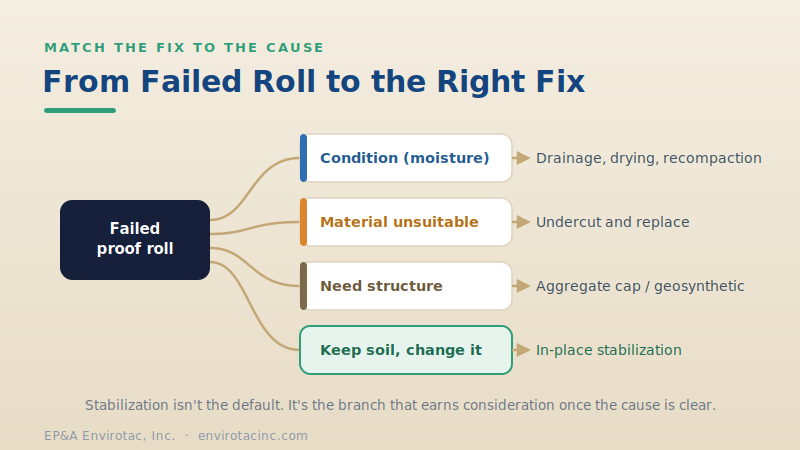
A failed proof roll is a reason to investigate, not a reason to reach for the nearest remedy.
If moisture pushed an otherwise sound subgrade past what it could carry, the fix may be the moisture: drainage, drying, or recompaction once conditions allow. If the material itself is unsuitable, undercutting reduces the uncertainty at the cost of excavation, disposal, and everything that comes with it, and for a clearly unsuitable zone, that cost can be worth paying. If the pavement section can be engineered to carry the load without improving the underlying soil, aggregate capping or geosynthetic reinforcement may be the cleaner answer. And if the existing soil is worth keeping but its behavior under load needs to change, in-place soil stabilization may be the better route, provided the material, treatment conditions, and required performance support that conclusion.
That last branch is where polymer stabilization can belong in the decision. Not as the default, but as the option that earns consideration when the conditions are right. For projects where that evaluation is worth making, EP&A Envirotac, Inc. works with project teams to assess soil characteristics, treatment conditions, and performance requirements before selecting a treatment approach. Contact us today to discuss your subgrade conditions, project requirements, and polymer stabilization options.
Applications - Dust Control & Soil Stabilization Products
Leave a Reply