
September 5, 2026
The distress is visible. The problem driving it may not be.
Pavement distress is often easy to see. Rutting, cracking, and surface deformation: the distress accumulates where traffic and weather work on it every day.
What it does not necessarily reveal is where the failure is originating or what would have to change to stop it from recurring.
The distress marks where a problem becomes visible. It does not, by itself, identify the layer generating it, the mechanism producing it, or where a repair is likely to hold.
Treating what is visible as the diagnosis is one of the more reliable ways to end up doing the same repair twice.
Find Where the Failure Starts
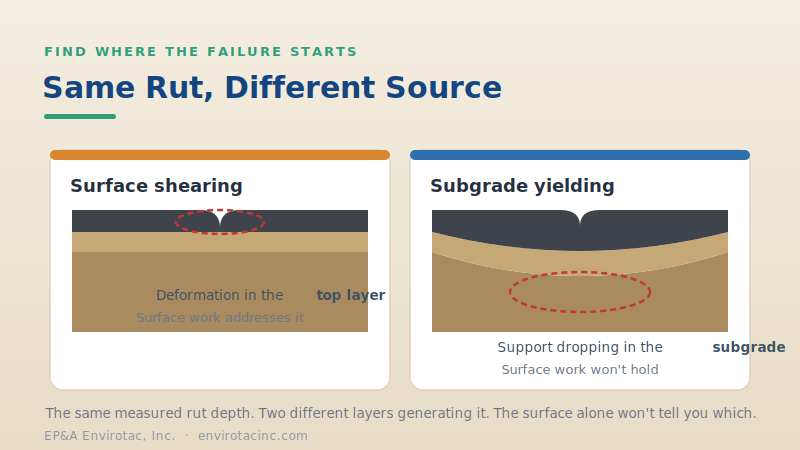
With rutting, the question is where deformation is accumulating because the answer changes what needs to be done.
Ruts that develop from surface material shearing under channelized load call for a different response than ruts driven by subgrade yielding under repeated loading. Both can produce the same measured surface rut depth. The depth profile, the deformation pattern revealed by excavation, and the load history help tell you which problem you have. The surface condition alone does not.
The same principle applies to reflective cracking, fatigue distress, and load-related shoving. The distress is real. Its location on the surface is real. Neither establishes where the failure is being generated, and a repair aimed at the wrong layer may hold only until the underlying mechanism reasserts itself.
Surface rehabilitation is sometimes exactly right when the surface layer is what is shearing, cracking, or deforming; treating it addresses the problem directly. The failure mode is not in working on the surface. It is in working on the surface when something below it is driving the failure, producing a visible short-term improvement but leaving the underlying mechanism in place.
Before selecting a treatment, locate the source. Where is the deformation accumulating, the support dropping, and the cracking initiating? That answer is not always where the pavement distress is most visible.
Separate Moisture Problems From Material Problems
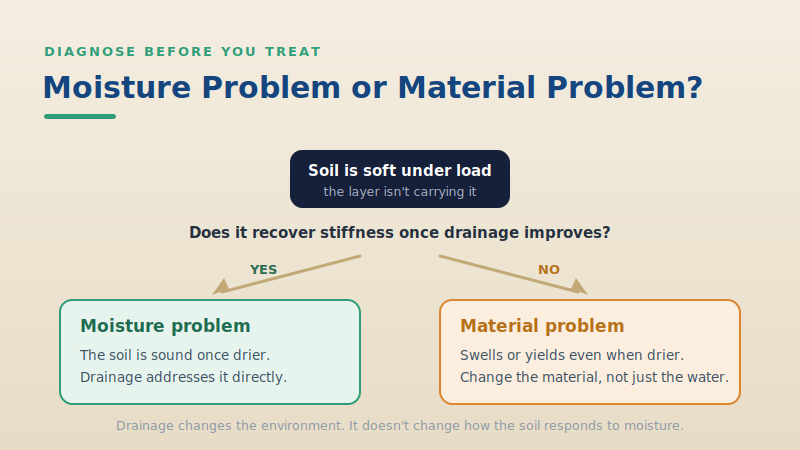
Locating the source layer is not enough on its own. A subgrade that softens seasonally as moisture rises is a different problem than one that yields under load regardless of moisture condition, and the two require different responses.
If seasonal saturation is driving softness but the soil recovers adequate stiffness as drainage improves, the problem is the moisture environment. Drainage addresses it directly and may be sufficient, depending on the site conditions.
If the soil swells, loses bearing capacity, or continues to deform under repeated loading even after drainage improves the moisture condition, the problem may lie in how the material behaves under the moisture it will continue to see in service.
Drainage changes the environment. It does not change how the soil responds to moisture. Applying one when the other governs the failure can leave the underlying mechanism in place.
This also determines what investigation is worth doing. A CBR or UCS result is worth its cost when it could change whether the designer drains, stabilizes, reinforces, or excavates. A result that would not alter that decision is less useful than the time and budget it consumed. Before specifying a testing program, identify what result would cause a different recommendation. If the answer is unclear, the program may need to be narrowed.
A precise measurement from an unrepresentative sample is often less useful than a less precise but honest picture of site variability. If moisture content, soil type, or compaction history varies across the site, and rehabilitation projects can contain that kind of variability, an investigation built around a single sample can produce precise numbers describing conditions that may exist somewhere on the site but not necessarily where the failure is occurring or where treatment will be applied.
Choose the Treatment by What It Changes
Each option resolves a different problem and takes on a different burden in exchange. Choosing well starts with being clear about what each one actually changes.
| Treatment | What it changes | What it takes on, or doesn’t reach |
| Excavation and replacement | Removes the failing material and substitutes something known | Excavation depth, disposal, imported fill, hauling, and access constraints |
| Drainage | The moisture environment within the pavement system | Doesn’t change how the soil itself responds to moisture |
| Reinforcement and geosynthetics | How loads distribute across and between layers | Doesn’t change the soil’s material behavior under stress |
| In-situ stabilization | The soil’s engineering behavior, moisture response, and deformation resistance, in place | Characterization, treatment design, application control, QA, and validation |
Excavation and replacement remove the material that is failing and substitute something else. The excavated problematic soil is gone, and the designer has a degree of certainty about what has been removed. The construction process takes on excavation depth, disposal, imported fill, hauling, and access constraints in exchange. Uncertainty around the retained material drops, but the project now carries the full burden of material movement.
Drainage changes the moisture environment. When seasonal saturation is driving bearing-capacity loss, and the underlying soil stiffens adequately at lower moisture content, effective drainage can address the problem directly and may resolve it. It does not change how the soil behaves under moisture. When the soil remains soft, swells, or deforms under loading conditions that drainage cannot fully control, drainage resolves part of the problem and leaves the rest.
Mechanical reinforcement and geosynthetics change how loads distribute across and between layers and, in some configurations, prevent fines migration that degrades how the base carries load over time. They do not fundamentally change the soil’s material behavior or its response to moisture. Separation and load distribution are valid and often appropriate; they are simply not the same function as changing what the material does under stress.
In-situ stabilization aims to change the soil’s engineering behavior, load-bearing capacity, moisture response, and resistance to deformation without removing it; less excavation, less disposal, less imported fill, and different construction logistics. What the contractor and designer take on instead is characterization depth, treatment design, application control, quality assurance, and validation. Excavation gives the designer greater certainty about what was removed; stabilization requires demonstrating that what was retained now performs. Those require different kinds of control and verification.
When Existing Soil Is Worth Stabilizing
If the problem is moisture-driven loss of bearing capacity, the treatment has to change how the soil responds to moisture, not merely improve its dry-condition strength. If the soil is deforming under repeated loading, the treatment has to stiffen it enough under the stresses and moisture conditions the layer will see in service. If neither can be demonstrated with reasonable confidence, retaining the material over excavating it cannot be justified by the cost of removal alone.
Retaining existing soil can reduce excavation, disposal, hauling, and imported fill significantly. That project benefit is there, but it holds only when the material can be understood well enough to treat, the treatment can close the gap between current behavior and required load-bearing or rutting resistance, and that result can be achieved consistently across the site’s variability.
Not all problematic soil meets those conditions. Some material yields or swells beyond what a practical treatment program can reliably control. Some sites have enough variability in moisture content or soil type that uniform treatment is not practical. Some load-bearing requirements are beyond what modification of the existing material can reliably deliver.
Is the existing material being retained because it can be made to carry the load and resist the deformation the layer requires, or because removal is expensive and stabilization seems like a reasonable alternative? Both answers are possible. The second risks producing a pavement that saves excavation costs but fails in service, a worse outcome than excavating. If the material cannot be brought to the stiffness and rutting resistance the layer must provide, the cost of removing it is not a reason to leave it in place.
Prove the Treated Layer Can Do the Job
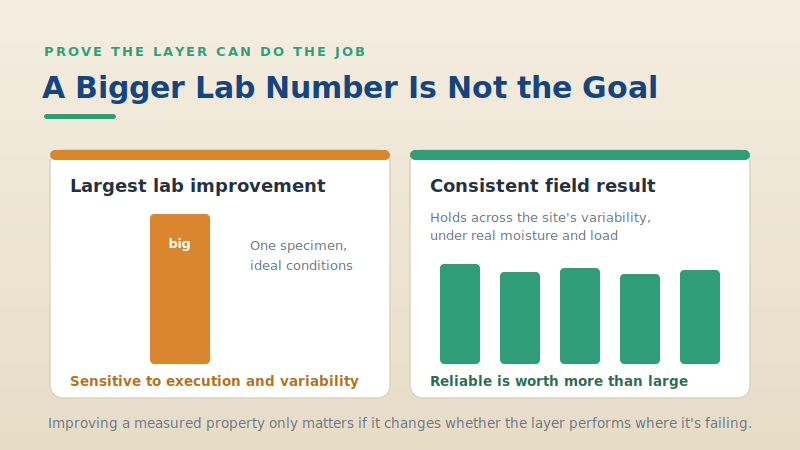
Start with what the layer has to do: what load must it carry, what deformation must it resist, under what moisture conditions, and over what service life? A significant CBR improvement in a lab specimen tells you the treated material responded under those test conditions. What matters next is whether that change addresses the reason the layer is failing, because improving a measured soil property is only useful insofar as it changes the layer’s ability to perform its required function.
If the layer is losing support as moisture rises, improving dry-condition strength alone leaves the controlling problem unresolved. If repeated loading is producing excessive deformation, the relevant question is whether the treatment changes that deformation under the stresses and moisture conditions the layer will experience in service.
For polymer stabilization, those are the effects that matter, not the largest laboratory improvement achievable, but the improvement that addresses why the layer is failing and whether the treated soil can deliver it consistently enough across the site’s actual variability to meet the load-bearing and rutting-resistance demands the pavement requires.
The treatment that produces the largest laboratory result is not always the most reliable field solution. A treatment optimized around a single specimen may not hold across a site where moisture content, soil composition, or compaction history varies. In some cases, a treatment that is less aggressive but more consistent and controllable in variable field conditions is sounder than one that delivers a larger laboratory improvement but is more sensitive to execution quality.
The stabilization decision is sound when the evidence shows the treated material can carry the load and resist deformation the layer requires under the moisture it will see in service, across the variability present on the site, and at the execution quality that can realistically be achieved and verified.
Conclusion
Surface rehabilitation, drainage, excavation, reinforcement, and stabilization solve different problems. Surface rehabilitation works when the relevant distress is confined to the surface layer. Drainage works when the moisture environment is driving softness and the underlying soil can recover adequate stiffness.
Excavation works when the material is genuinely unsuitable, and removal is the right option. Stabilization works when the existing soil can be made to carry the load and resist the deformation the layer requires, and when the treatment and verification demands are preferable to the excavation and logistics demands of removal.
For projects where existing material may be contributing to bearing-capacity loss or deformation under load, the starting point is understanding what is limiting the layer and what that layer must carry and resist. From there, the gap between current behavior and required performance determines which option makes sense, what each treatment changes, what it costs to change it, and whether the result can be verified in the field. If the material appears suitable for modification, EP&A Envirotac, Inc. can help evaluate whether polymer soil stabilization fits the pavement’s requirements.
Applications - Dust Control & Soil Stabilization Products
Leave a Reply