
September 3, 2026
The easy answer isn’t wrong. It’s just not enough.
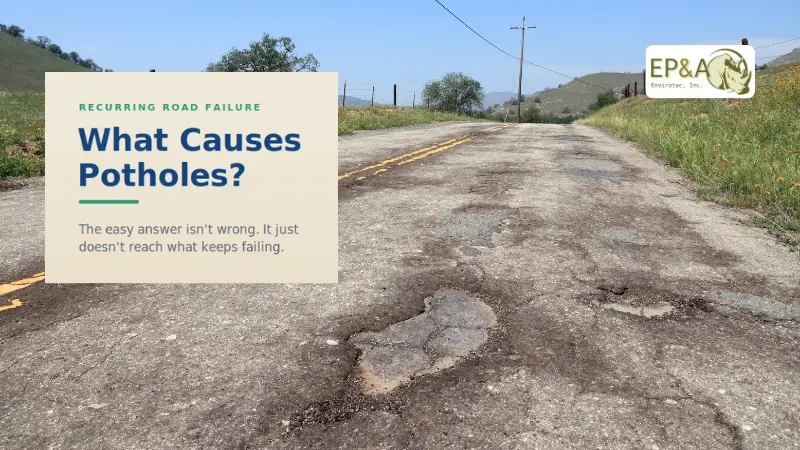
Potholes form when the pavement system can no longer maintain the performance required of it: moisture persisting where it changes how materials behave, load applied to layers that have lost the capacity to carry it, and support conditions that have shifted enough that the road can no longer do its job. It’s apparent and visible.
The harder part, especially when you’re standing over a section that’s opened up in the same spot for the second time, is figuring out which part of that system failed and what it would actually take to stop it happening again.
That’s the question worth asking. Not what potholes are, but what the failure is telling you and whether the repair you’re considering will reach the thing that needs to change.
What a Recurring Failure Is Telling You
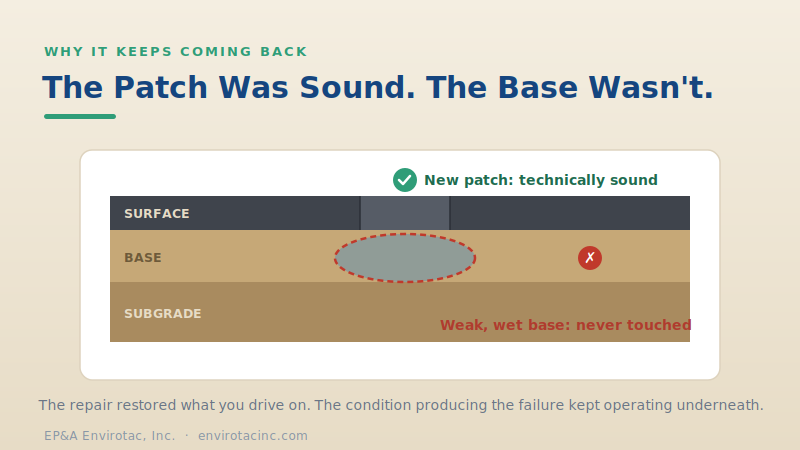
The first failure tells you where the road gave out. The second tells you something survived the fix.
A patch that holds six months and then opens at the same corner didn’t necessarily fail. It may have done exactly what it was designed to do: restore the surface and get the road back in service. But if the section keeps coming back, the patch isn’t the whole story. Something underneath kept producing the same result, and the patch never got near it.
That’s the shift worth making: from asking what happened to asking what remained capable of making it happen again. What conditions were present each time? What changed after the previous repair? More importantly, what didn’t change?
A forensic investigation of premature pavement failure found that replacing the top layer of asphalt didn’t stop the distress recurring. Subsequent investigation identified a weak base as the source. The surface repair was technically sound. It just didn’t reach what was actually failing.
Recurrence is evidence of persistence. It isn’t a diagnosis. A section that keeps failing could have trapped moisture, a base that’s lost support capacity, a subgrade responding poorly to load under the moisture conditions it faces, or a structural deficiency the surface repair never touched. Assuming you know which one before you’ve looked is how you end up doing the same repair a third time.
The physical character of the failure can begin to narrow this down. A section that reopens along the edge of a previous patch raises a different question from distress that has spread well beyond the repair. Deformation tracking the wheel path points somewhere different from an isolated surface break. Persistent wetness or settlement shifts the picture again, not by settling the question, but by making some explanations harder to sustain than others.
What Moisture Is Actually Doing
Moisture doesn’t cause potholes the way a hammer causes a dent. What it does is change how materials in the pavement system behave under load, and that effect depends on where moisture is present, how much has accumulated, how long unfavorable conditions persist, and which layer is experiencing the resulting change.
A base or subgrade that carries traffic without distress under normal conditions can lose enough stiffness when saturated that the same load produces entirely different results. The surface doesn’t know the difference. It just starts to go. Research on full-scale pavement behavior confirms that near-saturation conditions can dramatically reduce bearing capacity and accelerate damage and that the effect varies by material and layer, not uniformly across the structure.
Moisture also enters through more than one pathway. Surface infiltration through cracks matters, but edge inflow, subsurface drainage conditions, and groundwater can all contribute. A section failing repeatedly without obvious surface water entry hasn’t eliminated moisture as a factor; it may mean the pathway isn’t visible from above.
Drainage changes the amount and duration of moisture retained within the pavement system. Where that retained moisture is altering how materials behave under load, reducing it can change the picture substantially, sometimes more directly than anything done at the surface.
A moisture-affected material may recover meaningful performance as conditions improve. But drainage changes the moisture condition. It doesn’t change a material’s inherent capacity under the load it’s required to carry. If a material performs inadequately even under the moisture conditions it was designed to operate in, drying alone doesn’t resolve that deficiency.
Loading sits alongside all of this as the demand the system has to meet. A pavement can handle its traffic without distress at one loading level and experience substantially more moisture-related damage as demand increases. The same moisture condition doesn’t produce the same consequence regardless of what the road is being asked to carry. These aren’t independent variables; they interact, and the relevant question is whether the system can maintain its required behavior when both are working against it.
What Needs to Change, and Whether the Intervention Reaches It
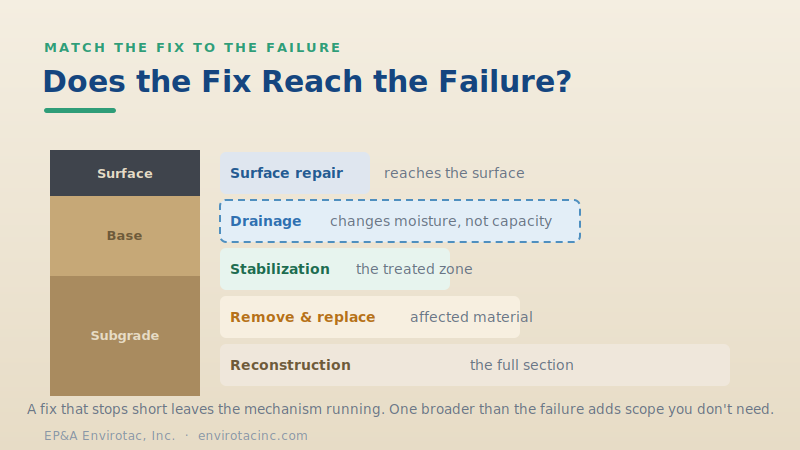
Most intervention decisions go wrong not because the engineer chose a bad treatment. They chose the right treatment for a different problem.
Every fix changes something specific. The mistake is assuming it changes the thing that needs changing and that it reaches the part of the system where that thing is.
A surface repair restores what you can see and drive on. It doesn’t reach moisture pathways, base condition, or how load is being distributed through the layers underneath. For a first failure with no clear pattern, that may be entirely right: restore serviceability and watch what develops. For a section with a history, it’s a short answer to a problem that sits deeper.
Drainage changes the moisture regime within the pavement system. Where moisture retention is contributing to the failure, that can change the picture substantially. But drainage doesn’t by itself change a material’s behavior under the load it’s required to carry.
And a stabilization treatment changes the behavior of material within the treated zone, but it doesn’t reach a moisture source operating outside that zone, a drainage deficiency still feeding the system, or a structural problem in the layers beyond the treatment’s depth.
Removal and replacement eliminate the affected material rather than treating it. That resolves the material constraint directly at the cost of construction scope, disruption, and resource requirements. Avoiding it doesn’t reduce the constraint. It leaves it in place. Reconstruction addresses a broader portion of the road when the failure is more extensive than targeted intervention can reasonably reach.
The Asphalt Paving Handbook is explicit on both sides of this: failed materials should be addressed at the depth the failure warrants, but economic and operational impacts are part of the decision. A broader intervention than the failure requires imposes its own burden.
An intervention that doesn’t reach the failure leaves the mechanism running. One broader than the failure requires introduces scope the situation doesn’t warrant. Neither direction is automatically right.
The Distinction That Changes the Stabilization Decision
Improving a material property is not automatically the same as improving road performance.
The gap between those two statements is where the engineering judgment lives. A treatment can improve a laboratory measurement without that improvement translating into the road performing better under the conditions it actually faces.
How laboratory properties translate to in-situ pavement behavior remains an important research gap. Research on synthetic polymer-stabilized soils has found that moisture susceptibility and strength retention under durability conditions are meaningful considerations, not because the treatment didn’t work, but because an initial property improvement isn’t the end of the question.
The right standard is harder than whether a property improved. It’s whether the changed material maintains the required behavior under the moisture and loading the road will actually experience. A treatment evaluated only against its initial laboratory result hasn’t been evaluated against the thing that matters.
When Stabilization Makes Engineering Sense
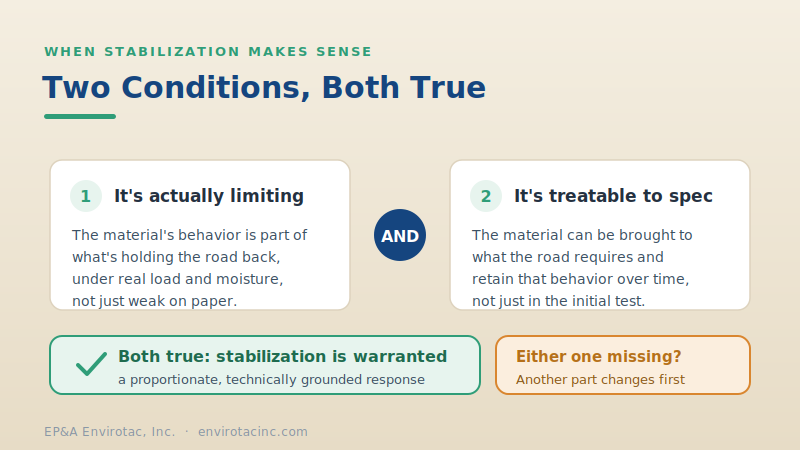
Start with what the failure is showing, not with what treatment is available.
Two things have to be true for stabilization to be a warranted response. The material’s behavior has to be part of what’s limiting the road, not just weak on paper but performing inadequately under the load and moisture conditions the pavement actually faces. And the material has to be treatable to the point where it can meet what the road requires and retain that behavior over time. Both have to be true.
If material behavior isn’t part of the performance problem, treating it changes something that wasn’t governing the failure. If the material can’t be brought to the required level under real conditions, stabilization improves a property without resolving what’s actually limiting the road.
Polymer soil stabilization sits within this logic as a technology-dependent category. Specific polymer treatments can modify how particular materials respond to moisture and load, but the outcome depends on the polymer, the material being treated, the treatment conditions, and the environmental exposure the road will experience. These are not uniform across polymer types or soil types, and how the treated material performs over time, not just initially, is a meaningful dimension of that evaluation.
What polymer stabilization changes is the behavior of the treated material within the treatment zone. What it doesn’t change is a moisture source continuing to operate outside that zone, a drainage deficiency still feeding the system, or a structural deficiency in the broader pavement section. Where those exist alongside a material performance problem, treating the material addresses one condition and leaves the others running.
Where material behavior is genuinely limiting the road, where the material can be treated to meet what’s required and retain it, and where the conditions outside the treatment zone are either not governing or are being addressed separately, that’s where stabilization is a proportionate and technically grounded response. Where those conditions aren’t met, a different part of the system needs to change first.
The Question That Should Come Before the Repair
What would have to be different for this section to stop failing?
Not the fastest fix, not what worked on the last project; what specifically, at this location, under the moisture conditions and load it faces when it fails, would have to change for the road to hold.
That question changes what you look for before you decide. Immediate repairs and longer-term work on the underlying condition often run on different timelines; that’s not a compromise, that’s how real projects get managed. But the underlying condition still has to get identified.
Fix what’s driving the failure. And be explicit about what that fix doesn’t touch, because that’s usually where the next one starts.
For a broader look at where road stabilization fits in infrastructure rehabilitation, read our article on Enhancing Infrastructure with Road Stabilization Products.
Applications - Dust Control & Soil Stabilization Products
Leave a Reply