
August 27, 2026
Every disturbed site is running two experiments at once. One begins when it rains. The other begins when the surface dries. Each tests a different question. Rain asks how easily soil moves across the ground. Wind asks how easily the finest particles leave it altogether. A site can pass one test and fail the other without anything about the stabilization strategy appearing obviously wrong.
Runoff finds the path of least resistance downslope while wind picks up whatever the surface has lost its ability to hold.
On many sites, these happen in different zones, sometimes on the same day, and a plan built around one while ignoring the other tends to find out which one it missed when conditions shift.
Erosion control, dust control, and soil stabilization evolved to address those two separate problems, and knowing which one each approach was built for is what makes thorough planning more reliable than product selection alone.
Wind and Water Create Different Stabilization Challenges
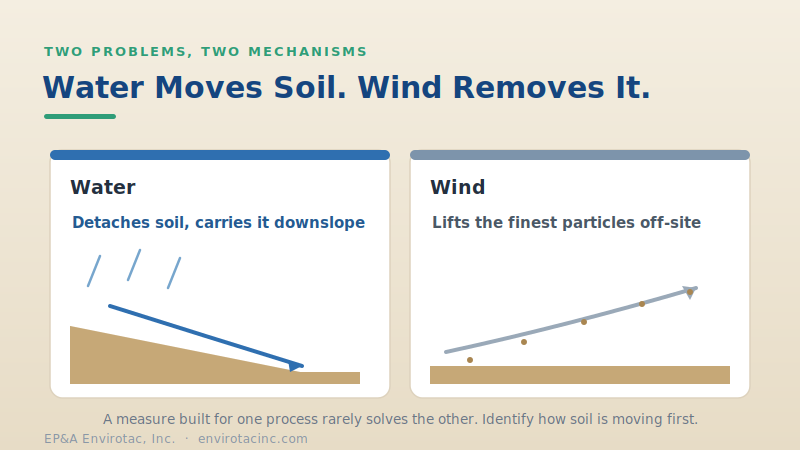
Wind and water remove soil through fundamentally different processes, so stabilization measures designed for one challenge rarely solve the other. Rainfall detaches surface particles, and runoff transports them downslope, while wind lifts the finest material into the air and carries it beyond the site boundary.
Understanding which process is dominant in each part of a site is the first step toward choosing an effective stabilization strategy.
Rain hits the bare ground, and the impact breaks surface particles loose before sheet flow begins. Runoff carries those particles downslope and drops them wherever velocity falls. Steeper grades and longer slopes determine how much material moves with each storm.
Wind operates on a different particle entirely. It lifts the finest, lightest material from a disturbed surface and carries it past the site boundary, often well before anyone notices the loss.
Vehicles and equipment churn that same fine material back to the surface on dry days, keeping it available for the next gust regardless of what happened the night before. A graded embankment sheds sediment during a storm while the haul road beside it generates dust clouds the following morning. Both are active.
A stabilization strategy that addresses only the more visible process leaves the other running unchecked. That’s why effective stabilization planning starts with identifying how soil is moving before deciding how to stabilize it.
What Erosion Control Blankets Contribute to Site Stabilization
On a freshly seeded slope, the problem starts before the first rain arrives. The surface has no protection, and when rain does come, impact energy dislodges particles before runoff begins carrying them.
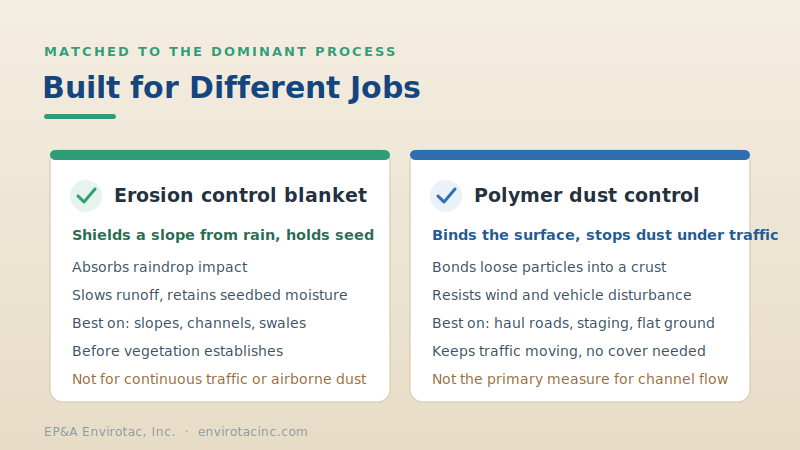
A blanket sits between the rainfall and the soil, absorbing that impact so fewer particles detach in the first place. As water moves across the ground, the blanket slows its velocity, which reduces how much sediment the flow picks up and carries downslope.
Seed put down on a graded slope has three problems working against it:
- Sheet flow moves it before germination.
- The surface dries faster than roots can establish.
- Temperature swings stress seedbeds with no canopy above them.
A blanket holds seed against early rain events, retains moisture at the surface, and moderates those fluctuations until vegetation takes hold.
For slope and channel protection during the period between grading and vegetative cover, that combination is difficult to match with a single alternative measure. Blankets are not generally designed for surfaces requiring continuous vehicle or equipment access, and they do not address airborne dust generated from surrounding exposed areas.
How Polymer Dust Control Supports Surface Stabilization
After a day of continuous truck traffic on untreated fine-grained material, the road surface generates visible dust plumes with each pass. The particles are already loose. Wind and vehicle turbulence do the rest, and water application offers short-term relief until the surface dries and the cycle starts again.
Polymer treatment works by binding loose particles together at the surface layer. Once that cohesion is established, wind and traffic disturbance cannot as readily detach and suspend fine material.
Vehicles keep moving. The dust generation that follows untreated roads under comparable loads does not. Staging areas, road shoulders, and cleared ground adjacent to active construction respond to polymer treatment for the same underlying reason: the instability on those surfaces comes from particle detachment, not runoff, and covering the ground is not a practical response to that problem.
Choosing the Right Approach: Blanket, Polymer, or Both?
A slope, a staging area, and a haul road can sit within a few hundred meters of each other and present entirely different stabilization challenges. Applying the same method across all three serves one well and leaves the others underserved. The plan needs to reflect what each zone actually presents.
Mapping the following variables by zone is where the evaluation begins:
- Slope grade and length
- Rainfall frequency and intensity during the project window
- Wind exposure and the presence of fine-grained surface material
- Volume and frequency of vehicular or equipment traffic
- The size and character of disturbed areas
- Vegetation timeline and whether temporary vs. long-term stabilization is the objective
With those variables mapped, four questions drive the decision:
- Which process, runoff or wind and traffic disturbance, is the more likely source of soil movement in each zone?
- Is the secondary process significant enough to warrant a second layer of response?
- Which stabilization measure fits the dominant condition in that zone, rather than the site as a whole?
- Where are the reassessment points as graded areas expand and haul routes shift during construction?
A slope with moderate wind exposure may need blanket coverage for rainfall protection and polymer treatment at its base, where haul traffic generates dust. The conditions differ by zone, and a plan that does not reflect that will serve some areas well and leave others exposed.
| Site Condition | Blanket | Polymer | Combined |
| Graded slope awaiting vegetation | Primary choice | Limited role | Where wind exposure adds a secondary risk |
| Active haul road or access road | Not practical | Primary choice | Where road borders an eroding slope |
| Flat staging area with fine soil | Limited role | Primary choice | Where perimeter runoff is also a concern |
| Utility corridor across varied terrain | Suitable for vegetated sections | Suitable for trafficked sections | Where both conditions exist along the same corridor |
| Channel or swale protection | Primary choice | Generally not the primary measure | Seldom applicable |
| Embankment face adjacent to active road | Suitable | Supplemental | Where dust from adjacent traffic compounds the challenge |
Applying the Framework to Common Site Conditions
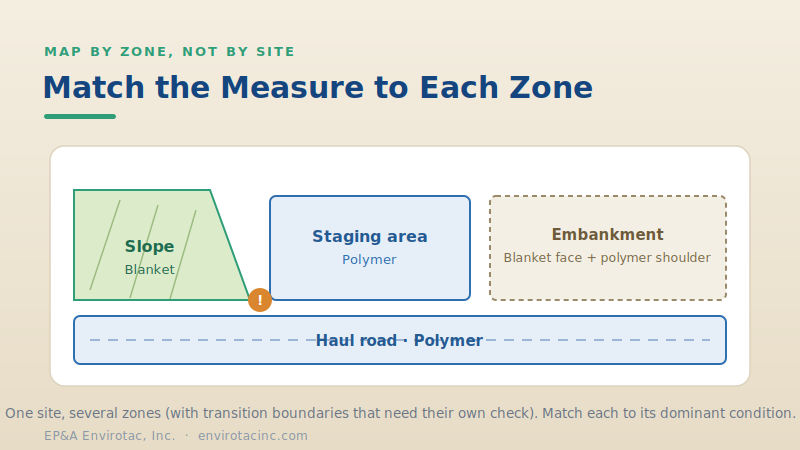
- Newly graded slope awaiting seeding: Rainfall striking bare ground before any cover establishes is the immediate risk. A blanket dissipates raindrop energy, retains seedbed moisture, and holds seed through early storm events. Where haul traffic or sustained wind creates a secondary challenge at the slope’s toe, polymer treatment addresses that area separately.
- Active haul road in a mining or aggregate operation: Compacted road surfaces under continuous traffic rarely shed significant runoff, but dust comes with nearly every vehicle pass. Polymer treatment applied to the road addresses that without slowing operations. For mining and aggregate operations with extended haul routes, keeping the road corridor treated is often what makes dust generation manageable across the full length of the route.
- Staging area with exposed fine-grained soil: Equipment movement and wind combine to generate surface dust across open staging areas. Blankets cannot accommodate continuous traffic, and runoff from flat ground is generally less severe than from graded slopes. Polymer treatment reduces particle detachment where disturbance is highest.
- Utility corridor traversing mixed terrain: A corridor may cross slopes, flat sections, and active access paths within a short distance. Each section carries a different dominant condition. Blankets suit the vegetated slope sections while polymers address the trafficked access areas, and both belong in the same corridor plan.
- Embankment awaiting vegetation near an active road: The embankment face needs rainfall protection and seedbed stabilization, which a blanket provides. The adjacent road shoulder, under traffic and wind, may need polymer treatment to prevent dust emissions from creating air quality concerns near the site boundary.
Common Planning Mistakes That Reduce Stabilization Performance
- Treating slope stabilization as the whole job: A well-specified blanket on the slope face is easy to point to during inspection. The surrounding cleared areas generating windborne particles throughout the day are harder to see from the road and often go untreated as a result. Their contribution to off-site dust and air quality concerns does not diminish because they received less attention during planning.
- Neglecting transition zones between stabilized and unstabilized areas: Where a blanket-covered slope meets an untreated staging area, the plan tends to lose continuity at the boundary. Runoff leaving the slope works at the edge of the treated zone. Dust from the staging area moves into ground the plan assumed was stable. That boundary deserves its own assessment. It rarely gets one.
- Failing to reassess after project conditions change: Graded areas expand. Haul routes shift. The balance between water and wind risk changes as earthwork progresses. A stabilization plan written at mobilization reflects none of that, and phases that run on its original assumptions often find those assumptions no longer match what the site has become.
- Delaying stabilization until after active work is complete: Soil becomes vulnerable the moment ground is disturbed. Gaps in erosion control planning that open during construction do not wait for project completion to create problems. Every storm event and sustained wind period that reaches unprotected ground adds to what gets addressed in the rework phase. Phasing stabilization alongside earthwork keeps that from accumulating.
Conclusion
Sites that manage erosion and dust well are not necessarily the ones with the most products specified. They are the ones where someone mapped actual conditions zone by zone, identified where water and wind each posed the greater risk, and matched the response accordingly before the first storm or wind event exposed the gaps.
Erosion control blankets serve the conditions polymer treatment is not built for. Polymer dust control serves the conditions blankets cannot reach. On sites where both are active across different areas, the case for combining them follows directly from what the ground presents.
Slope exposure, wind conditions, traffic frequency, and vegetation timelines mapped before any product decision is made are what allow both erosion control blankets and the polymer stabilization solutions from EP&A Envirotac, Inc. to land where the site actually needs them.
Applications - Dust Control & Soil Stabilization Products

Leave a Reply