
August 21, 2026
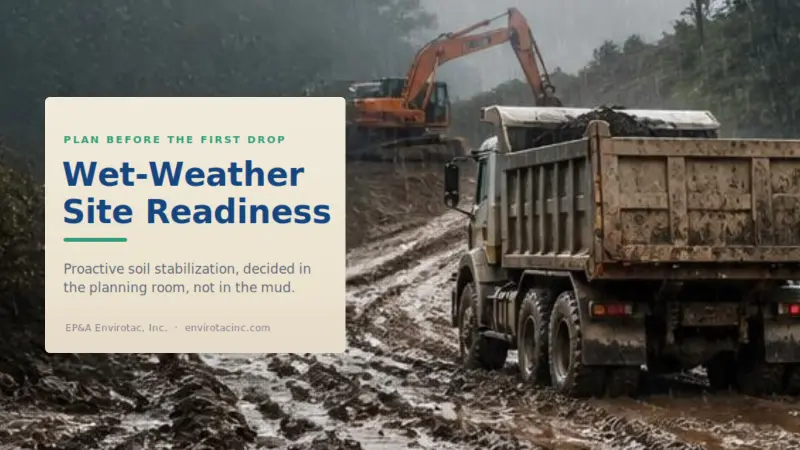
Wet weather rarely stops a construction site outright. More often, it slows everything down in ways that are harder to see and harder to recover from. Ground that was firm enough to carry traffic on Friday can turn soft and rutted after a weekend of rain, and the cost of that change shows up across the schedule long before anyone calls a full stop.
The sites that handle wet weather well tend to have one thing in common: they treated ground performance as a planning question, not a problem to solve once it appeared. Proactive soil stabilization is how that planning gets put into practice, and where it enters the project timeline usually determines how much it costs and how much it protects.
How Wet Ground Slows Construction Long Before Work Stops
The visible failures, a truck stuck on a haul road, a graded area that won’t hold compaction, get attention because they’re obvious. The more expensive damage is usually quieter.
Soft ground slows equipment cycles. Loads that moved efficiently on firm surfaces take longer when tires slip and operators reduce speed to stay safe. Access routes that were reliable become unpredictable, which forces rerouting and adds distance to routine trips. Crews wait on areas that aren’t ready, and work that was sequenced to flow gets broken into stops and restarts.
None of these register as a shutdown. They register as a site that is simply running slower than planned, with productivity draining away in increments that are hard to attribute to any single cause. By the time the pattern is clear, the schedule has already absorbed the loss.
Breaking the Cycle of Repeated Ground Repairs
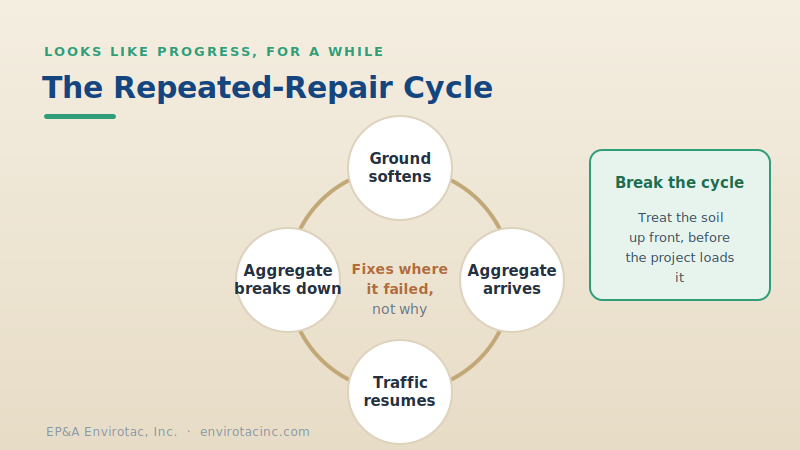
When ground softens, the common response is to bring in aggregate, regrade, and keep moving. It works, briefly. Then traffic resumes, the treated area breaks down again, and the same fix gets repeated a little further along the road.
Reactive maintenance like this treats the place where the ground failed without addressing why it failed. The underlying soil is still vulnerable to moisture, still carrying loads it can’t support when saturated, and still positioned to fail again the next time conditions turn. Each round of repair consumes material, labor, and time, and each one buys a shorter reprieve than the last.
Proactive stabilization breaks that cycle by changing how the soil itself responds to water and load before the project starts loading it. Rather than restoring a surface after it fails, it builds a surface that resists failing in the first place. Soil stabilization is most valuable when it enters that conversation early, while the ground can still be treated on the project’s terms rather than the weather’s.
Designing Sites for Consistent Ground Performance
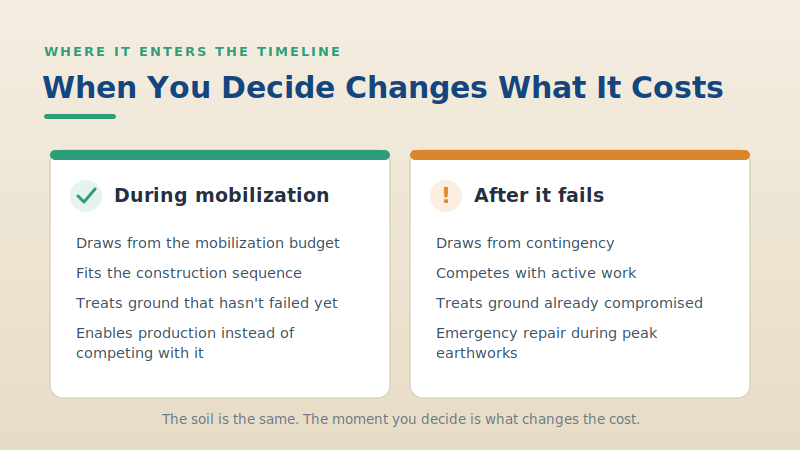
The same stabilization work costs differently depending on when it happens. Treated during mobilization, it draws from a planned budget, fits the construction sequence, and works on ground that hasn’t failed yet. Treated after a failure, it draws from contingency, competes with active work for attention, and has to recover ground that is already compromised.
The soil is the same. The moment of the decision is what changes the economics.
Designing for consistent ground performance means deciding, before equipment arrives, which surfaces have to stay reliable through the wet season and treating those surfaces so they do. Haul roads, primary access routes, and staging areas are the usual priorities because they carry the traffic the whole project depends on. When those hold, the rest of the site has room to absorb weather without cascading into delay.
This is planning that pays back quietly. A haul road that stays firm through a wet week doesn’t generate a story. It generates a schedule that held, which is exactly the outcome proactive stabilization is meant to produce, and seasonal weather exposure is precisely the condition it is designed to withstand.
Five Planning Priorities for Construction Sites Before Wet Weather Arrives
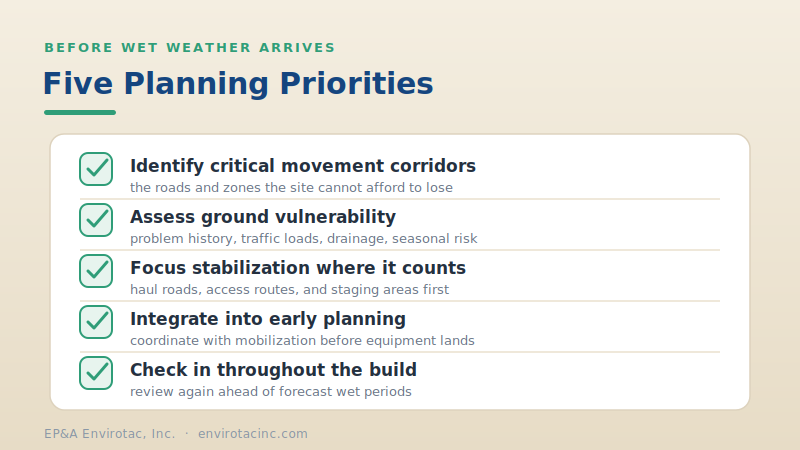
Turning that intent into action comes down to a short set of priorities that belong in the plan before the first forecast turns wet:
- Identify Critical Movement Corridors: Determine which roads, access points, and work zones the site cannot afford to lose when conditions deteriorate. These are the surfaces that keep the whole project moving.
- Assess Ground Vulnerability: Review historical problem areas, expected traffic loads, and what those loads mean for native soils under wet conditions. Past failures and drainage patterns tell you where the risk concentrates.
- Focus Stabilization Where It Counts: A soft zone in a secondary area is a nuisance. A soft zone on a primary haul road at peak production is a schedule problem. Direct stabilization to the surfaces whose failure would be most disruptive.
- Integrate Stabilization into Early Planning: Ground stabilization coordinated with mobilization, logistics planning, and construction sequencing costs less and disrupts less than the same work performed as an emergency response later.
- Check In Throughout the Build: Ground conditions change as traffic increases and wet periods arrive. Periodic reviews, particularly ahead of forecast wet weather, keep the plan aligned with what the site is actually experiencing.
Planning That Extends Beyond the Forecast
Weather forecasts describe the next several days. Construction schedules run for months. That mismatch is why reacting to individual weather events is such an inefficient way to manage ground conditions: by the time a storm is in the forecast, the useful window for treating the ground on favorable terms has usually closed.
Planning that extends beyond the forecast treats wet weather as a known condition of the project rather than a series of surprises. It asks which surfaces need to perform through the season, prepares them while preparation is still inexpensive, and revisits that preparation as the build evolves. The goal isn’t to predict any particular storm. It’s to build a site that doesn’t depend on the prediction.
That is what proactive soil stabilization contributes: ground that holds through the conditions the project will inevitably meet, so that wet weather becomes something the site absorbs rather than something the schedule pays for. To see how the approach fits a specific site and season, explore our soil stabilization solutions.
Applications - Dust Control & Soil Stabilization Products

Leave a Reply