
May 29, 2026
The ground doesn’t forget what happened to it. Strip the topsoil for a highway cut, grade a mine site flat, or run construction equipment across a slope for months, and what’s left isn’t just bare. It’s structurally different from what was there before. The surface looks like soil. It behaves like something else.
That distinction matters more than most hydromulching project plans account for. The application goes down on ground that has already been altered, and what that ground is capable of, structurally, physically, and at the particle level, shapes everything that follows. Seed selection, mulch type, and application rate: all of it sits on top of a soil condition that was set before the hydroseeder arrived.
Soil amendments address what the soil contains chemically. Soil stabilization polymers address what the soil physically is — its structure, its cohesion, its capacity to hold what’s placed on it. On disturbed ground, that physical condition is often the more immediate problem. Soil Stabilization Plus works on that condition.
What Disturbed Ground Actually Looks Like
The sites where hydromulching does its most consequential work share a common origin: human activity changed the ground before revegetation became the objective.
Construction grading removes the upper soil horizon, the layer with the most organic matter, biological activity, and natural cohesion, and leaves behind subsoil that was never meant to be a growing surface. Highway and infrastructure cuts expose parent material from depth, often with entirely different texture and composition than the surrounding native soil. Mine rehabilitation sites contend with spoil, tailings, and surfaces compacted repeatedly under heavy equipment loads over years of operation. Post-wildfire terrain loses the organic matter that holds soil particles together, leaving a hydrophobic surface layer that resists water infiltration rather than absorbing it. Development sites arrive at revegetation after months or years of grading, compaction, and exposure as the last phase of a project rather than a planned one.
The soil’s original structure, whatever it was, no longer exists in the form that supported the vegetation that was once there. The hydromulch application is working with what remains.
What Disturbance Does to Soil Structure
Disturbance isn’t uniform at the surface. A graded site can look workable while the profile below is compacted to a depth that surface-applied treatments don’t reach, and the mechanisms driving instability vary by site, soil type, and the nature of the disturbance.
On sites where equipment has operated, compaction extends below the surface, sometimes well below it. Roots developing from a surface-applied seed need to move through that profile. Compaction sitting below the application depth is a problem that surface treatment doesn’t resolve, and what germinates at the surface has limited soil to grow into, regardless of how well the slurry holds. Research documents root penetration declining by 35–65% in compacted soil, with bulk density exceeding 1.6 g/cm³ in clay soils and 1.8 g/cm³ in sandy soils, creating physical barriers that root systems cannot reliably penetrate. Water infiltration rates drop by 40–80% under the same conditions, meaning the surface sheds rainfall rather than absorbing it into the profile where germinating seed needs it.
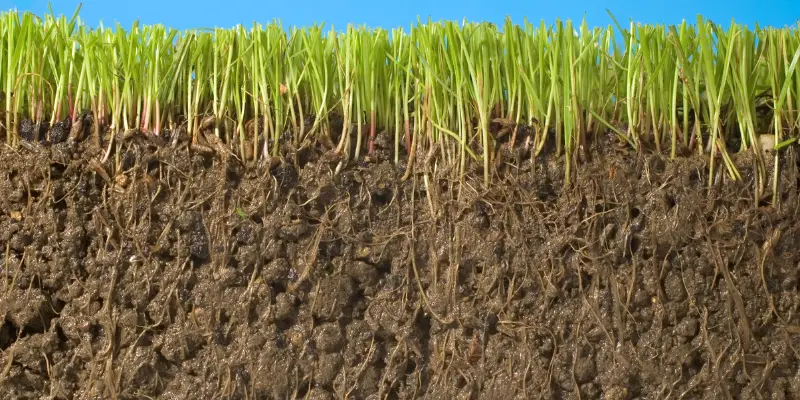
Disturbed sites also lose the inter-particle organization that soil builds over time through biological activity, organic matter decomposition, and chemical interactions between particles. When topsoil is removed or subsoil is exposed, that organization is gone. Individual particles without the binding that holds them into stable aggregates are more vulnerable to displacement under rainfall, less capable of retaining water in the profile, and less able to support the developing root systems that permanent vegetation requires. In healthy soil, pore space occupies approximately half the total soil volume, providing the pathways for water and air movement that root development depends on. A disturbance that collapses that structure removes the physical capacity the soil had to support what’s placed on it.
The soil type determines how these consequences play out in the field. Sandy soils lose inter-particle cohesion quickly under disturbance, leaving surfaces that erode under light rainfall and offer seeds with no stable contact point with the mineral particles below. Disturbed clay soils present a different condition: moisture fluctuation drives repeated expansion and contraction at the particle surface, breaking down whatever structural organization remains and producing a seedbed that shifts with every wet-dry cycle. Fine-grained soils compact readily and drain poorly, creating surface conditions where water pools rather than infiltrating, and the seed zone cycles between waterlogged and desiccated depending on weather.
Shear strength drops when inter-particle organization is lost, and compaction alters the particle arrangement. A surface with reduced shear strength moves under stress, and on a revegetation site, that stress arrives with the first rainfall after application. The slurry sitting on that surface has to either hold against it or move with it.
Soil Stabilization Methods for Difficult Ground
Addressing structural problems in disturbed soil before or alongside revegetation draws from several established approaches.
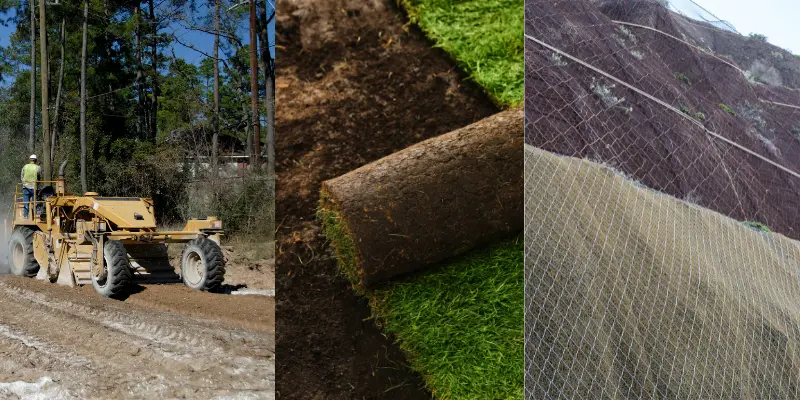
Mechanical stabilization through scarifying, ripping, or tilling breaks up compacted layers and restores pore space in the treated zone. Where compaction is the primary problem and equipment access is available, it works at the physical level, returning structure to a compressed profile.
Chemical stabilization using lime or cement is well-established in geotechnical practice for modifying high-plasticity clay soils, where moisture-driven expansion and contraction create ongoing surface instability. These methods alter particle interactions at the chemistry level and suit contexts where load-bearing improvement in clay-dominant profiles is the primary objective.
Polymer-based stabilization works through adsorption onto particle surfaces, forming bonds between soil particles that increase cohesion, improve resistance to erosion, and modify the soil’s water retention behavior. At concentrations that are workable in field application, polymer soil stabilizers have demonstrated measurable increases in shear strength and water retention across a range of soil types.
Acrylic co-polymer technology operates through interaction at the microstructure level. When an acrylic co-polymer penetrates the soil, it forms nanocomposites within the particle structure, filling cohesion gaps and producing a more load-bearing, uniform material from the in-situ soil. Soil Stabilization Plus, EP&A Envirotac’s acrylic copolymer product is formulated on this basis at 55 to 60% active solids. It works with in-situ soils across soil types without importing base material or requiring extensive surface preparation. Test results have shown CBR and UCS increases to levels comparable with pavement-grade material, and the formulation maintains its structural performance under freeze-thaw conditions — relevant on revegetation projects in cold climates where seasonal temperature cycling would otherwise compromise surface stability through the establishment period.
The polymer enters the hydroseeder as part of the slurry, so stabilization and tackification occur in the same application pass rather than as separate operations.
What This Means for Vegetation Establishment
Germination on disturbed ground requires a physical environment that the soil itself may not provide. Soil Stabilization Plus works on those conditions at the particle level, modifying the physical environment the soil presents before germination begins.
On compacted, poorly aggregated surfaces, seed placement after application is inconsistent. The surface texture that presses a seed into stable contact with the mineral particles below — what agronomy refers to as seed-to-soil contact — is absent where inter-particle organization has been lost. In conditions where rainfall follows application quickly, this is where seed displacement begins, not dramatically, but in the fine movement of material that separates seeds from the contact germination requires. Uneven contact produces uneven germination, and the result shows up two weeks after application in the sections that came in thin versus the sections that held.
In arid and semi-arid contexts, the moisture dimension of that problem is more acute and less forgiving. On degraded soils where pore structure has collapsed, water reaching the surface runs off rather than infiltrating into the zone where the seed is sitting. The seed zone dries faster than it would in structured soil, the window between adequate moisture and moisture stress narrows, and germination either proceeds in the first day or two after rainfall or doesn’t proceed at all. Mine rehabilitation in dry regions, highway revegetation in low-rainfall corridors, and post-wildfire reclamation on drought-affected ground all present this condition at project scales where failed establishment carries a reapplication cost; the project timeline and budget weren’t built around it. The moisture conditions it creates and maintains at the seed zone allow germination to proceed on the ground where the soil profile is not reliably providing them independently.
Root development into the profile is where the structural condition of the ground below the surface becomes the determining factor for whether a hydromulching application delivers permanent stabilization or temporary cover. A seed can germinate on a compacted surface. Whether the root system that follows can move through the profile below determines whether that germination becomes an established plant capable of anchoring the soil through subsequent rainfall events. Polymer treatment that improves inter-particle cohesion and pore structure in the treated zone gives developing roots a profile to work into. On sites where compaction extends below the surface application depth, this is the structural contribution that carries establishment from germination through to a root-anchored surface.
Project Types Where This Matters Most
Mine Rehabilitation
Mine sites carry some of the most structurally compromised soil conditions a revegetation project encounters. The structural problem runs through the profile rather than sitting only at the surface. Repeated equipment traffic over years of operation, spoil placement, and in some cases chemical alteration of the soil environment leave the ground with minimal inter-particle cohesion, deep compaction, and little organic matter to support structural recovery. The polymer’s work in the soil profile addresses the profile condition the hydromulch slurry lands on, not only the surface it covers.
Highway and Infrastructure Revegetation
Road construction exposes cut faces and fill slopes that carry regulatory revegetation requirements and erosion control obligations. The soils on these surfaces are subsoil material with no history of supporting vegetation, low organic matter, variable texture across the cut face, and compaction from construction equipment that may extend through the profile. Polymer stabilization provides the surface cohesion and moisture retention that these soils don’t carry on their own.
Post-Wildfire Reclamation
Fire-affected soils develop a hydrophobic layer at or within a few centimeters of the surface, formed from volatilized organic compounds that condense as they move through the profile — placing it directly in the zone where the seed sits after application. This layer reduces infiltration rate and increases runoff, which means water arriving at the surface after a fire moves across it rather than into it, and the seed zone stays dry regardless of how much rainfall follows application. The challenge on post-wildfire ground isn’t only getting the slurry to hold; it’s getting water and seed into the soil beneath a surface that is actively repelling moisture — past the hydrophobic layer to where infiltration and germination can actually proceed. Polymer stabilization applied alongside hydromulching addresses the surface cohesion and the infiltration condition on the ground, where both are working against establishment from the start.
Construction Site Restoration
Development sites that have been graded, trafficked, and exposed across extended project timelines present variable soil conditions within a single site boundary. One section may be sandy and low-cohesion from surface stripping; another may be compacted from equipment staging areas; a third may be exposed subsoil from cut operations with an entirely different texture than the surrounding sections. Construction sites operating under Stormwater Pollution Prevention Plans carry sediment control obligations that make surface stabilization on disturbed ground a compliance requirement, not just a revegetation objective. Polymer stabilization alongside hydromulching addresses both simultaneously — the revegetation establishment the project needs long-term and the surface stability the SWPPP requires while that establishment proceeds.
Arid and Semi-Arid Revegetation
In low-rainfall environments, maintaining adequate moisture at the seed zone between rain events on soil that may not be structured to hold it is the central establishment challenge. The consequences of getting that wrong on a remote mine rehabilitation site or a long highway corridor are measured in mobilization costs and project timelines, not just in reseeding materials. Polymer stabilization’s water retention effect on the treated surface addresses that challenge, and Soil Stabilization Plus has been used on mine rehabilitation and infrastructure revegetation projects across arid regions globally.
Stormwater Assets and Steep Batters
Drainage channels, retention basins, and steep cut batters are under regular hydraulic stress from the water they’re designed to manage. Vegetation establishment on these surfaces has to develop against conditions that actively test surface stability from the first rainfall event after application. The inter-particle cohesion that polymer stabilization provides to the treated zone gives the hydromulch application a structural base to work from while vegetation establishes on surfaces where the hydraulic loading doesn’t pause for the establishment period to complete.
Application
When Soil Stabilization Plus enters the hydroseeder with seed and mulch, what reaches the ground is a slurry whose components are already in contact with the polymer. At the surface, it functions as a super-strength tackifier, holding the mulch and seed in place on the compacted, low-cohesion, and hydrophobic surfaces that difficult ground presents — where surface retention is a function of what the soil is, not just how the application was carried out. Below that surface, in the soil profile, the slurry contacts, the polymer is doing the structural work: improving inter-particle cohesion, modifying water retention behavior, and building the physical conditions for germination in ground that wasn’t providing them.
The polymer also works to expedite the germination process on degraded and low-cohesion soils, improving the moisture conditions at the seed zone that the disturbed soil profile is not reliably providing on its own.
Frequently Asked Questions
Does Soil Stabilization Plus work on compacted or heavily disturbed soils?
Yes. It is formulated to work with in situ soils across a range of structural conditions, including heavily compacted and disturbed ground. The polymer improves inter-particle cohesion and load-bearing capacity within the treated zone, working with the soil already on site rather than requiring excavation or the import of base material. This makes it applicable to the ground types where importing and placing a prepared base is not practical or cost-effective.
What is the difference between a soil amendment and a soil stabilization polymer in a hydromulching context?
Soil amendments address the chemical environment of the soil: pH, nutrient availability, and organic matter content. Soil stabilization polymers address physical structure: inter-particle cohesion, shear strength, moisture retention, and surface stability. Both have their role in a revegetation project. They are solving different problems in the same soil, and a site that needs both is not unusual on difficult ground where chemical and structural deficits exist together.
Can Soil Stabilization Plus be used in arid or semi-arid revegetation projects?
Yes. The polymer’s effect on moisture retention at the soil surface and within the treated profile makes it applicable in low-rainfall environments where maintaining adequate seed zone moisture between rain events is a limiting factor for germination. It has been used across a range of climatic conditions, including dry-season applications on mine rehabilitation and infrastructure revegetation projects globally.
How long does the structural improvement from Soil Stabilization Plus last after vegetation establishes?
Soil Stabilization Plus is formulated for long-term performance. The acrylic co-polymer bonds formed within the soil profile during curing are not water-soluble, which means the structural modification persists beyond the establishment period. The load-bearing improvement it produces in the treated zone, as reflected in tested CBR and UCS results, is a durable change to the soil’s physical properties rather than a surface treatment that degrades with the mulch layer above it.
Applications - Dust Control & Soil Stabilization Products
Leave a Reply