
February 23, 2026
The Blind Spot Beneath Resilience
Climate resilience is now routine in boardrooms. Adaptation roadmaps sit beside capital plans. Infrastructure standards are revisited with increasing frequency. Investment continues to move toward energy transition, supply chain redundancy, and asset hardening. Volatility is no longer framed as a disruption. It is part of the operating environment.
The bulk of that focus remains fixed on visible systems—grids, ports, transport corridors, water infrastructure—assets that lend themselves to modeling, stress testing, and reinforcement. Far less examination is directed at the ground that underpins them.
Soil stability rarely enters strategic discussion directly. Roads, industrial platforms, agricultural land, and renewable installations—all depend on it. Yet in many planning documents, soil remains a fixed condition: something expected to absorb rainfall, anchor foundations, distribute load, and moderate runoff within known limits. Those limits are shifting.
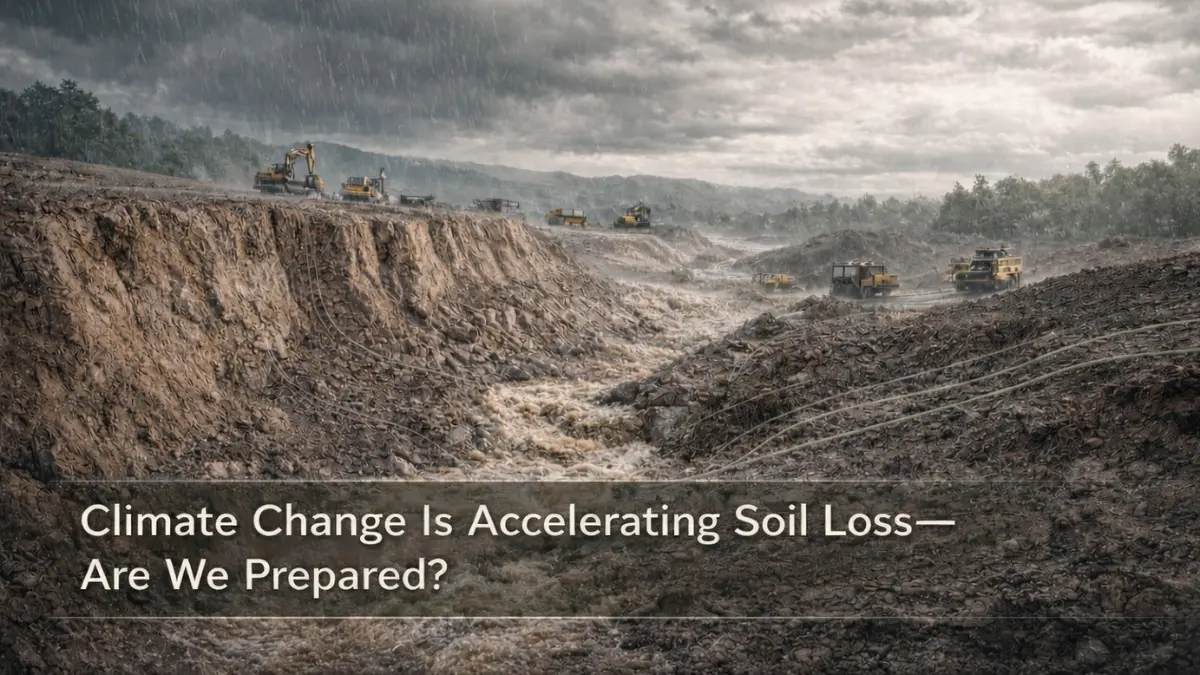
Rain comes harder now, compressed into narrower windows. The dry stretches between them grow longer. Across fire-prone landscapes, the ground cover that once absorbed impact before it reached soil has thinned or disappeared entirely. Precipitation intensity has been climbing—documented across broad geographies by major climate assessments—and the erosive consequences don’t lag far behind. What shifts more slowly is institutional response. Soil is behaving differently from what the frameworks built to manage it were designed to expect.
From Background Condition to Strategic Variable
Climate change is reshaping more than what happens above ground. The substrate beneath built systems—long treated as a fixed condition—is becoming less reliable in ways that rarely surface in strategic discussion until something fails. In a more variable climate, soil can no longer be treated as background context. It becomes a design variable.
For decades, development standards were calibrated within relatively stable climatic ranges. Engineering codes, agricultural planning cycles, and industrial site design evolved under stress patterns that changed slowly. Surfaces degraded, certainly—but generally within tolerances that maintenance schedules and drainage assumptions were designed to manage. That predictability is thinning.
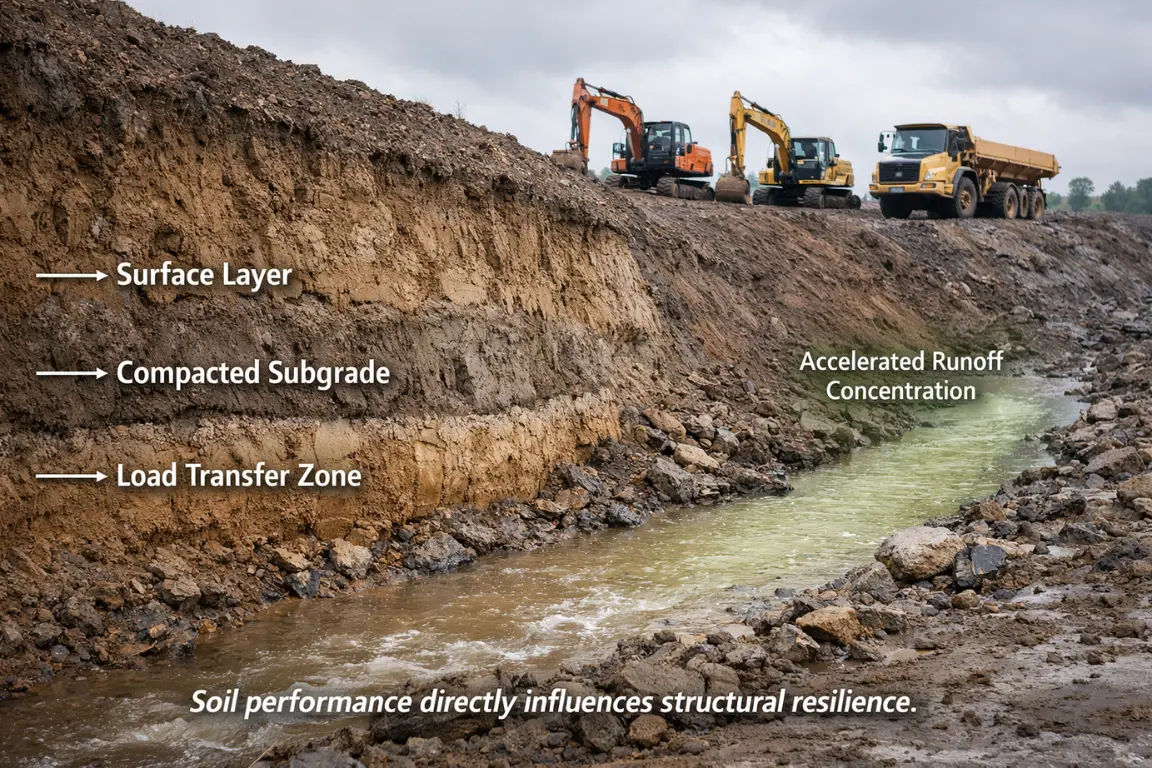
Heavier rainfall is now arriving on land that is simultaneously being cleared, graded, and built upon at a pace—infrastructure corridors, mining operations, urban edges, renewable installations, and large-scale agriculture. Disturbance has not moderated in response to a more variable climate. If anything, the two have accelerated in parallel. In many regions, it has accelerated. Cleared, graded, compacted, or stockpiled soils remain exposed longer, often under stress conditions that earlier frameworks did not anticipate.
Stabilization practices are being tested in ways they were not originally designed for. Some treatments perform well immediately after application yet reveal trade-offs over time. Runoff chemistry, leaching behavior, sediment migration into adjacent waterways, and dust transport into nearby communities are increasingly part of evaluation criteria. Under heavier precipitation, materials interact differently with flowing water. Under prolonged drought, surface treatments can fracture, loosen, or lose cohesion.
Regulatory review has followed this evolution. Performance is no longer assessed at installation alone but across wet–dry cycles and multiple seasons. Field experience reinforces the point. Operators have seen surfaces that appeared durable after initial application degrade after successive storms or extended dry periods. A slope that held through one season may begin to unravel in the next. As stress cycles compress, assessment frameworks are shifting toward multi-cycle performance rather than first-year results.
Large-scale modeling efforts in Europe, including the RUSLE2015 assessment, estimate soil losses in the hundreds of millions of tonnes annually. That scale reflects cumulative pressure more than an isolated catastrophe. Degradation builds incrementally.
Preparedness, then, extends beyond reinforcing visible assets. It requires examining how soil stabilization performs over time—and under stress patterns that no longer follow historical cadence. Organizations that integrate substrate performance into resilience modeling earlier often adjust design assumptions before variability forces correction. That difference in timing ripples outward—into how capital gets allocated, how maintenance is forecast, and how long-term exposure is carried on the books. It rarely announces itself clearly at the project outset.
Soil stability has not vanished. It simply cannot be assumed.
When Intensifying Weather Conditions Meet Expanding Exposure
Climate variability tends to manifest through intensity and duration. Rain arrives harder. Dry periods last longer. Colder regions contend with something different—temperature swings that have sharpened enough to multiply freeze-thaw cycles within a single season. Where wildfire has moved through, the ground arrives at the next storm already compromised; the cover that once absorbed the first force of rainfall is gone, and what remains underneath has had no time to recover.
These forces don’t tend to arrive separately. Their combined effect on soil—how it takes in water, how it drains, how it holds structure under load—is generally more than any single stressor would produce on its own.
Development continues regardless. Infrastructure advances. Mining sites expand or reopen. Cities extend outward. Renewable installations spread across previously undisturbed land. Each phase typically involves clearing, grading, compaction, or stockpiling. Under earlier climatic norms, exposure windows could be scheduled with reasonable confidence. That margin of confidence is narrowing.
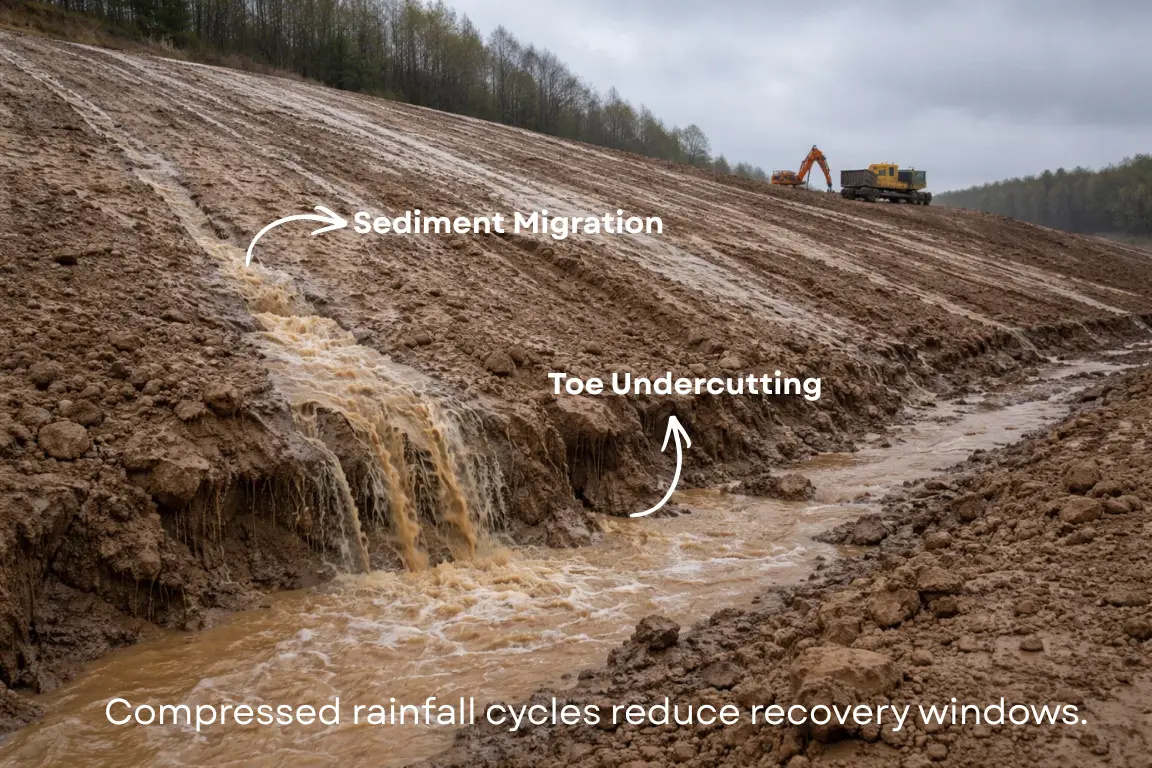
Heavier rainfall now meets freshly cut embankments more often. An extended drought increases dust generation along haul roads and construction platforms. In post-wildfire terrain, a single storm can move significant sediment across slopes that have lost their vegetation entirely. What shows up first is rarely a failure in any dramatic sense—more often it’s a subtle shift at the margins, easy to read as routine until it isn’t. They show up at the edges—slight undercutting at a slope toe, fine sediment shifting downslope, and shallow pooling where drainage gradients once held.
Maintenance crews notice before executives do. Re-grading intervals shorten. Water-truck cycles increase. Drainage ditches require clearing sooner than expected. After a heavy storm, haul routes may be offline for days. These are operational signals. They accumulate quietly.
The implications differ by sector but move in the same direction. Transport infrastructure can experience earlier subgrade weakening. Mining operations face instability in tailings and spoil piles alongside intensifying dust management demands. Urban expansion seals surfaces, redirecting runoff onto adjacent disturbed land. Agricultural systems confront irregular precipitation that affects aggregation and nutrient retention.
Not every region experiences the same configuration of stress. In some areas, rainfall intensity dominates. In others, prolonged drought exerts greater pressure. But the baseline is not neutral. FAO assessments already put roughly a third of the world’s soils in the moderately to highly degraded range. Climate variability, then, is not introducing fragility so much as finding it—arriving on ground that has been losing resilience for years. What tends to follow is instructive: operations feel the pressure before strategy acknowledges it. Schedules slip. Budgets stretch. The model catches up later. Recovery timelines that once felt routine now require contingency buffers. What changes first is not the model—it is the maintenance schedule.
Recalibrating Stability Before It Is Forced
Preparedness shifts meaning when soil performance is considered early in project design rather than addressed after disturbance occurs. Sequencing decisions change. Exposure windows narrow. Risk evaluation broadens.
On active sites, early indicators are rarely structural failures. They are patterns. A haul road rutting sooner than expected. Fine dust lingering after grading despite routine suppression. Drainage channels carrying higher suspended sediment loads than in previous seasons. Individually, none suggests systemic breakdown. Together, they signal that inherited design assumptions may no longer hold.
Cost behavior follows the same pattern. The initial application expense tells only part of the story. Across recurring stress cycles, the costs that accumulate are rarely dramatic in isolation—maintenance is called more often, equipment is running harder, emergency remediation is covering what routine upkeep once handled, and regulatory exposure is drifting wider without a clear inflection point. What changes the financial picture over an asset’s life is often not the size of individual interventions but how frequently they’re needed.
The economic case has repeatedly been discussed through development finance channels—erosion-related degradation carries consequences that extend well beyond the immediate site, feeding into long-term productivity loss and remediation obligations that dwarf what earlier intervention would have cost. Prevention, in that framing, is not a discretionary expense. It is load-bearing.
There is no universal stabilization solution. Mechanical reinforcement redistributes load and alters surface structure. Binding agents modify particle cohesion and moisture interaction. Biological and vegetative measures work differently—slower to establish, but oriented toward rebuilding the aggregation that mechanical or chemical treatments alone don’t restore. What holds up in practice tends to be a combination: approaches layered against the specific stress profile of a site, rather than a single method applied uniformly and left to perform across conditions it wasn’t calibrated for.
The principles climate-smart land management has long pointed toward—continuous cover, reduced disturbance, and practices that encourage infiltration rather than runoff—have not changed. What has changed is the cost of ignoring them. Those principles remain relevant. Under compressed recovery windows, they become more valuable.
Where disturbance cannot be avoided—infrastructure expansion, extraction, urban growth, renewable deployment—stabilization performs best when embedded early in the project lifecycle. Grading aligned with projected rainfall intensity. Drainage systems sized for evolving precipitation patterns. Careful compaction control. Rapid surface treatment following clearing. None of these measures is novel. The difference lies in timing and calibration.
In environments carrying higher exposure, some operators have moved toward engineered stabilization technologies—among them polymer-based binders that work at the particle level, tightening cohesion and reducing sediment movement under repeated loading. The function is not simply surface sealing. These materials act deeper in the soil matrix, shifting how moisture migrates and how bonding holds under hydraulic pressure. The result is a ground surface that responds differently to cyclical stress—not just more resistant on first contact, but more durable across successive events.
Material selection increasingly carries environmental scrutiny alongside structural durability. Runoff interaction, leaching potential, downstream sediment transport, and ecosystem compatibility shape evaluation. Under intensified precipitation, performance beyond site boundaries becomes part of the risk profile.
Adoption rarely hinges on engineering considerations alone. Environmental review, procurement alignment, specification standards, and documented field evidence intersect. Approaches supported by transparent testing and demonstrated multi-cycle behavior integrate more smoothly into established approval frameworks.
Stabilization systems also do not function independently. Drainage controls, sediment barriers, grading adjustments, and vegetative cover operate in parallel. Some provide immediate cohesion. Others build resilience incrementally. Together, they influence foundational reliability over time.
The distinction between reactive repair and durable performance often comes down to when recalibration occurs. Waiting for visible failure narrows options. Adjusting assumptions early expands them.

The Long Horizon Beneath Our Systems
Soil forms slowly. Infrastructure is built for long horizons. What has changed is the tempo of environmental stress. Cycles that were once spaced across years now arrive closer together. Durability must be reconsidered within that compressed rhythm.
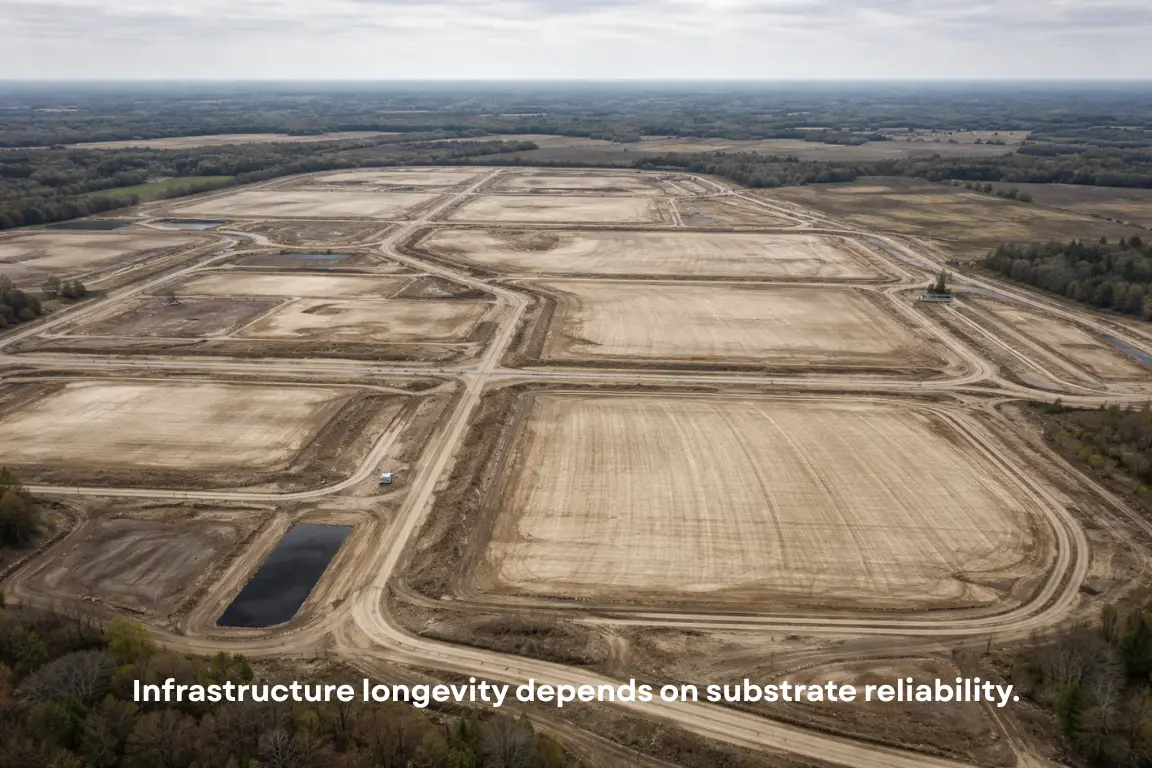
Topsoil accumulation can take centuries; just a single inch forms over generations. Accelerated loss is therefore not a seasonal inconvenience. It is a long-term capital concern.
Development will not pause. Urbanization continues. Resource extraction remains necessary. Energy transition requires land. Agriculture depends on periodic disturbance. The relevant question is not whether land will be used, but how its stability is managed amid intensifying variability.
Foundational reliability now influences cost structures, maintenance forecasting, regulatory exposure, and community trust more directly than before. Risk models are beginning to incorporate runoff, erosion, and surface performance variables—sometimes explicitly, sometimes indirectly through revised contingency allowances.
Many stabilization measures continue to perform adequately under ordinary conditions. The challenge is variance under repeated stress and shortened recovery intervals. That variance reshapes long-term exposure.
Preparedness, in this context, is not defined by reacting to isolated erosion events. It is defined by revisiting inherited assumptions before stress cycles make them untenable. Soil performance once operated as a backdrop. It now sits closer to the foreground of resilience planning. Stability remains achievable—but it is no longer ambient. It has to be designed for.
Soil performance once operated as a backdrop. It now sits closer to the foreground of resilience planning.
Stability remains achievable—but it is no longer ambient. It must be designed into systems and institutions.
Applications - Dust Control & Soil Stabilization Products
Leave a Reply