

February 10, 2026
In many traffic environments, road dust accounts for 30–70% of ambient PM10 and a considerable fraction of the atmospheric PM2.5 — a reminder that surface behavior under repeated traffic plays a larger role in air quality than exhaust alone.
Across traffic-exposed environments, treated surfaces absorb constant loading, movement, and stress. Over time, those forces shape surface behavior in ways that are consistent, even when outcomes appear unpredictable at first glance. Two sites using similar approaches can perform very differently—not because one treatment failed, but because of how the surface system evolves under use.
This article examines dust suppression through a traffic-exposed surface management lens. By focusing on how traffic reshapes surfaces over time, it offers a clearer framework for interpreting performance variability and understanding what those outcomes mean in real operating environments.
Why Dust Suppressant Performance Varies Under Traffic
Dust suppressant performance is often discussed as a single outcome, rather than a response shaped by operating conditions. In practice, performance under traffic rarely conforms to that expectation. Even with similar materials and application methods, the same treatment can last longer on one road than another. That contrast isn’t random. It reflects how traffic physically works on a surface over time.
In active traffic environments, dust suppression is shaped by more than just one factor at play. Repeated mechanical stress changes the surface layer with every vehicle pass. Tires disturb fines, redistribute loose material, and gradually alter how the surface resists movement. On roads that see daily use, those effects stack up. After enough repetition, traffic influence can outweigh differences between suppressant types.
Transportation guidance from the Federal Highway Administration notes that loading patterns and vehicle movement play a central role in how unpaved and lightly bound surfaces evolve. Anyone who has watched a haul route age under constant traffic has seen the same pattern: the surface doesn’t fail all at once. It changes gradually as stress concentrates in specific zones and particles shift under load.
This is why comparisons that ignore traffic context often mislead. A treatment that performs consistently on a lightly used access road may behave very differently where braking, turning, and heavy passes happen all day. What looks like inconsistent performance is often a surface responding to different working conditions.
Dust suppressants also operate within a broader surface system. Their effectiveness depends on how that system absorbs repeated traffic stress. As loads increase or movement becomes more concentrated, the surface adjusts. Treated conditions don’t simply disappear—they evolve under use, and that evolution shapes how long visible dust control is maintained.
Seen from that angle, performance becomes easier to interpret. In traffic-exposed settings, outcomes make more sense when attention stays on how traffic redistributes stress across the surface and how that stress interacts with material behavior over time. Once traffic is treated as a defining force rather than background activity, variability stops looking arbitrary and starts looking predictable.
Interpreting that variability requires a clearer way to describe how dust suppression behaves under working traffic.
Functional Approaches to Dust Suppression Under Traffic
Dust suppression approaches are often grouped by material type or formulation. Under traffic exposure, however, performance is more clearly understood by how an approach functions once a surface is subjected to repeated vehicle movement.
In transportation and land-management guidance, the terms “dust control” and “dust suppression” are often used interchangeably, but they are different. Soil stabilization typically refers to the structural modification of the surface. This article uses ‘dust suppression’ to mean managing fine particles at the surface when vehicles are present, and it discusses stabilization when it relates to the surface’s structure.
From a functional standpoint, dust suppression methods don’t all behave the same once traffic starts moving on the surface. Some primarily reduce the amount of loose material available at the top layer. Others change how particles hold together, shift, or resist being pushed out of place as vehicles pass. The difference shows up over time in how the surface settles and responds to repeated disturbance. These functional differences shape how treated surfaces behave as traffic intensity, speed, and repetition increase.
Looking at dust suppression through this lens helps explain why similar materials can produce different outcomes across sites. Functional behavior under traffic determines how a surface responds to braking, turning, and repeated loading, as well as how quickly dust-generating conditions re-emerge. Rather than categorizing approaches by what they are, a functional view focuses on what they do once traffic becomes a defining condition.
This framing does not replace material classification or application considerations. Instead, it provides a complementary way to interpret performance in traffic-exposed environments, where surface behavior over time is often more influential than initial treatment characteristics.
Examining the governing factors behind traffic-exposed performance directly clarifies this functional lens.
This functional perspective aligns with how transportation agencies evaluate surface performance under use, where behavior over time is often more informative than initial material classification.
Key Factors That Govern Performance on Traffic-Exposed Surfaces
A single variable doesn’t control performance on traffic-exposed surfaces. It emerges from several forces working together. Material choice matters, but what ultimately shows up in the field depends on how traffic stress combines with surface condition, weather exposure, and day-to-day operating patterns.
Traffic variables act as a primary driver in this system. Vehicle volume, axle load, speed, and movement patterns determine how frequently and how intensely the surface is disturbed. Factors such as vehicle passes per day and axle loading intensity determine how quickly surface conditions evolve.
Traffic-driven stress is shaped by variables such as:
- vehicle volume
- axle load
- speed
- braking and turning concentration
- vehicle passes per day
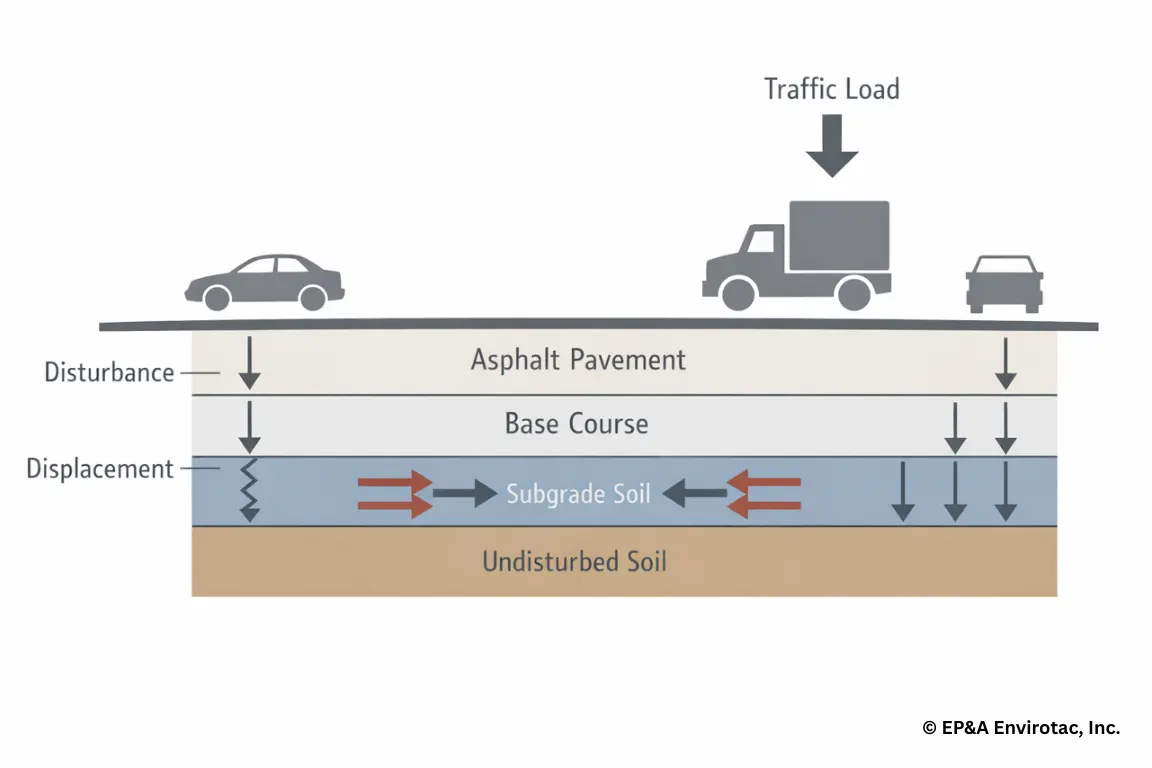
Federal Highway Administration guidance treats traffic intensity and loading as forces that amplify existing surface conditions. Gradation, moisture, and maintenance history don’t act in isolation—traffic magnifies their effects, shaping how particle availability and surface response change under repeated use.
These relationships are often illustrated as layered stress models that show how traffic amplifies existing surface tendencies, helping practitioners visualize why variability follows predictable patterns.
Surface characteristics further shape how traffic stress is expressed. Gradation, moisture sensitivity, and existing compaction influence how fines respond to repeated loading and movement. Two surfaces exposed to similar traffic can behave differently depending on how readily particles are displaced or redistributed usinder stress.
Environmental conditions and operational practices interact with both traffic and surface properties. Weather patterns, maintenance intervals, and site-specific use all affect how long treated conditions are maintained and how performance is perceived over time. Rather than acting independently, these factors form a system in which traffic exposure sets the pace of change and other variables shape the response.
Understanding performance in this way helps explain why outcomes vary predictably across sites. When traffic is treated as an organizing factor—rather than a background condition—the relative influence of surface, environment, and operations becomes easier to interpret within a consistent framework.
How Traffic Variables Drive Dust Re-Entrapment and PM Behavior
Mechanical disturbance under traffic
Under traffic exposure, dust generation is not just about initial surface condition but also about how particles behave once they are repeatedly disturbed. As vehicles move across a surface, mechanical forces act on fine particles that have settled, migrated, or become exposed over time. These forces determine whether particles remain bound, shift within the surface, or become available for re-entrainment.
Traffic variables shape this process in distinct ways. The speed of a vehicle changes how air and surface forces move around the road, making turbulence and shear stronger near the ground. Axle load and tire pressure press directly into the surface, compacting some areas while pushing particles out of others. Braking, acceleration, and turning don’t act evenly—they focus stress in predictable zones. Over many passes, that uneven pressure loosens fines, shifts them across the surface, and periodically lifts them back into the air.
The U.S. Environmental Protection Agency’s AP-42 guidance describes how wheel action pulverizes surface material and how turbulent wakes behind vehicles continue to disturb the surface after passage, mechanisms that underpin road dust generation and resuspension.
Particle fraction behavior
Particulate matter behavior reflects these dynamics. They directly shape how particulate matter—including PM10 and PM2.5—behaves around active roadways. Heavier particles usually fall back to the surface quickly and stay nearby. Finer material behaves differently: once lifted, it can remain suspended longer and move well beyond the immediate traffic zone.
Research on traffic-derived particles treats resuspension as a repeating cycle: material settles, becomes available at the surface, gets disturbed again, and is lifted back into the air. In that cycle, finer fractions tend to stay airborne longer, while heavier particles fall out sooner. Air-quality literature refers to this ongoing pattern as road dust resuspension.
Air-quality research often views resuspension as a cycle of movement instead of just a single release of particles, highlighting that the presence of particles is influenced by ongoing disturbances rather than just one-time events.
Cyclical resuspension dynamics
This behavior is frequently conceptualized as a resuspension cycle—deposition, availability, disturbance, and re-entrainment—a model used in air-quality research to describe how particulate matter persists in traffic-exposed environments.
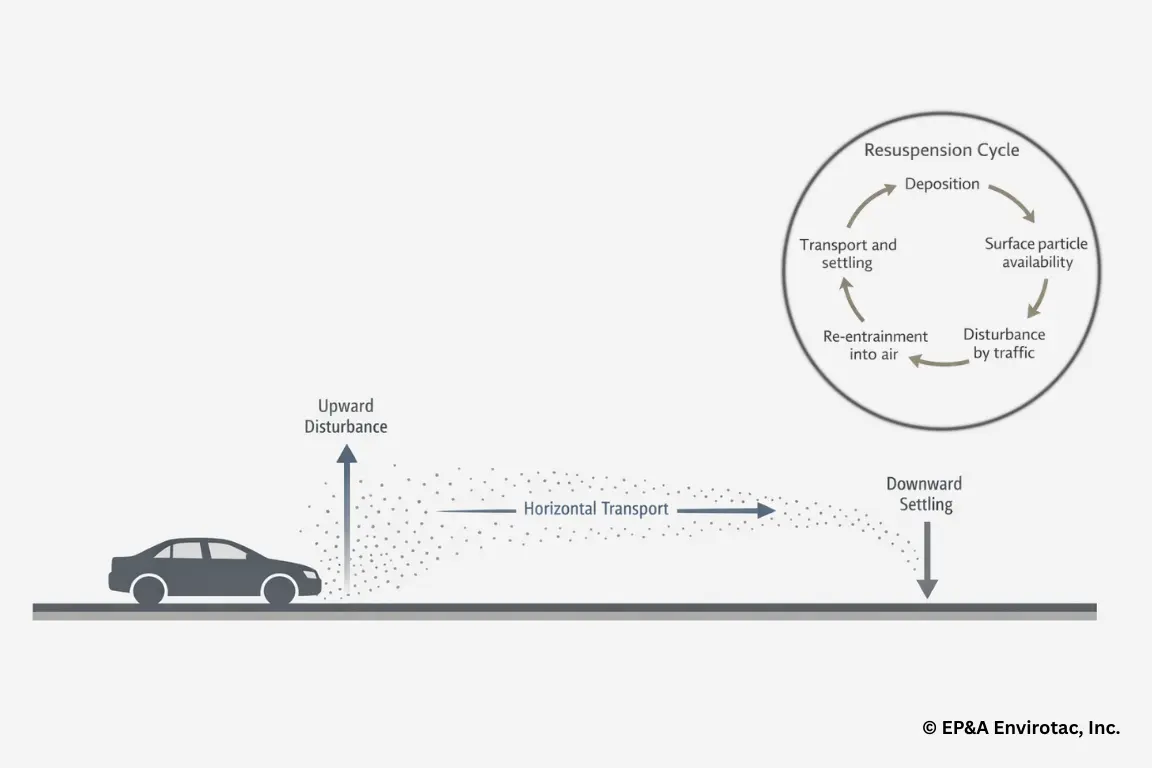
Viewed this way, re-entrained dust is a surface response to traffic stress rather than a single emission event. Changes in traffic patterns can therefore alter dust behavior even when surface treatments remain unchanged. Understanding how traffic variables influence particle availability and movement helps explain why air quality outcomes and visible dust levels can shift over time across traffic-exposed environments.
These mechanisms become most visible when interpreted through real-world traffic patterns.
Operational Reality Under Traffic-Exposed Conditions
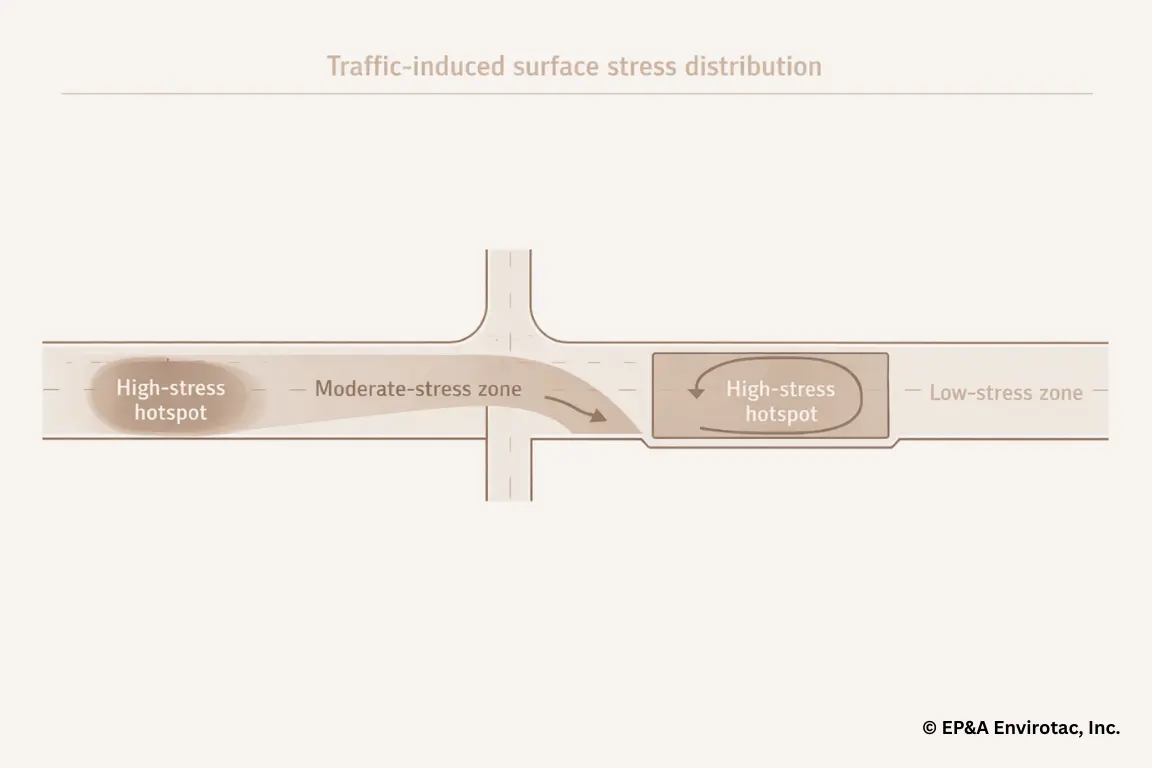
In traffic-exposed environments, dust suppression performance is shaped as much by where and how stress is applied as by the treatment itself. Traffic does not act uniformly across a surface. Instead, disturbance concentrates in specific locations and follows repeatable patterns tied to vehicle movement and site use.
Certain areas experience higher rates of surface disruption under traffic. Intersections, curves, grades, loading zones, and braking areas are more prone to stress the rest of the surface. Those spots concentrate stress, and they’re usually where dust starts showing up again first. FHWA field observations describe the same pattern: traffic pressure isn’t evenly distributed, and treated surfaces wear unevenly as a result.
High-stress traffic zones typically include:
- intersections
- braking areas
- grades
- loading zones
- turning corridors
Practitioners often evaluate these zones using a hotspot framework that maps traffic concentration against surface response, allowing maintenance attention to be prioritized according to stress intensity rather than uniform scheduling.
Monitoring in these environments is therefore interpretive rather than purely numerical. Observations of surface condition, dust visibility, and traffic behavior provide context for understanding how treated areas are responding over time.
Monitoring methods in these environments usually focus on specific observation points—like traffic areas, surface conditions, and visible dust—creating a record that helps in making informed decisions over time.
Maintenance and reapplication follow naturally from this understanding. In traffic-heavy settings, reapplication isn’t a failure signal. It’s what happens when a surface absorbs constant stress. Maintenance timing follows traffic patterns more than calendars. High-pressure zones need attention sooner, while lightly used stretches hold longer. Over time, dust suppression stops looking like a one-time action and starts behaving like routine surface maintenance.
Dust suppression works the right way if other factors at play are taken into account. Stabilizing the surface is crucial when structural instability, subgrade failure, or aggregate loss is the problem. Without that foundation, surface treatments can’t perform reliably.
Lifecycle evaluation in traffic-exposed settings is often framed as a systems calculation that weighs material durability, reapplication frequency, and localized stress distribution together rather than in isolation.
Operational programs often formalize this evaluation through traffic-aligned decision frameworks that prioritize treatment according to stress distribution rather than uniform scheduling.
Evaluations commissioned by the Pennsylvania Department of Environmental Protection and carried out by Penn State researchers found that oil-and-gas brine roadspreading delivered only limited short-term dust control and raised additional environmental concerns. The results underscore the importance of evaluating material performance in the context of local operating and regulatory conditions.
Lifecycle cost considerations emerge from these operational realities. Costs aren’t determined by material choice alone. Traffic wear, maintenance frequency, and how stress concentrates across a site all shape the real expense over time. Looking at costs across the life of the surface—not just per application—gives a more accurate picture of performance and helps guide smarter resource decisions.
Environmental and Regulatory Considerations
Environmental and regulatory factors provide the framework in which dust suppression operates on traffic-exposed surfaces. They influence how performance is judged and how surface management decisions are ultimately made. Rather than acting as external constraints, these considerations often reflect the same surface and traffic dynamics that influence dust behavior in day-to-day operations.
From an environmental perspective, traffic-driven re-entrainment affects how particulate matter moves and persists in the air. Changes in traffic patterns, surface conditions, and weather can influence observed dust levels even when treatment approaches remain consistent. U.S. Environmental Protection Agency guidance acknowledges that observed particulate levels near trafficked surfaces vary with traffic patterns and surface conditions over time, reinforcing the importance of interpreting air-quality observations within an operational context.
Regulatory frameworks typically focus on outcomes rather than methods. Requirements related to particulate matter, visibility, or nuisance dust are often interpreted through monitoring, observation, and documentation practices that vary by jurisdiction. In traffic-exposed settings, this means that compliance is closely tied to how surface behavior evolves under use, rather than to the characteristics of any single application.
Viewing environmental and regulatory considerations through a surface management lens supports more effective alignment between operational practice and compliance expectations. When we understand that traffic exposure is an important factor, we can organize monitoring, record-keeping, and maintenance plans to show how well dust suppression works in real-life situations while still being flexible to local rules.
Use-Case Scenarios Across Traffic-Defined Environments
Traffic-exposed surfaces operate across a wide range of environments, each defined less by location and more by how traffic interacts with the surface over time. Viewing use cases through traffic characteristics rather than industry labels helps clarify why dust suppression behaves differently across settings that may otherwise appear similar.
The Federal Highway Administration and AASHTO suggest that how well a road performs and what maintenance it needs depend more on the type of traffic it gets than on its official road category, which supports understanding surface behavior based on traffic. The structure of maintenance planning mirrors this traffic-defined classification, where usage patterns influence performance expectations more than nominal road categories.
Low-traffic access roads and service routes typically experience intermittent disturbance, allowing treated surfaces to retain their condition for longer periods between maintenance activities. In these environments, surface behavior tends to evolve gradually, with dust generation closely tied to changes in weather or episodic traffic increases rather than continuous use.
Moderate-traffic environments, such as industrial roads, staging areas, or shared-use corridors, introduce more frequent surface disruption. Here, repeated vehicle passes influence how fines redistribute and how quickly dust-generating conditions re-emerge. Performance variability in these settings often reflects differences in traffic patterns—such as peak-use periods or directional loading—rather than differences in surface treatment alone.
Concentrated and repetitive stress characterizes high-traffic environments, such as haul routes, intersections, and areas with frequent braking or turning. In these scenarios, surface behavior undergoes more rapid changes, and the distribution of traffic loads across the site closely influences dust suppression performance. Localized wear and variability are common, showing that stress zones are defined by traffic rather than a uniform surface response.
Traffic characteristics offer a uniform framework for assessing performance across all use cases. By focusing on how surfaces are used—rather than where they are located—these scenarios help contextualize variability and reinforce the role of traffic exposure in shaping dust suppression outcomes.
Treating Dust Suppression as Surface Management
Across traffic-exposed environments, dust suppression outcomes are shaped by how surfaces respond to use over time. Traffic introduces repeated and uneven stress that influences particle availability, surface conditions, and maintenance needs, making variability a normal and understandable feature rather than an exception.
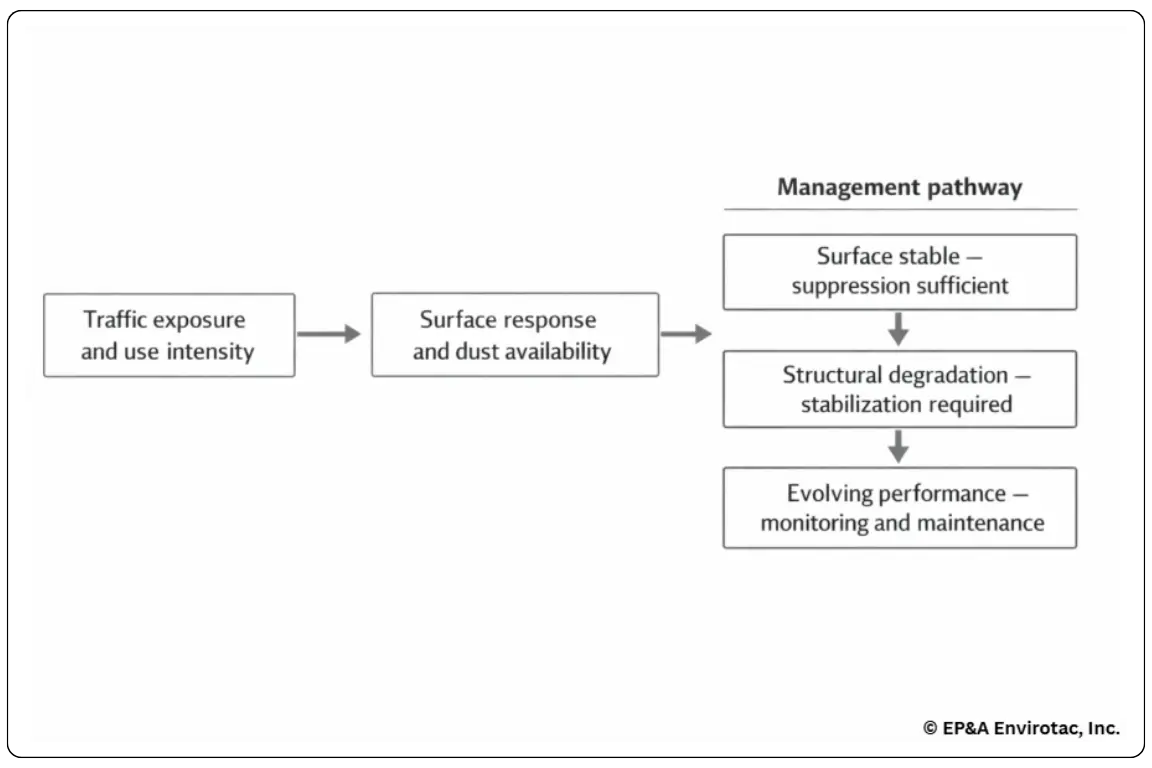
Viewing dust suppression as part of surface management helps integrate these dynamics into a coherent framework. Performance is no longer interpreted solely through material characteristics or application events, but through how traffic, surface properties, environmental conditions, and operations interact as a cohesive system. This perspective supports a more consistent interpretation of outcomes across different sites and use cases.
This system’s interpretation positions dust suppression as an adaptive management practice rather than a single intervention, aligning surface treatment with how traffic-exposed infrastructure is maintained in long-term planning.
By treating traffic exposure as a defining condition, dust suppression becomes easier to evaluate, plan, and maintain within real-world constraints. The result is a clearer understanding of why performance differs across environments and how surface behavior under traffic provides the context needed to manage dust effectively over time.
Applications - Dust Control & Soil Stabilization Products

Leave a Reply