
December 27, 2025
Where Erosion Control Quietly Starts to Fail
Erosion control systems usually succeed for a while. More often, they give way gradually, across a series of ordinary rain events. Not the storms that dominate reports or trigger emergency responses, but the routine ones that arrive on schedule, soak the ground, and pass without much notice. Many temporary erosion and sediment control measures are designed around typical seasonal runoff and project-level design storm assumptions, rather than continuously evolving site conditions. They are also where many begin to lose ground.
After the first storm, the signs are subtle. A small shift in runoff flow paths. Sediment was collecting where it hadn’t before. Erosion control products that appear intact but no longer behave the same way. Nothing that suggests a breakdown. By the next event, the same areas require attention again. Repairs are made, notes are logged, and the site moves forward.
Over time, a pattern starts to form. The same sections are revisited. The same erosion control measures are adjusted. Each instance is addressed in isolation, as if the previous one never occurred. Yet repetition changes the meaning of what’s being observed. When soil erosion shows up in the same places under normal conditions, it stops looking like a coincidence and starts pointing to something more structural.
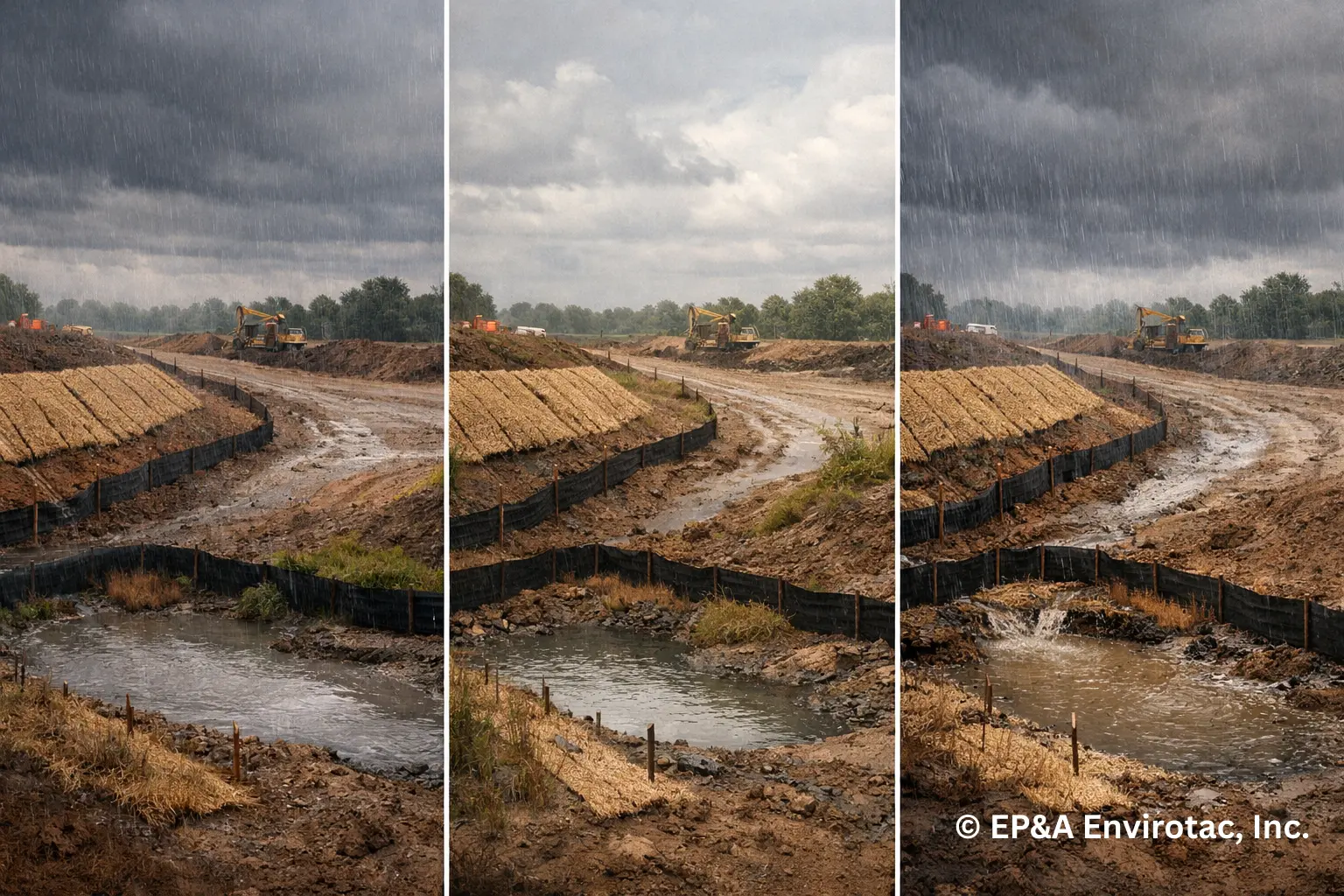
Most of the time, this isn’t treated as a system issue. It’s treated as maintenance. Or weather. Or the cost of working in exposed conditions on construction sites. Regulatory guidance for construction stormwater permits generally emphasizes inspection frequency, corrective actions, and documentation, which can unintentionally reinforce a short-term, pass–fail view of erosion control performance. But the persistence of these failures suggests a different story—one where the problem isn’t the intensity of the storm, but how the erosion control system responds to being tested again and again.
When Passing Isn’t the Same as Performing
What allows these patterns to persist is not a lack of knowledge or effort. It’s the way erosion and sediment control are often framed—narrowly, and in short cycles. Costs are evaluated upfront. Performance is assessed at inspection points. Responsibility is distributed just enough to keep projects moving. What happens between those moments tends to fade into the background.
In many cases, erosion control products are judged by how they look at the moment they’re inspected, not by how they hold up over time. Inspections tend to focus on whether controls are in place and maintained when someone is on-site, while what happens across several ordinary storms is harder to capture in a single check. If they remain in place, if they meet the letter of the specification, or if they satisfy a compliance check, they’re considered functional. Whether they continue to perform after successive storm events is harder to see and easier to defer. The system works well enough to pass, even as it quietly accumulates long-term risk.
This dynamic is reinforced by scale. Small failures spread across multiple sites rarely draw much attention beyond the immediate repair. Over time, though, those smaller events add up. Repeated, lower-intensity runoff can move more sediment than expected, even when no single storm seems significant. Minor washouts, sediment migration, recurring maintenance—these often get absorbed as operating costs instead of being read as early warnings. Until something larger occurs, something visible enough to affect a community or attract regulatory or public scrutiny, the pattern remains largely unchallenged.
From a broader perspective, this short-term framing obscures who erosion control programs are really meant to protect. Not just permits or project schedules, but workers on site, downstream environments, neighboring communities, and public infrastructure that absorb the consequences of stormwater runoff over time. When performance is reduced to compliance alone, the cumulative impacts become easier to ignore—even as they continue to compound.
What Repeated Storms Reveal About the System
When erosion control is viewed over time rather than at a single moment, a different picture starts to form. What first appears as a string of unrelated issues often traces back to the same assumptions. Design, installation, inspection, and maintenance are usually handled as separate phases, each judged on its own terms. In reality, they behave as one connected erosion control system, tested again and again by water moving through a site that never quite stays the same.
Plans are typically developed around expected drainage patterns and stable conditions. But sites rarely behave that neatly. Grading evolves as work progresses. Traffic compacts some areas while loosening others. Small changes in surface condition alter runoff concentration and flow paths. After the first storm, these shifts are minor. After several years, they begin to redirect water in ways the original erosion control design was never meant to handle.
How Small Shifts Accumulate Into Structural Stress
What fails first is often not the erosion control product itself, but the assumptions around it. A barrier placed where runoff was expected no longer intercepts flow once water finds a slightly lower path. A surface that initially resists erosion can begin to change after repeated wet–dry cycles. With each cycle, soil strength and surface cohesion can decline, leaving less margin for the next storm. Sediment capture capacity is used up gradually, not all at once, and each event leaves the system slightly more exposed than before. Each storm leaves the system a little less prepared for the next.
Maintenance is meant to respond to these changes, but it operates within real constraints. Responsibility is often shared across contractors, owners, and agencies, with action triggered only after specific issues are observed. Repairs tend to restore appearance or short-term function, while the underlying pattern that caused the issue remains in place. Rarely is there time—or incentive—to step back and ask why the same erosion control areas require attention again and again.
When Short-Term Performance Masks Long-Term Risk
It’s also important to acknowledge that many of these erosion control measures are doing what they were designed to do, at least initially. Sediment controls capture material. Surface stabilization methods—including mechanical barriers, vegetative cover, and erosion control polymers—reduce immediate soil loss. But effectiveness is often measured in short windows. When performance is judged storm by storm, rather than across a sequence of events, gradual degradation blends into the background. The system appears serviceable even as its margin for error narrows.
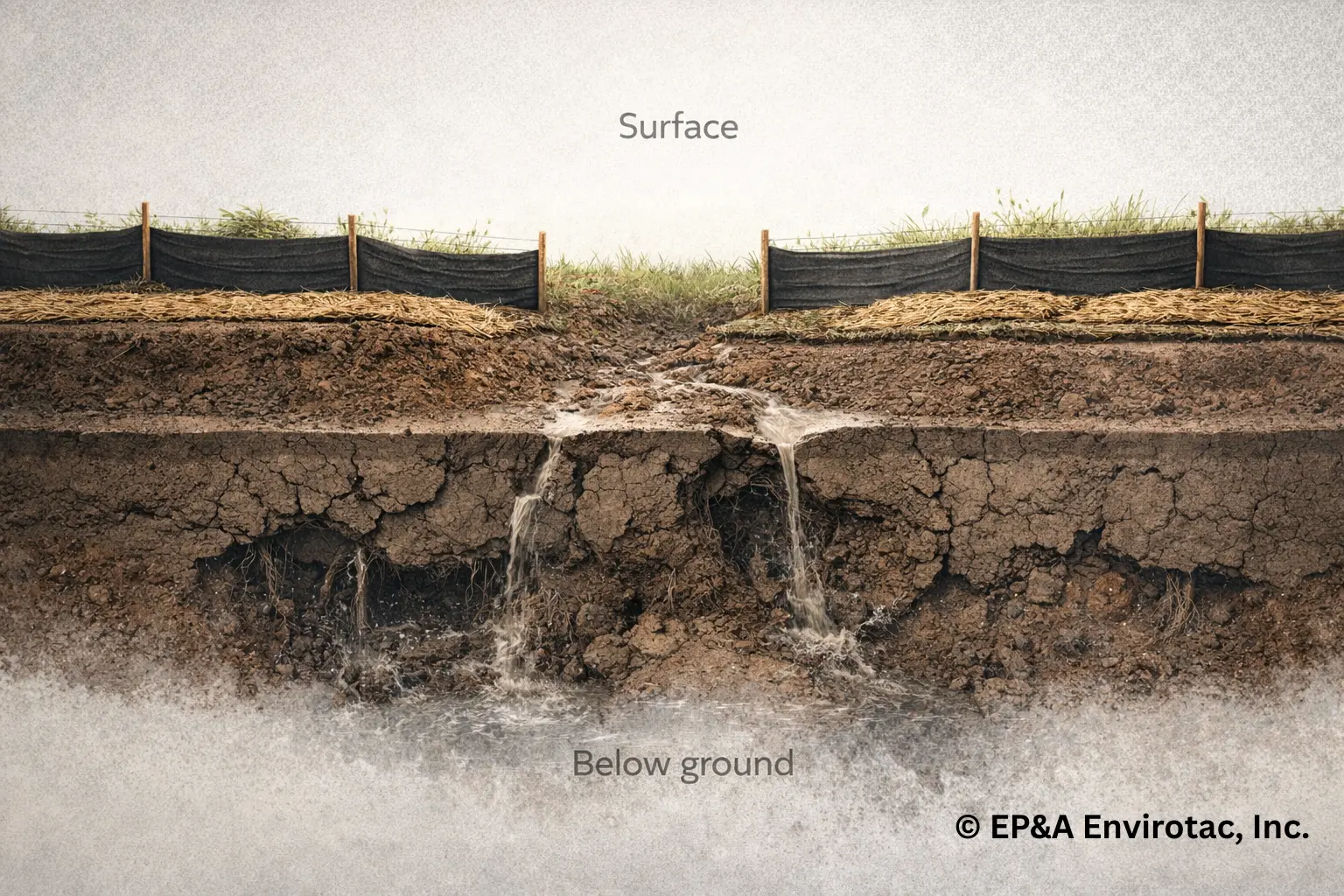
This creates a paradox. The very erosion control systems intended to manage soil erosion can mask deeper weaknesses when they are evaluated only in isolation. Repeated, ordinary storm events don’t overwhelm the system—they reveal where it was never designed to adapt. And because these revelations unfold slowly, they are easy to overlook, absorbed into routine work rather than recognized as signals pointing to a larger pattern.
Learning to Read Erosion as a Pattern Over Time
Moving forward doesn’t begin with changing materials or rewriting specifications. It begins with changing what is paid attention to. When erosion is viewed as a sequence rather than a series of isolated events, the question shifts from whether a control passed inspection to how it behaved over time. Not whether it was present, but whether it adapted as site conditions changed.
Teams that manage erosion and sediment control more effectively tend to watch for patterns instead of incidents. They look at where repairs recur, where sediment consistently escapes, and where runoff keeps finding new paths after each storm. These aren’t treated as maintenance nuisances but as diagnostic clues. Over time, those clues reveal which assumptions no longer match the site’s reality.
When Patterns Redefine Responsibility
This perspective also changes how responsibility is understood. Rather than treating erosion control as something that belongs to a single phase or role, it becomes a shared condition that evolves with the project lifecycle. Design intent, installation quality, construction traffic, sequencing, and ongoing maintenance all interact. When those connections are acknowledged, small degradations are easier to address early, before they harden into routine failures.
Redefining Success Over Repetition
There is also a shift in how success is defined. Instead of asking whether a measure worked for a given storm, experienced teams ask whether the erosion control system retained its capacity across several storms. Whether surface cohesion held. Whether controls continued to intercept runoff as conditions shifted. Performance becomes something observed over time, not something assumed after installation.
Seen this way, erosion control stops being reactive. It becomes observational. Each storm adds information. Each repair is a chance to learn something about how water is actually moving through the site. When those lessons are allowed to inform decisions—about placement, sequencing, maintenance, or overall approach—the system gradually becomes more resilient, not because it resists every storm, but because it responds more intelligently to repetition.
At its core, this isn’t about doing more. It’s about seeing differently. When erosion control is treated as a living system rather than a static requirement, the gap between compliance and long-term performance begins to narrow on its own.
When Attention Fades, Performance Tells the Truth
In the end, erosion control is rarely undone by a single moment. It’s shaped by what happens when ordinary conditions repeat, when small shifts accumulate, and when early signals are absorbed into routine work instead of being examined. The storms that matter most are often the ones that barely register, precisely because they arrive without urgency.
Seen this way, repeated failure isn’t a surprise. It’s information that hasn’t been fully acknowledged yet. Each return to the same repair, each familiar washout, each incremental cost is a reminder that erosion control systems reveal themselves over time, not all at once. What appears stable in a snapshot can look very different when viewed across seasons.
Because maybe the real measure of erosion control isn’t how it performs when attention is close, but how it holds together when attention fades. Not whether it satisfies a requirement, but whether it continues to serve the people, places, and environments it was meant to protect as conditions quietly change.
And when those quieter patterns are taken seriously, the next storm doesn’t just test the system.
It teaches it.
For deeper insight into why preventive planning beats reactive fixes in erosion and stormwater management, read:
Rethinking the Cost Curve: Why Preventive Infrastructure Beats Emergency Maintenance.Explore long-term strategies that prioritize durability over compliance alone.
Applications - Dust Control & Soil Stabilization Products

Leave a Reply